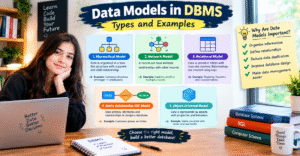
💻 Data Models in DBMS: Types and Examples
📌 Introduction
Data Models in DBMS define how data is organized, stored, and connected within a database. They help developers understand the structure of data and make database management easier. Let’s explore the main types of data models in simple terms.
🗂️ 1. Hierarchical Data Model
The Hierarchical Data Model organizes data in a tree-like structure, where one parent can have multiple children. It is useful when data follows a clear parent-child relationship.
Example: A company structure where one manager supervises multiple employees.
🔗 2. Network Data Model
The Network Data Model allows records to have multiple relationships. Unlike the hierarchical model, a record can connect to several other records, making complex relationships easier to represent.
Example: Students enrolling in multiple courses, with each course having many students.
📊 3. Relational Data Model
The Relational Data Model stores data in tables containing rows and columns. Relationships between tables can be created using keys, making data easy to search, update, and manage.
Example: A school database with separate tables for students, teachers, and courses.
🧩 4. Entity-Relationship (ER) Model
The ER Model represents data using entities, attributes, and relationships. It is commonly used during database planning and design before creating the actual database.
Example: A customer places an order, connecting the Customer entity with the Order entity.
🌳 5. Object-Oriented Data Model
The Object-Oriented Data Model represents data as objects that contain both properties and, where applicable, behaviors. It can be useful for applications that manage complex data structures.
Example: A game application representing a character with properties such as name, level, and health.
🎯 Why Are Data Models Important?
Data models help organize information, define relationships, reduce unnecessary duplication, and improve database design. Choosing a suitable model makes it easier to build reliable applications and manage data efficiently.
✅ Conclusion
Data Models are an important part of database design. From hierarchical structures to relational tables and object-based representations, each model serves different purposes. Understanding these models helps students and developers choose the right approach for their database projects.
💻 Data Models in DBMS: Types and Examples
📌 Introduction
Data Models in DBMS यह बताते हैं कि database में data को कैसे organize, store और connect किया जाता है। इनकी मदद से developers data का structure आसानी से समझ सकते हैं और database को efficiently manage कर सकते हैं। आइए Data Models के main types को आसान भाषा में समझते हैं।
🗂️ 1. Hierarchical Data Model
Hierarchical Data Model में data को tree-like structure में organize किया जाता है। इसमें एक parent के कई child हो सकते हैं, लेकिन हर child का आमतौर पर एक ही parent होता है।
Example: Company में एक manager के under कई employees काम करते हैं।
🔗 2. Network Data Model
Network Data Model में एक record कई दूसरे records से connect हो सकता है। यह model complex relationships को represent करने में मदद करता है, जहाँ data के बीच multiple connections होते हैं।
Example: एक student कई courses में enroll कर सकता है और हर course में कई students हो सकते हैं।
📊 3. Relational Data Model
Relational Data Model में data को tables के रूप में store किया जाता है, जिनमें rows और columns होते हैं। Tables के बीच relationships बनाने के लिए primary keys और foreign keys का इस्तेमाल किया जा सकता है।
Example: School database में Students, Teachers और Courses के लिए अलग-अलग tables बनाई जाती हैं।
🧩 4. Entity-Relationship (ER) Model
ER Model database design करने में मदद करता है। इसमें data को entities, attributes और relationships के माध्यम से represent किया जाता है। इसका उपयोग actual database बनाने से पहले structure plan करने के लिए किया जाता है।
Example: एक Customer order place करता है, जिससे Customer और Order entities के बीच relationship बनता है।
🌳 5. Object-Oriented Data Model
Object-Oriented Data Model में data को objects के रूप में represent किया जाता है। इन objects में properties और उनसे जुड़े behaviors हो सकते हैं। यह model complex data को manage करने वाली applications में useful हो सकता है।
Example: एक game में character का name, level और health उसकी properties हो सकती हैं।
🎯 Why Are Data Models Important?
Data Models database को सही तरीके से organize करने और information के बीच relationships define करने में मदद करते हैं। सही model चुनने से data duplication कम करने, database design बेहतर बनाने और information को efficiently manage करने में मदद मिल सकती है।
✅ Conclusion
Data Models DBMS का एक important part हैं। Hierarchical Model data को tree structure में, Network Model multiple connections में और Relational Model tables में organize करता है। वहीं, ER Model database planning और Object-Oriented Model complex objects को represent करने में मदद करता है।
इन models को समझकर आप database design की मजबूत foundation बना सकते हैं और अपने projects के लिए सही approach चुन सकते हैं।