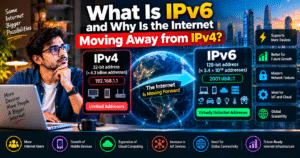
🌐 What Is IPv6 and Why Is the Internet Moving Away from IPv4?
📌 Introduction to IPv6
IPv6 (Internet Protocol Version 6) is a modern network-layer protocol designed to identify devices and enable communication across networks. It was developed primarily to address the limitations of IPv4 and support the growing number of internet-connected devices worldwide.
Every device that communicates over an IP network uses IP addressing to send and receive data. Computers, smartphones, servers, smart TVs, and Internet of Things (IoT) devices all depend on IP-based communication.
IPv4 has been widely used since the early development of the internet. However, its 32-bit address space provides approximately 4.29 billion possible addresses. As internet usage expanded through mobile devices, cloud computing, connected services, and IoT, the availability of public IPv4 addresses became increasingly limited.
IPv6 addresses this challenge by using a 128-bit addressing system, which provides approximately (3.4 \times 10^{38}) possible addresses. This enormous address space supports the continued growth of internet infrastructure and provides greater flexibility for modern network design.
⚙️ What Is IPv6 and How Does It Work?
IPv6 is a network-layer protocol that provides IP addressing and enables data packets to travel between networks.
When a user opens a website or accesses an online application, the device sends IP packets containing source and destination addresses. Routers examine the destination address and forward packets toward the appropriate network.
IPv6 addresses are 128 bits long and are represented using hexadecimal notation, with groups separated by colons.
Example of an IPv6 Address:
2001:0db8:85a3:0000:0000:8a2e:0370:7334
IPv6 addresses can be shortened by removing leading zeros within groups and replacing one consecutive sequence of zero groups with ::.
For example:
2001:0db8:0000:0000:0000:0000:0000:0001
Can be shortened to:
2001:db8::1
IPv6 addresses can be configured manually or assigned automatically through supported mechanisms. Once configured, devices communicate through IPv6-enabled networks, while routers use IPv6 routing information to forward packets toward their destinations.
🏗️ Understanding the IPv6 Addressing System
One of the most important features of IPv6 is its significantly larger address space.
🔢 1. 128-Bit Addressing
IPv6 uses 128-bit addresses, compared with the 32-bit addresses used by IPv4.
This provides an enormous number of possible addresses, allowing networks to accommodate growing numbers of devices and services without the same address limitations associated with IPv4.
🌐 2. Hexadecimal Address Format
IPv6 addresses use hexadecimal characters from 0–9 and A–F. An address is divided into eight groups of 16 bits, separated by colons.
Example:
2001:db8:1234:5678::1
This notation provides a compact way to represent a 128-bit address.
✂️ 3. Address Compression
IPv6 supports address compression to make long addresses easier to read and write.
Leading zeros within a group can be omitted, and one consecutive sequence of zero groups can be represented by ::.
The :: notation can appear only once in a single address because using it multiple times would make the original address ambiguous.
🔗 4. IPv6 Address Types
IPv6 supports three major address types:
- Unicast: Identifies a single network interface.
- Multicast: Delivers packets to a selected group of network interfaces.
- Anycast: Assigns the same address to multiple interfaces, allowing routing to select an appropriate destination.
Unlike IPv4, IPv6 does not use broadcast addressing. Multicast is used for many functions that require communication with groups of devices.
🔍 What Is IPv4?
IPv4, or Internet Protocol Version 4, is an established network-layer protocol used to communicate across IP networks. It uses a 32-bit addressing system.
IPv4 addresses are commonly written as four decimal numbers separated by dots.
Example of an IPv4 Address:
192.168.1.1
Each number ranges from 0 to 255. IPv4 provides (2^{32}), or 4,294,967,296, possible addresses. Some of these addresses are reserved for special purposes, so not all are available for general public use.
IPv4 remains widely deployed across websites, routers, servers, and internet services. Technologies such as Network Address Translation (NAT) have helped many devices share a smaller pool of public IPv4 addresses.
However, the limited address space of IPv4 has encouraged the gradual adoption of IPv6 to accommodate expanding internet requirements.
⚠️ Why Is the Internet Moving Away from IPv4?
The internet is not abandoning IPv4 completely. Instead, IPv6 is being adopted gradually, and both protocols continue to operate alongside each other across many networks.
Several factors are driving the transition.
📉 1. IPv4 Address Exhaustion
IPv4 has a limited pool of possible addresses. The growth of internet users, smartphones, cloud servers, and connected devices has increased demand for public IPv4 addresses.
IPv6 provides a much larger address space, making it easier to assign addresses to new devices and expand network infrastructure.
📱 2. Growth of Internet of Things (IoT)
The Internet of Things includes smart cameras, sensors, connected vehicles, smart appliances, and industrial devices.
As the number of connected devices increases, IPv6 provides additional addressing capacity to support future deployments. IoT devices can also operate on IPv4 networks, particularly when private addressing and NAT are used.
☁️ 3. Expansion of Cloud Computing
Cloud platforms support virtual machines, containers, servers, and distributed applications that may be created or removed dynamically.
IPv6 can provide greater flexibility for address planning and network design in large cloud environments.
🌍 4. Support for Large Networks
IPv6 supports hierarchical addressing and route aggregation, which can help organize large network deployments and simplify some routing designs.
Actual routing efficiency depends on network topology, configuration, and routing policies.
🔐 5. Modern Networking Capabilities
IPv6 includes standardized features such as extension headers, multicast support, and Stateless Address Autoconfiguration (SLAAC).
IPsec support is included in IPv6 specifications, but IPv6 traffic is not automatically encrypted or secure. Both IPv4 and IPv6 networks require appropriate security controls and configuration.
⚖️ IPv4 vs. IPv6: Key Differences
| Feature | IPv4 | IPv6 |
|---|---|---|
| Full Form | Internet Protocol Version 4 | Internet Protocol Version 6 |
| Address Length | 32 bits | 128 bits |
| Address Format | Decimal | Hexadecimal |
| Example | 192.168.1.1 | 2001:db8::1 |
| Address Space | About 4.29 billion possible addresses | About (3.4 \times 10^{38}) possible addresses |
| Base Header | Variable length, 20–60 bytes | Fixed 40-byte base header |
| Broadcast | Supported | Not supported; multicast is used |
| Configuration | Manual, DHCP, and other mechanisms | Manual, SLAAC, DHCPv6, and other mechanisms |
| NAT | Widely used | Less necessary for address conservation in many designs |
| Deployment | Widely established | Gradually expanding |
IPv6 is not automatically faster than IPv4. Actual performance depends on routing, ISP support, network configuration, and application requirements.
🚀 Advantages of IPv6
🌍 1. Massive Address Space
IPv6 provides approximately (3.4 \times 10^{38}) possible addresses. This enormous capacity supports the continued expansion of internet-connected devices, cloud infrastructure, and enterprise networks.
🔧 2. Flexible Address Configuration
IPv6 supports Stateless Address Autoconfiguration (SLAAC), which allows compatible devices to configure addresses using information advertised by routers.
DHCPv6 can also be used when required by the network design.
📦 3. Simplified Base Header
IPv6 uses a fixed 40-byte base header, while optional information is handled through extension headers.
This creates a more consistent packet-header structure, although it does not guarantee better performance in every network.
🔗 4. Support for End-to-End Connectivity
IPv6’s large address space makes it easier to assign globally unique addresses to network interfaces. This can simplify direct communication between devices in suitable network designs.
Firewalls and security policies can still restrict access, so a globally routable address does not automatically mean a device is publicly accessible.
📡 5. Improved Multicast Support
IPv6 uses multicast to send packets to selected groups of interfaces. This supports network discovery and other group communication functions.
📈 6. Future-Ready Infrastructure
IPv6 helps organizations prepare their networks for growing internet usage, connected devices, cloud services, and modern communication requirements.
⚠️ Challenges of IPv6 Adoption
Although IPv6 offers significant benefits, its adoption requires planning and investment.
🧩 1. Legacy System Compatibility
Some older devices, applications, and network systems may not fully support IPv6. Organizations may need software updates, hardware upgrades, or configuration changes.
🔄 2. IPv4 and IPv6 Coexistence
IPv4 remains widely used, so many organizations need to support both protocols during the transition.
Dual-stack deployment allows compatible devices and services to communicate over IPv4 and IPv6 while the migration progresses.
🛠️ 3. Network Configuration
IPv6 deployment requires appropriate address planning, routing configuration, DNS records, firewall policies, and monitoring tools.
Incorrect configurations can cause connectivity problems or introduce security gaps.
🔐 4. Security Considerations
IPv6 networks require the same careful attention to firewalls, access controls, monitoring, and software updates as IPv4 networks.
If IPv6 traffic is not properly monitored or filtered, security vulnerabilities may remain unnoticed.
💰 5. Migration Costs
Large organizations may need to invest in staff training, network testing, application updates, and infrastructure upgrades.
A phased migration strategy can help reduce disruption and allow compatibility issues to be identified early.
🔄 How Are Organizations Migrating from IPv4 to IPv6?
Organizations generally do not replace IPv4 across their entire infrastructure overnight. Instead, they use migration strategies suited to their networks and applications.
🔗 1. Dual-Stack Implementation
Dual Stack allows devices and services to support IPv4 and IPv6 simultaneously. Organizations can maintain existing IPv4 connectivity while introducing IPv6 gradually.
🌉 2. Tunneling
Tunneling technologies carry packets from one IP protocol through infrastructure using another protocol. They can be useful in certain transition scenarios where native connectivity is unavailable.
🔄 3. Protocol Translation
Translation mechanisms enable communication between IPv4 and IPv6 networks. For example, NAT64 and DNS64 can help certain IPv6-only clients access IPv4-based services.
The appropriate method depends on application compatibility and network architecture.
🏢 Real-World Applications of IPv6
📱 1. Mobile Networks
Mobile operators can use IPv6 to support modern mobile connectivity and large-scale device addressing.
☁️ 2. Cloud Computing
Cloud platforms can use IPv6 addresses for virtual machines, applications, and network services, depending on the provider and architecture.
🏭 3. Internet of Things (IoT)
IPv6’s large address space can support connected sensors, smart devices, and industrial equipment in expanding IoT deployments.
🏢 4. Enterprise Networks
Organizations can deploy IPv6 across campus networks, data centers, and enterprise infrastructure to support modern addressing and routing requirements.
🌐 5. Internet Service Providers
Internet Service Providers can offer IPv6 connectivity, enabling customers to access IPv6-enabled websites, applications, and online services.
🔮 What Is the Future of IPv6?
IPv6 adoption is an important part of modernizing internet infrastructure. As cloud computing, mobile networks, IoT devices, and distributed applications continue to grow, the demand for scalable IP addressing will remain significant.
The internet will not transition from IPv4 to IPv6 overnight. IPv4 is still widely deployed, and many organizations will continue operating both protocols for years.
The pace of IPv6 adoption depends on ISP support, device compatibility, application readiness, and the migration strategies chosen by network operators.
Understanding IPv6 is valuable for professionals working in computer networking, cloud computing, cybersecurity, and IT infrastructure.
❓ Frequently Asked Questions (FAQs)
1. What Is IPv6?
IPv6 stands for Internet Protocol Version 6. It is a network-layer protocol that uses 128-bit addresses to support communication across IP networks.
2. Why Was IPv6 Created?
IPv6 was developed primarily to address the limitations of IPv4’s address space and support the growing demand for IP addresses.
3. How Many Addresses Does IPv6 Provide?
IPv6 provides (2^{128}), or approximately (3.4 \times 10^{38}), possible addresses.
4. Is IPv6 Faster Than IPv4?
Not necessarily. Performance depends on routing, ISP support, network configuration, and application requirements.
5. Is IPv4 Being Completely Replaced?
No. IPv4 remains widely used. IPv6 adoption is gradual, and both protocols can operate simultaneously.
6. What Is the Main Difference Between IPv4 and IPv6?
IPv4 uses 32-bit addresses, while IPv6 uses 128-bit addresses. IPv6 also uses hexadecimal notation and does not support broadcast addressing.
7. Does IPv6 Improve Security?
IPv6 includes modern networking capabilities and IPsec support in its specifications, but it is not automatically more secure. Proper firewall configuration, access controls, and monitoring remain essential.
📝 Conclusion
IPv6 is an important technology in the evolution of internet infrastructure. Its 128-bit addressing system provides a significantly larger address space than IPv4, supporting the growth of connected devices, cloud platforms, and IoT networks.
Its benefits include extensive address capacity, flexible address configuration, multicast support, and modern networking capabilities. However, organizations must also address compatibility, migration costs, and security configuration during deployment.
IPv4 remains an important part of the internet, so organizations are gradually adopting IPv6 while continuing to support both protocols where necessary.
For anyone learning computer networking, cloud computing, or cybersecurity, understanding IPv4 and IPv6 addressing, their differences, and migration techniques provides a strong technical foundation.
🌐 What Is IPv6 and Why Is the Internet Moving Away from IPv4?
📌 Introduction to IPv6
IPv6 (Internet Protocol Version 6) इंटरनेट पर devices के बीच communication करने के लिए इस्तेमाल होने वाला एक modern network protocol है। इसका मुख्य उद्देश्य internet-connected devices को unique IP addresses उपलब्ध कराना और internet की लगातार बढ़ती जरूरतों को support करना है।
Internet Protocol (IP) एक ऐसा system है, जो network पर data packets को सही destination तक पहुँचाने में मदद करता है। जब कोई computer, smartphone, server या smart device internet से connect होता है, तो network communication के लिए उसे IP address की जरूरत होती है।
पहले internet पर मुख्य रूप से IPv4 का उपयोग किया जाता था। IPv4 में लगभग 4.3 billion यानी 4.29 billion unique addresses उपलब्ध हैं। लेकिन smartphones, cloud computing, IoT devices और connected services की बढ़ती संख्या के कारण IPv4 addresses की उपलब्धता सीमित हो गई।
इस समस्या को हल करने के लिए IPv6 विकसित किया गया। यह 128-bit addressing system का उपयोग करता है, जिससे लगभग (3.4 \times 10^{38}) addresses उपलब्ध होते हैं। इतनी बड़ी address space भविष्य में internet-connected devices की बढ़ती जरूरतों को पूरा करने में मदद करती है।
⚙️ What Is IPv6 and How Does It Work?
IPv6 एक network-layer protocol है, जो devices को IP addresses प्रदान करने और networks के बीच data packets को route करने में मदद करता है।
जब कोई user website open करता है या किसी online application का उपयोग करता है, तो device network communication के लिए IP packets भेजता है। इन packets में source और destination IP addresses होते हैं, जिनकी सहायता से routers data को appropriate destination की ओर forward करते हैं।
IPv6 में addresses 128 bits लंबे होते हैं और hexadecimal notation में लिखे जाते हैं। Address को colon से अलग किए गए आठ groups में दर्शाया जाता है।
Example of an IPv6 Address:
2001:0db8:85a3:0000:0000:8a2e:0370:7334
इस address को leading zeros हटाकर और लगातार zero groups को एक बार :: से replace करके छोटा भी लिखा जा सकता है।
IPv6-enabled networks में devices manually configure किए जा सकते हैं या supported mechanisms के माध्यम से automatically addresses प्राप्त कर सकते हैं। इसके बाद routers IPv6 routing information के आधार पर packets को destination network तक पहुँचाते हैं।
🏗️ IPv6 Addressing System
IPv6 की सबसे महत्वपूर्ण विशेषताओं में से एक इसकी विशाल address space है।
🔢 1. 128-Bit Addressing
IPv6 में प्रत्येक address 128 bits का होता है। इसके विपरीत, IPv4 केवल 32-bit addressing का उपयोग करता है।
इस बड़े address format के कारण IPv6 में बहुत अधिक unique addresses उपलब्ध होते हैं, जो internet infrastructure के expansion को support करते हैं।
🌍 2. Hexadecimal Notation
IPv6 addresses को hexadecimal format में लिखा जाता है, जिसमें 0–9 और A–F characters का उपयोग होता है।
उदाहरण:
2001:db8:1234:5678::1
यह format IPv6 addresses को पढ़ने और लिखने में उपयोगी बनाता है।
🧩 3. Address Compression
IPv6 addresses में लगातार zero groups को :: का उपयोग करके compress किया जा सकता है। किसी address में :: का उपयोग अधिकतम एक बार किया जा सकता है, ताकि address को सही तरीके से reconstruct किया जा सके।
उदाहरण:
2001:0db8:0000:0000:0000:0000:0000:0001
इसे छोटा करके लिखा जा सकता है:
2001:db8::1
🔗 4. Address Types
IPv6 में मुख्य रूप से तीन प्रकार के addresses उपयोग किए जाते हैं:
- Unicast: किसी एक network interface को identify करता है।
- Multicast: एक selected group of interfaces तक packets पहुँचाता है।
- Anycast: एक ही address assigned किए गए कई interfaces में से routing के अनुसार किसी एक suitable interface तक packets पहुँचाता है।
IPv6 में IPv4 की तरह broadcast addressing का उपयोग नहीं होता। कई local-link functions के लिए multicast का उपयोग किया जाता है।
🔍 What Is IPv4?
IPv4 यानी Internet Protocol Version 4 internet का एक पुराना और व्यापक रूप से इस्तेमाल होने वाला network protocol है। यह 32-bit addressing system का उपयोग करता है।
IPv4 addresses सामान्यतः चार decimal numbers में लिखे जाते हैं, जिन्हें dots से अलग किया जाता है।
Example of an IPv4 Address:
192.168.1.1
प्रत्येक number की value 0 से 255 के बीच होती है। IPv4 में कुल (2^{32}), यानी 4,294,967,296 possible addresses हैं।
इन addresses में से कुछ special purposes के लिए reserved हैं, इसलिए सभी addresses सामान्य public devices के लिए उपलब्ध नहीं होते।
IPv4 आज भी बहुत से networks, websites, routers और internet services में उपयोग किया जाता है। NAT (Network Address Translation) जैसी technologies ने limited public IPv4 addresses के साथ अनेक devices को internet access देने में मदद की है।
हालाँकि, IPv4 address limitations और बढ़ती network requirements ने IPv6 adoption की जरूरत को बढ़ाया है।
⚠️ Why Is the Internet Moving Away from IPv4?
Internet पूरी तरह से IPv4 को छोड़ नहीं रहा है। इसके बजाय, IPv6 को धीरे-धीरे अपनाया जा रहा है और दोनों protocols लंबे समय से साथ-साथ उपयोग किए जा रहे हैं।
इसके पीछे कई महत्वपूर्ण कारण हैं।
📉 1. IPv4 Address Exhaustion
IPv4 के पास सीमित number of addresses हैं। Internet users, mobile devices, cloud servers और IoT devices की बढ़ती संख्या के कारण public IPv4 addresses की उपलब्धता सीमित हो गई है।
IPv6 की विशाल address space नए devices और networks को addresses उपलब्ध कराने के लिए अधिक flexibility प्रदान करती है।
📱 2. Growth of IoT Devices
Internet of Things (IoT) में smart cameras, sensors, smart TVs, connected vehicles और industrial devices शामिल हैं।
इन devices की बढ़ती संख्या को देखते हुए IPv6 का large address space future network expansion के लिए उपयोगी है।
हालाँकि, IoT devices का उपयोग IPv4 networks पर भी किया जा सकता है, विशेष रूप से NAT और private addressing के माध्यम से।
☁️ 3. Cloud Computing Expansion
Cloud platforms में virtual machines, containers, servers और distributed applications की संख्या लगातार बदल सकती है।
IPv6 का large address space cloud infrastructure को address planning और network design में अधिक flexibility प्रदान कर सकता है।
🌐 4. Better Support for Large Networks
IPv6 बड़े network deployments के लिए hierarchical addressing और route aggregation को support करता है। इससे कुछ network designs में address planning और routing organization को आसान बनाया जा सकता है।
हालाँकि, actual routing performance network design और routing policies पर निर्भर करती है।
🔐 5. Modern Network Capabilities
IPv6 में कुछ capabilities को protocol design में बेहतर तरीके से integrate किया गया है, जैसे standardized extension headers और stateless address autoconfiguration support।
IPv6 में IPsec support को protocol specifications में शामिल किया गया है, लेकिन इसका अर्थ यह नहीं है कि हर IPv6 connection automatically encrypted या अधिक secure होता है।
Proper security configuration दोनों protocols में आवश्यक है।
⚖️ IPv4 vs IPv6: Key Differences
IPv4 और IPv6 दोनों internet communication के लिए उपयोग किए जाते हैं, लेकिन इनके addressing formats और कुछ protocol features अलग हैं।
| Feature | IPv4 | IPv6 |
|---|---|---|
| Full Form | Internet Protocol Version 4 | Internet Protocol Version 6 |
| Address Length | 32 bits | 128 bits |
| Address Format | Decimal | Hexadecimal |
| Example | 192.168.1.1 | 2001:db8::1 |
| Address Space | लगभग 4.29 billion possible addresses | लगभग (3.4 \times 10^{38}) addresses |
| Header | Variable length, 20–60 bytes | Fixed 40-byte base header |
| Broadcast | Supported | Broadcast नहीं; multicast का उपयोग |
| Address Configuration | Manual, DHCP और अन्य mechanisms | Manual, SLAAC, DHCPv6 और अन्य mechanisms |
| NAT Usage | आमतौर पर widely used | सामान्य end-to-end designs में इसकी आवश्यकता कम हो सकती है, लेकिन NAT-related mechanisms मौजूद हैं |
| Adoption | व्यापक रूप से deployed | धीरे-धीरे बढ़ रहा है |
IPv6 हर परिस्थिति में IPv4 से faster नहीं होता। Actual performance network configuration, ISP support, routing और application requirements पर निर्भर करती है।
🚀 Advantages of IPv6
🌍 1. Massive Address Space
IPv6 लगभग (3.4 \times 10^{38}) possible addresses प्रदान करता है। यह internet-connected devices और future network expansion के लिए पर्याप्त address capacity उपलब्ध कराने में मदद करता है।
🔧 2. Simplified Address Configuration
IPv6 में Stateless Address Autoconfiguration (SLAAC) की सुविधा है। Supported networks में devices router advertisements के आधार पर अपना address configure कर सकते हैं।
DHCPv6 का उपयोग भी network requirements के अनुसार किया जा सकता है।
📦 3. Efficient Header Design
IPv6 का base header fixed 40 bytes का होता है। कई optional functions extension headers के माध्यम से implement किए जाते हैं।
इससे protocol design अधिक consistent बनता है, लेकिन इससे हर network में automatic performance improvement की guarantee नहीं मिलती।
🌐 4. Better Support for End-to-End Connectivity
IPv6 की बड़ी address space devices को globally unique addresses प्रदान करने में मदद करती है। इससे कुछ network architectures में direct end-to-end communication आसान हो सकता है।
फिर भी firewalls और security policies access को restrict कर सकते हैं, इसलिए public address का होना unrestricted access का मतलब नहीं है।
📡 5. Improved Multicast Support
IPv6 multicast का उपयोग selected groups of interfaces तक packets पहुँचाने के लिए करता है। यह network discovery और अन्य group communication functions में उपयोगी है।
📈 6. Future-Ready Infrastructure
IPv6 adoption organizations को modern internet requirements के अनुसार infrastructure तैयार करने में मदद करता है। यह cloud services, mobile networks और connected devices की बढ़ती संख्या को support करने के लिए उपयोगी है।
⚠️ Challenges of IPv6 Adoption
IPv6 के कई benefits हैं, लेकिन इसका adoption पूरी दुनिया में एक साथ नहीं हुआ है।
🧩 1. Legacy System Compatibility
कुछ पुराने devices, applications और network systems IPv6 को पूरी तरह support नहीं करते। ऐसे environments में hardware upgrades, software updates या additional configuration की जरूरत हो सकती है।
🔄 2. IPv4 and IPv6 Coexistence
क्योंकि internet पर IPv4 अभी भी व्यापक रूप से उपयोग किया जाता है, organizations को दोनों protocols manage करने पड़ सकते हैं।
Dual-stack deployment में devices और services IPv4 तथा IPv6 दोनों का उपयोग कर सकते हैं।
🛠️ 3. Network Configuration
IPv6 deployment के लिए addressing plans, routing protocols, firewall policies, DNS records और monitoring tools को सही तरीके से configure करना जरूरी है।
🔐 4. Security Considerations
IPv6 networks को भी firewall rules, access controls, monitoring और regular security updates की जरूरत होती है।
यदि IPv6 traffic को ठीक से monitor या filter नहीं किया जाता, तो security gaps उत्पन्न हो सकते हैं।
💰 5. Migration Costs
Large organizations को staff training, network testing, infrastructure upgrades और application compatibility पर investment करना पड़ सकता है।
इसलिए IPv6 migration को planned और phased approach के साथ implement करना उपयोगी होता है।
🔄 How Are Organizations Migrating from IPv4 to IPv6?
Organizations आमतौर पर IPv4 से IPv6 पर एक ही बार में पूरी तरह switch नहीं करते। इसके बजाय, वे network requirements के अनुसार gradual migration strategies अपनाते हैं।
🔗 1. Dual-Stack Implementation
Dual Stack में devices और services IPv4 तथा IPv6 दोनों protocols को support करते हैं। इससे organizations existing IPv4 connectivity बनाए रखते हुए IPv6 introduce कर सकते हैं।
🌉 2. Tunneling
Tunneling technologies एक IP protocol के packets को दूसरे protocol के माध्यम से transport कर सकती हैं। इसका उपयोग कुछ migration scenarios में किया जाता है।
🔄 3. Protocol Translation
Translation mechanisms IPv4 और IPv6 networks के बीच communication facilitate कर सकते हैं। उदाहरण के लिए, NAT64 और DNS64 कुछ IPv6-only clients को IPv4-based services तक पहुँचने में मदद कर सकते हैं।
इन technologies का चुनाव network architecture और application requirements पर निर्भर करता है।
🏢 Real-World Applications of IPv6
📱 1. Mobile Networks
Mobile operators IPv6 का उपयोग modern mobile networks और internet connectivity के लिए कर सकते हैं। इससे large-scale device addressing की जरूरतों को support करने में मदद मिलती है।
☁️ 2. Cloud Computing
Cloud environments में IPv6 virtual machines, applications और network services के लिए addressing options प्रदान करता है।
🏭 3. Internet of Things (IoT)
Connected sensors, smart appliances और industrial devices के बढ़ते ecosystem में IPv6 का large address space उपयोगी हो सकता है।
🏢 4. Enterprise Networks
Organizations IPv6 को campus networks, data centers और enterprise infrastructure में deploy कर सकते हैं। इससे modern addressing और routing requirements को support करने में मदद मिलती है।
🌐 5. Internet Service Providers
Internet Service Providers (ISPs) IPv6 connectivity प्रदान कर सकते हैं, जिससे users और organizations IPv6-enabled websites तथा services access कर सकें।
🔮 What Is the Future of IPv6?
IPv6 का adoption internet infrastructure के modernization का एक महत्वपूर्ण हिस्सा है। जैसे-जैसे cloud computing, connected devices, mobile networks और distributed applications का उपयोग बढ़ता है, वैसे-वैसे large-scale IP addressing की आवश्यकता भी बढ़ती है।
Internet पूरी तरह IPv4 से IPv6 पर overnight switch नहीं करेगा। IPv4 infrastructure अभी भी widely deployed है और कई organizations दोनों protocols का उपयोग जारी रखेंगे।
आने वाले समय में IPv6 adoption का विकास ISP support, device compatibility, application readiness और organizations की migration strategies पर निर्भर करेगा।
IPv6 को समझना networking, cloud computing, cybersecurity और IT infrastructure के क्षेत्र में काम करने वाले professionals के लिए महत्वपूर्ण है।
❓ Frequently Asked Questions (FAQs)
1. What Is IPv6?
IPv6 यानी Internet Protocol Version 6 एक network-layer protocol है, जो 128-bit IP addresses का उपयोग करता है और internet communication को support करता है।
2. Why Was IPv6 Created?
IPv6 मुख्य रूप से IPv4 address limitations को दूर करने और internet की बढ़ती addressing requirements को support करने के लिए विकसित किया गया।
3. How Many Addresses Does IPv6 Provide?
IPv6 में (2^{128}), यानी लगभग (3.4 \times 10^{38}) possible addresses उपलब्ध हैं।
4. Is IPv6 Faster Than IPv4?
IPv6 हर स्थिति में faster नहीं होता। Performance network routing, ISP support, configuration और application requirements पर निर्भर करती है।
5. Is IPv4 Being Completely Replaced?
नहीं, IPv4 अभी भी widely used है। IPv6 adoption gradual है और दोनों protocols लंबे समय तक साथ-साथ काम कर सकते हैं।
6. What Is the Difference Between IPv4 and IPv6?
IPv4 32-bit addressing का उपयोग करता है, जबकि IPv6 128-bit addressing का उपयोग करता है। IPv6 की address space बहुत बड़ी है और इसका addressing format hexadecimal होता है।
7. Does IPv6 Improve Security?
IPv6 में IPsec support जैसी capabilities हैं, लेकिन IPv6 automatically अधिक secure नहीं होता। Effective security के लिए correct configuration, firewalls और access controls आवश्यक हैं।
📝 Conclusion
IPv6 modern internet infrastructure के विकास में महत्वपूर्ण भूमिका निभाता है। इसका 128-bit addressing system IPv4 की तुलना में बहुत बड़ी address space प्रदान करता है, जिससे growing internet-connected devices, cloud platforms और IoT infrastructure की requirements को support करना आसान होता है।
हालाँकि IPv6 के benefits में large address capacity, flexible address configuration और modern networking capabilities शामिल हैं, लेकिन compatibility, migration cost और security configuration जैसी चुनौतियों पर भी ध्यान देना जरूरी है।
IPv4 अभी भी internet का महत्वपूर्ण हिस्सा है, इसलिए organizations धीरे-धीरे IPv6 adopt कर रही हैं और कई environments में दोनों protocols साथ-साथ उपयोग किए जा रहे हैं।
यदि आप Computer Networking, Cloud Computing या Cybersecurity सीख रहे हैं, तो IPv4 और IPv6 के differences, addressing system और migration techniques को समझना आपके technical knowledge को मजबूत करने में मदद करेगा।