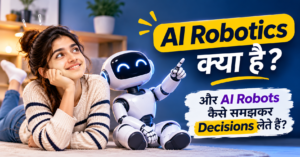
🤖 What Is AI Robotics and How Does AI Help Robots Understand and Make Decisions?
🧠 What If Robots Could Do More Than Just Follow Instructions?
Robots have been used for years in factories, warehouses, healthcare, and many other industries. Traditional robots usually perform tasks based on predefined instructions.
But Artificial Intelligence is changing the way robots work.
AI Robotics combines Artificial Intelligence with robotics to help robots understand their surroundings, analyze information, recognize patterns, and make decisions based on different situations.
In simple words, AI can help robots move beyond simply following fixed instructions and become more adaptive, intelligent, and capable of responding to changing environments.
🔍 What Is AI Robotics?
AI Robotics is the combination of Artificial Intelligence and robotics, where AI technologies help robots understand their environment, process information, learn from data, and choose appropriate actions.
A traditional robot may be programmed to perform a specific task in a specific way.
An AI-powered robot can use cameras, sensors, AI models, and other technologies to understand what is happening around it and respond accordingly.
For example, a warehouse robot may detect an obstacle in its path and adjust its movement instead of simply following the original route.
🧠 How Does AI Make Robots Smarter?
AI provides robots with the ability to process and interpret information.
A robot can collect information through cameras, sensors, microphones, and other devices. AI can then analyze this information and help the robot understand the situation.
A simple process looks like this:
📡 Collect Data → 🧠 Analyze Data → 🔎 Understand the Situation → 🤔 Make a Decision → ⚙️ Take Action
This creates an important difference between basic automation and AI-powered robotics.
The robot is not only performing a physical task. It can also use AI to interpret information and respond to changing conditions.
👀 How Do Robots Understand Their Environment?
AI robots can use different types of sensors and input systems to understand the world around them.
📷 Cameras
Cameras can help robots identify objects, people, movement, and surroundings.
📡 Sensors
Sensors can provide information about distance, movement, temperature, pressure, or other environmental conditions.
🎙️ Microphones
Microphones can help robots process sounds and, in some systems, understand spoken commands.
🧠 AI Models
AI models can analyze the collected information and help the robot recognize patterns, objects, or situations.
By combining these inputs, robots can develop a better understanding of their surroundings.
🤔 How Do AI Robots Make Decisions?
Imagine an AI-powered robot working inside a warehouse.
The robot is moving toward a specific location when it detects an unexpected obstacle.
Instead of blindly continuing along the same path, the robot can use sensor information to detect the obstacle and determine an alternative action, depending on how the system has been designed and trained.
The process can be understood as:
Environment Changes → Data Is Collected → AI Analyzes It → Decision Is Selected → Robot Takes Action
This ability to respond to changing situations is one of the important features of AI-powered robotics.
🔄 Can AI Robots Learn From Experience?
Some AI-powered robotic systems can use Machine Learning and related techniques to learn patterns from data and previous experiences.
For example, a robot may encounter different situations while performing a task. Training data and feedback can help improve the AI model’s ability to recognize similar situations in the future.
However, not every AI robot automatically learns everything on its own.
Its learning capability depends on the AI model, training process, hardware, feedback system, and overall design.
🏭 Where Is AI Robotics Used?
AI Robotics has applications across many industries.
🏭 Manufacturing
AI-powered robots can support assembly, inspection, material handling, and quality-control tasks.
🏥 Healthcare
Robotic systems can assist with patient support, hospital operations, rehabilitation, and other healthcare-related activities.
📦 Logistics & Warehousing
Robots can help identify, move, sort, and transport products inside warehouses.
🌾 Agriculture
AI-powered robots can support crop monitoring, weed detection, harvesting, and other agricultural activities.
🏠 Smart Homes
Intelligent robots can assist with cleaning, monitoring, navigation, and other household tasks.
🚀 Space Exploration
Robots can explore difficult environments, collect information, and perform tasks where sending humans may be challenging or risky.
⚡ Key Benefits of AI Robotics
🧠 Smarter Decision-Making
AI can help robots analyze available information and select suitable actions for different situations.
🎯 Better Accuracy
AI-powered computer vision and sensing technologies can help robots identify objects and patterns more accurately in suitable applications.
🚀 Higher Efficiency
Robots can perform repetitive tasks consistently, helping improve productivity and operational efficiency.
🛡️ Safer Handling of Risky Tasks
Robots can be deployed in environments that may be dangerous, difficult, or uncomfortable for humans.
🌍 Better Adaptability
AI can help robots respond to changes in their surroundings instead of relying only on fixed instructions.
⚠️ What Are the Challenges of AI Robotics?
AI Robotics also comes with several challenges.
💰 High Development Costs
Advanced robots may require expensive sensors, processors, hardware, software, and maintenance.
🧩 Complex Integration
Combining AI models with robotic hardware, sensors, navigation systems, and control mechanisms can be technically challenging.
🛡️ Safety
When robots operate around humans, reliable safety mechanisms and careful testing are extremely important.
⚖️ Ethical Concerns
Autonomous systems can raise questions about privacy, responsibility, decision-making, and the appropriate use of AI.
🌎 Unpredictable Real-World Environments
Real-world environments can change unexpectedly. Designing robots that can handle unusual situations reliably remains a major challenge.
🤖 Traditional Robots vs AI Robots
⚙️ Traditional Robot
Fixed Instructions → Fixed Task → Predictable Action
Traditional robots can be highly effective when tasks are repetitive and environments are controlled.
🧠 AI-Powered Robot
Data → AI Analysis → Situation Understanding → Decision → Action
AI-powered robots can use information from their surroundings to support more adaptive behaviour.
💡 The Simple Difference
Traditional Robot: “I will follow the instructions I was given.”
AI Robot: “I can analyze available information and respond according to the situation.”
🚀 What Is the Future of AI Robotics?
The combination of AI and robotics could make future robots more intelligent, autonomous, adaptive, and collaborative.
AI-powered robots may become increasingly useful in healthcare, manufacturing, logistics, agriculture, transportation, space exploration, and everyday life.
One of the most exciting possibilities is the development of robots that do not simply work for humans but can effectively work alongside humans.
The future may be less about replacing people and more about creating intelligent systems that help humans perform tasks more safely, efficiently, and effectively.
🎯 Final Thoughts
The basic idea behind AI Robotics is simple:
Give robots not only the ability to perform tasks, but also the intelligence to understand information and respond to different situations.
With cameras, sensors, Machine Learning, Computer Vision, and other AI technologies, robots can collect information, analyze their surroundings, and support intelligent actions.
In one simple line:
“Robotics gives AI a body, while AI can give robots the intelligence to understand, learn, and make better decisions.” 🤖🧠
💬 What Would You Ask an AI Robot to Do?
If AI robots become a regular part of our daily lives, what would you want one to help you with?
🏠 Home Assistance
🚗 Travel & Transport
🏥 Healthcare
📦 Delivery
🤖 Personal Assistance
Share your answer in the comments!
🤖 AI Robotics क्या है और AI Robots को खुद समझने और Decisions लेने में कैसे Help करता है?
🧠 क्या होगा अगर Robots सिर्फ Instructions Follow न करें, बल्कि Situation को समझकर खुद Decision लें?
हमने robots को लंबे समय से factories, warehouses और different industries में काम करते हुए देखा है। लेकिन traditional robots अक्सर वही काम करते हैं जिसके लिए उन्हें पहले से program किया गया हो।
अब Artificial Intelligence (AI) robotics को एक नया level दे रहा है।
AI Robotics में Artificial Intelligence और Robotics को combine किया जाता है, जिससे robots अपने surroundings को समझने, data को analyze करने, patterns पहचानने और situation के according appropriate action लेने में ज्यादा capable बन सकते हैं।
यानी robot सिर्फ “क्या करना है” follow नहीं करता, बल्कि कुछ situations में “अब क्या करना चाहिए?” यह decide करने में भी AI की मदद ले सकता है।
🔍 AI Robotics क्या है?
AI Robotics, Artificial Intelligence और Robotics का combination है, जिसमें AI technologies robots को environment को समझने, data से सीखने और decisions लेने में help करती हैं।
Simple words में:
Traditional Robot को instructions follow करने होते हैं, जबकि AI-powered Robot अपने surroundings को analyze करके situation के हिसाब से response चुन सकता है।
उदाहरण के लिए, एक normal robot को किसी object को एक fixed location से दूसरी location पर move करने के लिए predefined instructions दिए जा सकते हैं।
लेकिन AI-powered robot camera और sensors की मदद से object की position identify कर सकता है और environment में बदलाव होने पर अपने action को adjust करने की कोशिश कर सकता है।
🧠 AI Robots को Smarter कैसे बनाता है?
AI robot को data से सीखने और information को process करने की ability देता है।
Robot अपने sensors, cameras और other inputs से data collect कर सकता है।
फिर AI उस data को analyze करके situation को understand करने में मदद करता है।
एक simple process को ऐसे समझ सकते हैं:
📡 Data Collect → 🧠 Analyze → 🔎 Situation Understand → 🤔 Decision → ⚙️ Action
यानी robot के पास सिर्फ physical body नहीं होती, बल्कि AI उसकी intelligence layer की तरह काम कर सकता है।
👀 Robots अपने Environment को कैसे समझते हैं?
AI robot को अपने आसपास की दुनिया समझने के लिए अलग-अलग sensors और cameras का इस्तेमाल कर सकता है।
For example:
📷 Cameras — objects और surroundings को identify करने में मदद कर सकते हैं।
📡 Sensors — distance, movement या environmental conditions जैसी information collect कर सकते हैं।
🎙️ Microphones — आवाज और speech-related inputs को process करने में मदद कर सकते हैं।
🧠 AI Models — collected information को analyze करके meaningful output generate कर सकते हैं।
इन सभी inputs को combine करके robot अपने environment के बारे में better understanding बना सकता है।
🤔 AI Robots Decisions कैसे लेते हैं?
मान लीजिए एक warehouse में AI-powered robot सामान deliver कर रहा है।
अगर उसके सामने रास्ते में कोई obstacle आ जाए, तो एक fixed-program robot शायद predefined path follow करने की कोशिश करे।
लेकिन AI-powered system available sensor data को analyze करके obstacle को detect कर सकता है और situation के according alternative action choose करने में मदद कर सकता है।
यानी:
Environment बदलता है → Data मिलता है → AI Situation Analyze करता है → Robot Action Adjust करता है
यही capability AI Robotics को traditional automation से अलग बनाती है।
🔄 क्या AI Robots Experience से सीख सकते हैं?
कुछ AI-powered robotic systems Machine Learning और related techniques का use करके data और previous experiences से patterns सीख सकते हैं।
For example, robot बार-बार किसी task को perform करते समय अलग-अलग situations observe कर सकता है।
Training और feedback के आधार पर AI model future situations में बेहतर predictions या actions support कर सकता है।
हालाँकि, यह जरूरी नहीं कि हर AI robot खुद से unrestricted तरीके से सीखता रहे। Learning capability उसके model, training process और system design पर depend करती है।
🏭 AI Robotics के Real-Life Applications
AI Robotics का use कई industries में तेजी से बढ़ रहा है।
🏭 Manufacturing
Factories में AI robots assembly, inspection, material handling और quality checking जैसे tasks में मदद कर सकते हैं।
🏥 Healthcare
Healthcare robotics में patient assistance, medical support और hospital-related tasks के लिए intelligent robotic systems develop किए जा रहे हैं।
📦 Logistics & Warehousing
Warehouses में robots products को identify, move, sort और deliver करने में मदद कर सकते हैं।
🌾 Agriculture
AI-powered robots crops की monitoring, weed detection और कुछ agricultural tasks में support कर सकते हैं।
🏠 Smart Home
Future में intelligent robots घर के अंदर cleaning, monitoring और assistance जैसे tasks में ज्यादा useful हो सकते हैं।
🚀 Space Exploration
Robots ऐसे environments में exploration और data collection कर सकते हैं जहाँ humans के लिए जाना difficult या risky हो।
⚡ AI Robotics के Main Benefits
🧠 Smarter Decision-Making
AI robots को available data के आधार पर situations को analyze करने और suitable actions चुनने में help कर सकता है।
🎯 Better Accuracy
AI-based vision और sensing systems कुछ tasks में objects और patterns को accurately identify करने में मदद कर सकते हैं।
🚀 Higher Efficiency
Robots repetitive tasks को लगातार perform करके productivity improve करने में support कर सकते हैं।
🛡️ Risky Tasks में Safety
Robots को dangerous या difficult environments में deploy किया जा सकता है, जिससे humans को कुछ risky tasks से दूर रखा जा सकता है।
🌍 Adaptability
AI-powered robots changing environments को detect करके predefined systems की तुलना में ज्यादा flexible behaviour support कर सकते हैं।
⚠️ क्या AI Robotics के सामने Challenges भी हैं?
बिल्कुल।
AI robots को develop और maintain करना काफी complex हो सकता है।
💰 High Development Cost
Advanced sensors, hardware और AI models की वजह से development cost बढ़ सकती है।
🧩 Complex Integration
AI software को robotic hardware, sensors और control systems के साथ properly integrate करना challenging हो सकता है।
🛡️ Safety
जब robots humans के आसपास operate करते हैं, तो reliable safety systems बहुत important हो जाते हैं।
⚖️ Ethical Concerns
AI-powered autonomous systems में responsibility, privacy और decision-making से जुड़े ethical questions भी important हैं।
🌎 Real-World Uncertainty
Real world हमेशा predictable नहीं होता। इसलिए robot को unexpected situations में reliable तरीके से operate कराना एक major challenge है।
🤖 Traditional Robots vs AI Robots
⚙️ Traditional Robot
Fixed Instructions → Fixed Task → Predictable Action
Traditional robots predefined instructions के अनुसार काम करने में बहुत effective हो सकते हैं।
🧠 AI-Powered Robot
Data → AI Analysis → Situation Understanding → Decision → Action
AI-powered robots environment और available information के आधार पर ज्यादा adaptive behaviour support कर सकते हैं।
Simple difference:
Traditional Robot: “मुझे जो instruction दिया गया है, मैं वही करूँगा।”
AI Robot: “मैं available information को समझकर situation के हिसाब से appropriate action चुनने में मदद कर सकता हूँ।”
🚀 AI Robotics का Future क्या है?
AI और robotics के combination से आने वाले समय में robots और ज्यादा intelligent, autonomous और collaborative हो सकते हैं।
Future में AI robots healthcare, manufacturing, logistics, agriculture, space exploration और daily life में ज्यादा important role निभा सकते हैं।
लेकिन future का सबसे interesting part यह होगा कि robots सिर्फ humans के लिए काम करने वाली machines न रहें, बल्कि humans के साथ collaborate करने वाले intelligent systems बनें।
🎯 Final Thoughts
AI Robotics का basic idea simple है — robots को सिर्फ काम करने की ability नहीं, बल्कि situation को समझने और intelligent decisions support करने की capability देना।
AI robots को cameras, sensors और machine learning जैसे technologies के जरिए environment से information collect करने, उसे analyze करने और उसके आधार पर action लेने में मदद कर सकता है।
एक simple line में:
“Robotics gives AI a body, और AI उस robot को समझने, सीखने और बेहतर decisions लेने की intelligence दे सकता है।” 🤖🧠
💬 अब आपकी बारी!
अगर future में AI robots आपके daily life का हिस्सा बन जाएँ, तो आप उनसे कौन-सा काम करवाना चाहेंगे?
🏠 Home Assistance
🚗 Travel & Transport
🏥 Healthcare
📦 Delivery
🤖 Personal Assistant
अपना answer comment में जरूर बताइए!