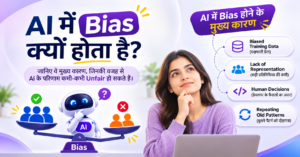
Why Does Bias Happen in AI?
Introduction
Artificial Intelligence (AI) is now used in many areas of our daily lives. It helps with tasks such as education, hiring, healthcare, business, and online services.
However, sometimes AI can produce unfair or one-sided results. This is known as AI Bias.
AI does not usually create bias on its own. Bias can come from the data, design, or decisions used to develop an AI system.
🤖 What Is AI Bias?
AI Bias happens when an AI system gives unfair or unequal results to a person or group without a valid reason.
In simple words, if an AI system repeatedly favors one group while treating another group unfairly, the system may have bias.
📊 1. Biased Training Data
AI learns from large amounts of data. If the training data already contains bias or imbalance, the AI may learn and repeat those patterns.
For example, if an AI system is trained mostly using data from one particular group, it may not perform equally well for other groups.
👥 2. Lack of Representation
AI needs diverse data to work well for different types of people and situations.
If some groups are underrepresented in the training data, the AI may produce less accurate or less fair results for them.
🧑💻 3. Human Decisions
AI systems are designed and developed by people. The choices, assumptions, and priorities made during development can sometimes influence how an AI system behaves.
This is why having different perspectives during AI development is important.
🔄 4. Repeating Old Patterns
AI learns patterns from historical data. If that data contains unfair patterns from the past, AI may learn and repeat them.
AI does not automatically understand whether a pattern is fair or unfair. It mainly learns from the information provided to it.
⚠️ 5. Why Is AI Bias a Problem?
AI Bias can become a serious issue when AI is used for important decisions.
For example, bias in job recruitment, education, finance, or healthcare can lead to unfair outcomes for certain people or groups.
That is why AI systems need to be regularly tested, monitored, and improved.
🛠️ How Can AI Bias Be Reduced?
AI Bias cannot always be completely removed, but several steps can help reduce it:
- 📊 Use diverse and balanced training data.
- 🔍 Regularly test AI systems for bias.
- ⚖️ Check whether AI results are fair.
- 👥 Include people with different backgrounds in AI development.
- 🔄 Review and improve AI models regularly.
- 🧠 Keep human oversight for important decisions.
Conclusion
AI Bias can happen because of biased data, limited representation, human decisions, and unfair patterns in historical information.
Building a smart AI system is not enough. AI should also be fair, transparent, and responsible.
As AI becomes more powerful, making sure that its decisions are fair and respectful to people becomes even more important.
AI में Bias क्यों होता है?
Introduction
Artificial Intelligence (AI) आज कई तरह के कामों में हमारी मदद कर रहा है। लेकिन कभी-कभी AI के results unfair या एकतरफा हो सकते हैं। इसे AI Bias कहा जाता है।
AI खुद से bias नहीं बनाता। अक्सर bias उसके training data, design या development process से आ सकता है।
🤖 AI Bias क्या है?
जब कोई AI system किसी व्यक्ति या group के साथ बिना सही कारण के unfair या unequal तरीके से behave करता है, तो इसे AI Bias कहा जाता है।
आसान भाषा में, अगर AI बार-बार किसी particular group को फायदा और दूसरे group को नुकसान पहुंचाने वाला result देता है, तो उसमें bias हो सकता है।
📊 1. Biased Data की वजह से
AI बहुत सारे data से सीखता है। अगर training data में पहले से पक्षपात या imbalance मौजूद है, तो AI भी उसी pattern को सीख सकता है।
उदाहरण के लिए, अगर किसी system को एक particular group के data से ज्यादा train किया गया है, तो वह दूसरे groups के लिए कम accurate results दे सकता है।
👥 2. Data में Representation की कमी
अगर training data में सभी तरह के लोगों या situations को properly represent नहीं किया गया है, तो AI कुछ groups के लिए बेहतर काम कर सकता है और कुछ के लिए कम accurate हो सकता है।
इसलिए AI को train करते समय diverse और balanced data important होता है।
🧑💻 3. Human Decisions का असर
AI को इंसान design और develop करते हैं। Developers द्वारा लिए गए design decisions, assumptions और priorities कभी-कभी AI system के results को प्रभावित कर सकते हैं।
इसलिए AI development में अलग-अलग perspectives को शामिल करना जरूरी है।
🔄 4. पुराने Patterns को दोहराना
AI पुराने data में मौजूद patterns को पहचानकर सीखता है। अगर पुराने data में कोई unfair pattern मौजूद है, तो AI उसे दोबारा reproduce कर सकता है।
यानी AI हमेशा यह नहीं समझता कि कोई पुराना pattern fair है या unfair।
⚠️ 5. AI Bias क्यों Problem है?
AI का bias अगर important areas में दिखाई दे, तो इससे लोगों पर गलत असर पड़ सकता है।
जैसे job recruitment, education, finance या healthcare जैसे क्षेत्रों में biased AI decision किसी व्यक्ति के लिए unfair situation पैदा कर सकता है।
इसलिए AI systems को regularly test, monitor और improve करना जरूरी है।
🛠️ AI Bias को कैसे कम किया जा सकता है?
AI Bias को पूरी तरह खत्म करना हमेशा आसान नहीं होता, लेकिन इसे कम करने के लिए कई steps लिए जा सकते हैं:
- 📊 Diverse और balanced data का इस्तेमाल करें।
- 🔍 AI system को regularly test करें।
- ⚖️ Results में fairness check करें।
- 👥 अलग-अलग backgrounds के लोगों को development process में शामिल करें।
- 🔄 AI models को समय-समय पर review और improve करें।
- 🧠 Important decisions में human oversight रखें।
Conclusion
AI Bias का एक बड़ा कारण biased data, incomplete representation और human decisions हो सकते हैं।
इसलिए सिर्फ smart AI बनाना काफी नहीं है। हमें ऐसा AI बनाना चाहिए जो fair, transparent और responsible भी हो।
AI जितना powerful होता जा रहा है, उतना ही जरूरी है कि उसके decisions में fairness और human values का ध्यान रखा जाए।