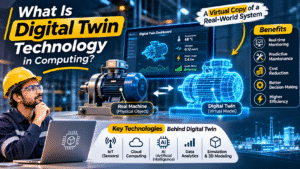
🧩 What Is Digital Twin Technology in Computing?
Technology is changing the way businesses design, monitor, and manage real-world systems. From factories and vehicles to buildings, machines, and even entire cities, organizations now have the ability to create digital representations of physical objects.
This concept is known as Digital Twin Technology. A digital twin connects a physical object or system with a virtual model that can be monitored and analyzed using real-world data. By combining sensors, cloud computing, Artificial Intelligence, IoT, and data analytics, digital twins can help organizations understand how physical systems behave and make better decisions. 🚀
🧠 What Is a Digital Twin?
A Digital Twin is a virtual representation of a physical object, machine, process, or system.
The digital model is connected to its physical counterpart through data. Sensors and connected devices can continuously collect information such as temperature, pressure, movement, speed, energy usage, or operating conditions.
That information can then be sent to the digital twin, allowing the virtual model to reflect what is happening in the real world.
In simple terms:
Physical Object → Sensors → Data → Digital Twin → Analysis → Better Decisions
This connection allows organizations to monitor real-world systems without depending only on physical inspections. 🔗
⚙️ How Does Digital Twin Technology Work?
A digital twin typically combines several technologies working together.
📡 1. Sensors and IoT Devices
Sensors installed on machines, vehicles, buildings, or other physical systems collect real-time information.
For example, sensors inside an industrial machine might measure temperature, vibration, pressure, and energy consumption.
☁️ 2. Data Collection and Cloud Computing
The collected data can be transferred to computing systems or cloud platforms where it can be stored and processed.
Cloud infrastructure can provide the computing power required to manage large amounts of real-time data.
🧠 3. Data Analytics and AI
Analytics tools and Artificial Intelligence can examine the incoming data to identify patterns, unusual behavior, or potential problems.
This can help organizations understand not only what is happening now but also what might happen in the future.
🖥️ 4. Virtual Model
The collected information is represented inside a digital model. This model can provide a real-time or near-real-time view of the physical system.
Depending on the application, the digital twin may include dashboards, 3D models, simulations, charts, and predictive analytics.
🏭 Digital Twins in Manufacturing
Manufacturing is one of the most important areas where Digital Twin Technology is being used.
Factories contain machines and production systems that need continuous monitoring. A digital twin can provide information about machine performance, production conditions, energy consumption, and potential failures.
Instead of waiting for a machine to stop working, engineers can analyze its digital representation and identify unusual patterns.
This can support predictive maintenance, helping companies plan maintenance before a major failure occurs. 🔧
🚗 Digital Twins in Automotive Technology
Digital twins can also be used in the automotive industry.
Engineers can create virtual models of vehicles, components, or manufacturing processes and use simulations to study how they behave under different conditions.
This can help teams test designs, analyze performance, and identify potential problems before making physical changes.
Connected vehicles can also generate large amounts of data that may be used to improve monitoring and maintenance systems.
🏙️ Digital Twins for Smart Cities
Digital Twin Technology is not limited to individual machines.
A city can also have a digital representation that combines information from traffic systems, buildings, roads, energy networks, environmental sensors, and public infrastructure.
A smart city digital twin can help authorities study traffic patterns, energy consumption, infrastructure conditions, and possible changes before implementing them in the real world.
This can make planning and resource management more data-driven. 🌆
🏢 Digital Twins in Buildings
Modern buildings can use sensors to monitor temperature, lighting, electricity consumption, air quality, occupancy, and equipment performance.
A digital twin can bring this information together in a single virtual environment.
Building managers can use the data to identify inefficient systems, improve energy usage, and monitor equipment conditions.
This can be particularly useful for large offices, hospitals, shopping centers, airports, and industrial facilities. 🏢
🤖 Digital Twins and Artificial Intelligence
Artificial Intelligence can make digital twins much more powerful.
A basic digital twin may show what is happening in a physical system. AI can analyze that information and help identify patterns or predict possible future conditions.
For example, an AI system could analyze machine vibration data and identify signs that a component may require maintenance.
AI can also be used with simulations to explore different scenarios and estimate how a system might respond.
This combination of Digital Twins + AI + IoT + Data Analytics is becoming an important area of modern computing. 🤖📊
🔮 Predictive Maintenance
One of the biggest advantages of digital twins is their ability to support predictive maintenance.
Traditional maintenance may follow a fixed schedule. A machine could be serviced after a certain number of operating hours, whether it actually needs maintenance or not.
With a digital twin, organizations can analyze real-time sensor data and machine behavior.
If the system detects unusual vibration, temperature changes, or performance patterns, engineers may be able to investigate the problem before it becomes a major failure.
This can help reduce unexpected downtime and improve maintenance planning. 🔧📈
🧪 Digital Twins and Simulation
Digital twins can also be used to simulate different scenarios.
For example, engineers could create a virtual model of a machine and test how it might perform under different temperatures, workloads, or operating conditions.
Testing these scenarios digitally can sometimes be faster, safer, and less expensive than experimenting directly with physical equipment.
This makes digital twins useful for product development, engineering, research, and optimization.
🔐 Are Digital Twins Secure?
Security is an important consideration because digital twins can process large amounts of information about physical systems.
A digital twin may receive data from sensors, connected devices, cloud platforms, and enterprise applications. If these systems are not properly secured, attackers could potentially gain access to sensitive information.
Organizations should therefore use strong authentication, encryption, access controls, secure APIs, monitoring, and regular software updates.
The more connected a digital twin becomes, the more important its cybersecurity architecture becomes. 🛡️
🌐 What Technologies Power Digital Twins?
Digital Twin Technology is not based on a single technology. It is usually a combination of several technologies working together.
Important technologies include:
- 📡 Internet of Things (IoT) – collects real-world data
- ☁️ Cloud Computing – stores and processes large datasets
- 🤖 Artificial Intelligence – analyzes patterns and predicts outcomes
- 📊 Data Analytics – turns raw data into useful insights
- 🧠 Machine Learning – helps systems learn from historical data
- 🥽 3D Visualization – creates interactive digital representations
- 🔗 Edge Computing – processes some data closer to the physical device
Together, these technologies create a connection between the physical and digital worlds.
🌟 Benefits of Digital Twin Technology
Digital twins can provide several benefits depending on the application.
🔍 Better Monitoring:
Organizations can get a clearer view of how physical systems are performing.
🔧 Predictive Maintenance:
Potential problems can be identified earlier using sensor data and analytics.
💰 Reduced Operational Costs:
Better monitoring and planning can help reduce unnecessary maintenance and downtime.
🧪 Safer Testing:
Organizations can simulate certain scenarios digitally before making changes to physical systems.
📈 Improved Decision-Making:
Real-time and historical data can support more informed decisions.
⚡ Greater Efficiency:
Businesses can identify inefficient processes and explore ways to improve performance.
🚀 What Is the Future of Digital Twin Technology?
Digital Twin Technology is becoming increasingly connected with AI, IoT, cloud computing, edge computing, and advanced analytics.
In the future, digital twins could become more intelligent and capable of analyzing complex systems with less human intervention.
Factories, vehicles, healthcare systems, energy networks, buildings, and cities could use increasingly sophisticated digital models to understand their physical environments.
The long-term goal is not simply to create a digital copy. It is to create a connected and intelligent digital representation that helps people understand, predict, and improve real-world systems.
📝 Final Thoughts
Digital Twin Technology creates a bridge between the physical and digital worlds.
By collecting real-time information from sensors and combining it with cloud computing, AI, data analytics, and simulation, organizations can build virtual models of machines, products, buildings, and complex systems.
The technology can help businesses monitor performance, predict potential failures, test ideas, and make better decisions.
As more physical objects become connected to the internet, digital twins could become an important part of the next generation of computing and smart technology. 🌐🚀
🧩 What Is Digital Twin Technology in Computing?
Aaj technology सिर्फ computers और smartphones तक सीमित नहीं है। अब machines, vehicles, buildings, factories और even entire cities को भी digital systems के साथ connect किया जा रहा है। इस बदलाव में Digital Twin Technology एक interesting और powerful concept बनकर सामने आई है।
Simple भाषा में कहें तो Digital Twin किसी real-world object या system का एक digital version या virtual representation होता है। यह virtual model real object से आने वाले data के साथ connected रह सकता है और उसकी condition, performance और behavior को समझने में मदद करता है। 🌐💻
🧠 Digital Twin क्या है?
Digital Twin एक physical object, machine, process या system का virtual representation होता है।
मान लीजिए किसी factory में एक बड़ी machine लगी हुई है। उस machine में अलग-अलग sensors लगाए गए हैं जो temperature, vibration, pressure, speed और energy consumption जैसी information collect करते हैं।
यह data एक digital model तक पहुंच सकता है। इस तरह digital model हमें यह समझने में मदद करता है कि real machine में इस समय क्या हो रहा है।
एक simple flow इस तरह समझ सकते हैं:
Physical Object → Sensors → Data → Digital Twin → Analysis → Better Decision
यानी Digital Twin सिर्फ एक 3D image नहीं है। यह real-world system के data के साथ connected एक intelligent digital representation हो सकता है। 🔗
⚙️ Digital Twin Technology कैसे काम करती है?
Digital Twin कई technologies को मिलाकर काम करती है। इसमें IoT, sensors, cloud computing, Artificial Intelligence और data analytics जैसी technologies important role निभाती हैं।
📡 1. Sensors और IoT
सबसे पहले physical object या machine से data collect किया जाता है।
Sensors temperature, pressure, vibration, movement, speed और energy usage जैसी information लगातार या समय-समय पर collect कर सकते हैं।
☁️ 2. Data Collection और Cloud Computing
Sensors से आने वाला data computing systems या cloud platforms तक भेजा जा सकता है।
Cloud computing बड़ी मात्रा में data को store और process करने के लिए computing resources provide कर सकती है।
🧠 3. AI और Data Analytics
Collected data को AI और analytics tools analyze कर सकते हैं।
यह system unusual patterns, performance issues या potential problems को identify करने में मदद कर सकता है।
🖥️ 4. Virtual Model
इस सारी information को एक digital model में represent किया जाता है।
यह model dashboard, charts, simulations या 3D visualization के रूप में दिखाई दे सकता है।
🏭 Manufacturing में Digital Twin
Manufacturing industry में Digital Twin Technology का काफी उपयोग हो सकता है।
एक factory में कई machines लगातार काम करती हैं। अगर किसी machine में अचानक problem आ जाए, तो production रुक सकता है और company को नुकसान हो सकता है।
Digital Twin machine से आने वाले sensor data को analyze करके unusual behavior identify करने में मदद कर सकता है।
उदाहरण के लिए अगर machine की vibration सामान्य से ज्यादा हो रही है, तो system engineers को संभावित problem के बारे में संकेत दे सकता है।
इस approach को Predictive Maintenance के साथ use किया जा सकता है। 🔧📊
🚗 Automotive Industry में Digital Twin
Cars और modern vehicles में आज बहुत सारे electronic systems और sensors होते हैं।
Digital Twin का इस्तेमाल vehicle components, manufacturing processes या complete vehicle systems के virtual models बनाने के लिए किया जा सकता है।
Engineers अलग-अलग conditions में virtual model को test कर सकते हैं और देख सकते हैं कि system कैसे behave कर सकता है।
इससे कुछ situations में physical testing से पहले problems identify करने और design को improve करने में मदद मिल सकती है। 🚗⚙️
🏙️ Smart Cities में Digital Twin
Digital Twin सिर्फ machines के लिए नहीं है। इसका इस्तेमाल Smart Cities में भी किया जा सकता है।
एक city का digital twin traffic, roads, buildings, energy systems, environmental sensors और public infrastructure से related data को एक virtual environment में combine कर सकता है।
उदाहरण के लिए authorities किसी नए road project या traffic change को implement करने से पहले उसके possible effects को digitally analyze कर सकती हैं।
इससे city planning को ज्यादा data-driven बनाने में मदद मिल सकती है। 🌆📊
🏢 Buildings में Digital Twin
Modern buildings में temperature, electricity usage, air quality, lighting और occupancy जैसी information को sensors के जरिए collect किया जा सकता है।
Digital Twin इस data को एक जगह combine करके building की overall performance समझने में मदद कर सकता है।
इससे building managers को energy consumption कम करने, equipment monitor करने और maintenance planning में मदद मिल सकती है।
Large offices, hospitals, airports और shopping centers जैसे बड़े buildings में यह technology काफी useful हो सकती है। 🏢💡
🤖 Digital Twin और Artificial Intelligence
Digital Twin को और ज्यादा powerful बनाने में Artificial Intelligence important role निभा सकती है।
एक basic digital twin यह दिखा सकता है कि अभी physical system में क्या हो रहा है। लेकिन AI historical और real-time data को analyze करके possible future conditions के बारे में insights देने में मदद कर सकती है।
उदाहरण के लिए किसी machine में vibration लगातार बढ़ रही है, तो AI उस pattern को analyze करके यह संकेत दे सकती है कि machine के किसी component को inspection या maintenance की जरूरत पड़ सकती है।
यानी:
Digital Twin + IoT + AI + Data Analytics = Smarter Monitoring 🤖📈
🔮 Predictive Maintenance क्या है?
Traditional maintenance में अक्सर machines की servicing एक fixed schedule के हिसाब से की जाती है।
लेकिन हर machine को एक ही समय पर maintenance की जरूरत हो, यह जरूरी नहीं है।
Digital Twin real-time sensor data और machine behavior को analyze करने में मदद कर सकता है। अगर system को किसी unusual pattern का पता चलता है, तो engineers पहले से जांच कर सकते हैं।
इससे unexpected breakdown और unnecessary downtime को कम करने में मदद मिल सकती है। 🔧⚡
🧪 Digital Twin और Simulation
Digital Twin का एक बड़ा फायदा simulation भी है।
मान लीजिए engineers किसी machine का नया design test करना चाहते हैं। हर बार physical prototype बनाकर testing करना expensive और time-consuming हो सकता है।
Digital model के जरिए कुछ conditions को virtual environment में test किया जा सकता है।
Engineers अलग temperature, workload या operating conditions में system का behavior analyze कर सकते हैं।
इससे design और decision-making process को बेहतर बनाने में मदद मिल सकती है। 🧪💻
🔐 क्या Digital Twin Secure है?
Digital Twin में बहुत सारी important information शामिल हो सकती है। इसमें machines, buildings, business operations और connected devices का data शामिल हो सकता है।
इसलिए security बहुत जरूरी है।
Organizations को strong authentication, encryption, access control, secure APIs, monitoring और regular software updates जैसी security practices अपनानी चाहिए।
अगर Digital Twin कई IoT devices और cloud systems से connected है, तो उसका cybersecurity architecture और भी important हो जाता है। 🛡️
🌐 Digital Twin में कौन-कौन सी Technologies Use होती हैं?
Digital Twin किसी एक technology पर depend नहीं करता। यह कई technologies का combination हो सकता है।
- 📡 IoT – physical objects से data collect करने के लिए
- ☁️ Cloud Computing – data store और process करने के लिए
- 🤖 Artificial Intelligence – patterns और predictions के लिए
- 📊 Data Analytics – raw data को useful information में बदलने के लिए
- 🧠 Machine Learning – data से patterns सीखने के लिए
- 🥽 3D Visualization – digital models को visually represent करने के लिए
- ⚡ Edge Computing – data को device के करीब process करने के लिए
इन technologies की मदद से physical और digital world के बीच एक strong connection बनाया जा सकता है।
🌟 Digital Twin Technology के फायदे
Digital Twin अलग-अलग industries को कई तरह के benefits दे सकता है।
🔍 Better Monitoring
Real-time या near-real-time data के जरिए physical system की condition को समझना आसान हो सकता है।
🔧 Predictive Maintenance
Potential problems को पहले identify करने में मदद मिल सकती है।
💰 Cost Reduction
Downtime और unnecessary maintenance को कम करने में मदद मिल सकती है।
🧪 Safer Testing
कुछ scenarios को पहले virtual environment में test किया जा सकता है।
📈 Better Decision-Making
Real-time और historical data के आधार पर बेहतर decisions लिए जा सकते हैं।
⚡ Improved Efficiency
Organizations inefficient processes को identify करके उन्हें improve कर सकती हैं।
🚀 Digital Twin का Future क्या है?
आने वाले समय में Digital Twin का connection AI, IoT, Cloud Computing, Edge Computing और Advanced Analytics के साथ और मजबूत हो सकता है।
Future में factories, vehicles, hospitals, buildings, energy networks और smart cities के increasingly intelligent digital models देखने को मिल सकते हैं।
AI इन digital twins को सिर्फ monitoring तक सीमित रखने के बजाय prediction और optimization में भी ज्यादा useful बना सकती है।
इसका ultimate goal सिर्फ किसी physical object की digital copy बनाना नहीं है। बल्कि ऐसा connected और intelligent digital model बनाना है जो real-world system को समझने, predict करने और improve करने में मदद करे। 🚀
📝 Final Thoughts
Digital Twin Technology physical और digital world के बीच एक bridge की तरह काम करती है।
Sensors और IoT से real-world data collect किया जा सकता है, cloud systems उसे process कर सकते हैं और AI तथा analytics उस data से useful insights निकालने में मदद कर सकते हैं।
Simple शब्दों में:
Physical World → Data → Digital Twin → Analysis → Better Decisions
जैसे-जैसे machines और devices ज्यादा connected होते जा रहे हैं, Digital Twin Technology का importance भी बढ़ सकता है।
Future में यह technology manufacturing, healthcare, automotive, smart cities, energy, construction और कई दूसरे sectors में monitoring, prediction और decision-making को एक नया direction दे सकती है। 🌐🤖