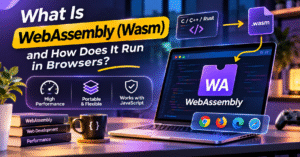
🌐 What Is WebAssembly (Wasm) and How Does It Run in Browsers?
Modern websites are no longer limited to displaying text, images, and simple forms. Today, web applications can run games, process images and videos, handle complex calculations, edit documents, and even perform certain AI tasks directly inside a browser.
However, some of these workloads require more computational performance than typical JavaScript code can efficiently provide. This is where WebAssembly (Wasm) becomes useful.
WebAssembly is a compact, low-level binary instruction format designed to run efficiently in modern web browsers. It allows developers to bring performance-focused code to the web and build applications that can perform complex tasks directly in the browser. ⚡💻
🧠 What Is WebAssembly?
WebAssembly, commonly called Wasm, is a portable binary instruction format designed for safe and efficient execution.
In simple terms, WebAssembly provides a way to run code compiled from languages such as C, C++, and Rust inside a web browser.
WebAssembly is not designed to replace JavaScript. Instead, it works alongside JavaScript.
Developers can use JavaScript for user interfaces, browser APIs, and application logic while using WebAssembly for computationally intensive tasks.
This combination allows developers to build powerful and interactive web applications. 🌐
⚙️ How Does WebAssembly Work?
The WebAssembly workflow starts with source code written in a supported programming language.
The code is then compiled into a WebAssembly module, commonly represented as a .wasm file.
When a user opens a web application, the browser downloads the WebAssembly module, validates it, and executes it using its built-in WebAssembly engine.
A simplified workflow looks like this:
Source Code → Compiler → WebAssembly (.wasm) → Browser → Wasm Engine → Output
This process allows computationally intensive code to run directly on the user’s device through the browser. 🚀
🌐 How Does WebAssembly Run in a Browser?
Modern browsers such as Chrome, Firefox, Edge, and Safari include WebAssembly support.
When the browser receives a WebAssembly module, it processes the binary code and executes it inside a controlled environment.
WebAssembly can also communicate with JavaScript. This allows developers to create applications where JavaScript manages the interface and WebAssembly handles specific performance-heavy operations.
For example:
JavaScript → User Interface and Application Logic
WebAssembly → Heavy Computation
This combination can be especially useful for applications that need both flexibility and performance. 💻⚡
🚀 Why Is WebAssembly Fast?
One of the main reasons developers use WebAssembly is performance.
JavaScript engines have become extremely fast, but some applications involve workloads that require large amounts of computation. WebAssembly provides a compact binary format and a low-level execution model that browsers can process efficiently.
This can make WebAssembly useful for tasks such as image processing, gaming, scientific calculations, and other performance-sensitive workloads.
However, WebAssembly is not automatically faster than JavaScript in every situation. Actual performance depends on the application, algorithm, browser, workload, and how the code is implemented.
🎮 Where Is WebAssembly Used?
WebAssembly can be useful in many types of modern applications.
🎮 Browser Gaming
WebAssembly can help developers run complex game engines and computationally demanding game logic directly inside browsers.
🎨 Image and Video Processing
Tasks such as image manipulation, compression, filtering, and certain video-processing operations can benefit from WebAssembly.
🤖 AI and Machine Learning
Some machine-learning and numerical workloads can be executed locally in the browser using WebAssembly, reducing the need to send every computation to a remote server.
🧮 Data Processing
WebAssembly can handle computationally intensive calculations and data-processing operations directly on the user’s device.
🧊 3D Applications
Interactive 3D applications can use WebAssembly for performance-heavy calculations that support rich visual experiences.
🔗 WebAssembly vs JavaScript
WebAssembly and JavaScript should not be viewed as direct competitors.
JavaScript is widely used for user interfaces, event handling, API communication, browser features, and general application logic.
WebAssembly is particularly useful when an application needs high-performance computation.
A modern application can use both technologies together.
For example:
JavaScript → UI, Events, APIs, Application Logic
WebAssembly → Complex Calculations and Performance-Heavy Tasks
This approach allows developers to use the strengths of both technologies. 🔥
👨💻 Which Programming Languages Can Be Used With WebAssembly?
Developers do not normally write large WebAssembly applications directly in raw Wasm instructions.
Instead, they can use programming languages and tools that compile code into WebAssembly.
Some popular options include:
- 🦀 Rust
- ⚙️ C
- 💻 C++
- 🔷 Other languages and tools with WebAssembly compilation support
Rust has become particularly popular in the WebAssembly ecosystem because it combines performance with strong memory-safety features.
🔐 Is WebAssembly Secure?
WebAssembly was designed with browser security in mind. WebAssembly modules run within the browser’s security and sandboxing environment.
This helps prevent WebAssembly code from freely accessing the underlying system.
However, WebAssembly does not automatically make an application completely secure.
Developers still need to follow good security practices such as input validation, secure authentication, proper authorization, safe memory handling, and regular updates.
Security depends on the complete application, not just the technology used to run it. 🛡️
📦 One Major Advantage: Portability
Another important feature of WebAssembly is portability.
A WebAssembly module can run across different browsers and operating systems when the required environment and APIs are available.
This can reduce the need to create completely different versions of performance-critical code for every platform.
Because of this portability, WebAssembly is becoming interesting not only for browsers but also for other computing environments.
🌍 Is WebAssembly Only for Browsers?
WebAssembly was originally created with the web in mind, but its potential has expanded beyond browsers.
Today, WebAssembly is also being explored for server-side applications, edge computing, plugins, cloud workloads, and other environments.
Its combination of portability, performance, and sandboxing makes it useful for applications that need a controlled way to execute compiled code.
This means WebAssembly is gradually becoming more than just a browser technology.
🔮 What Is the Future of WebAssembly?
Web applications are becoming increasingly powerful. Users now expect browser-based software to provide experiences that were once limited to desktop applications.
WebAssembly can help developers bring more computationally demanding workloads to the web without requiring users to install traditional desktop software.
Future applications of WebAssembly could include gaming, AI, image processing, developer tools, cloud applications, edge computing, and advanced interactive web experiences.
Its ability to combine performance, portability, and web compatibility makes it an important technology to watch. 🚀
📝 Final Thoughts
WebAssembly (Wasm) is a modern technology that allows high-performance code to run efficiently inside web browsers.
It is not a replacement for JavaScript. Instead, WebAssembly works alongside JavaScript to handle tasks where additional computational performance may be useful.
In simple terms:
JavaScript helps control the web application, while WebAssembly provides an efficient way to run performance-intensive code.
As web applications continue to become more powerful and capable, WebAssembly could play an increasingly important role in bringing near-native performance and advanced computing capabilities to the browser. 🌐⚡
🌐 What Is WebAssembly (Wasm) and How Does It Run in Browsers?
Aaj websites aur web applications सिर्फ simple pages दिखाने तक limited नहीं हैं। Modern browsers में हम video editing, gaming, image processing, 3D graphics, data analysis और even complex software जैसी चीजें directly browser में चला सकते हैं। लेकिन इतने complex कामों के लिए केवल JavaScript ही हमेशा enough नहीं होता।
यहीं पर WebAssembly, जिसे short में Wasm कहा जाता है, important हो जाता है। WebAssembly एक low-level, compact और fast binary format है जिसे modern web browsers efficiently run कर सकते हैं। इसका main purpose web applications को near-native performance के साथ complex tasks perform करने में मदद करना है। ⚡💻
🧠 WebAssembly क्या है?
WebAssembly (Wasm) एक portable binary instruction format है जिसे browsers में efficiently execute करने के लिए design किया गया है।
Simple भाषा में समझें तो WebAssembly एक ऐसा तरीका है जिससे developers C, C++, Rust जैसी languages में लिखे code को browser में run करने के लिए compile कर सकते हैं।
WebAssembly JavaScript को replace करने के लिए नहीं बनाया गया है। बल्कि यह JavaScript के साथ काम करता है और उन tasks को handle करने में useful हो सकता है जिनमें ज्यादा processing power की जरूरत होती है।
इसलिए modern web application में JavaScript और WebAssembly दोनों साथ-साथ काम कर सकते हैं। 🌐
⚙️ WebAssembly कैसे काम करता है?
WebAssembly का working process थोड़ा अलग है। Developer पहले किसी supported programming language में application या performance-critical code लिखता है।
इसके बाद उस code को WebAssembly के binary format (.wasm) में compile किया जाता है।
जब user browser में web application open करता है, browser WebAssembly module को load करता है और उसका code अपने WebAssembly runtime में execute करता है।
एक simple flow इस तरह समझ सकते हैं:
Source Code → Compiler → WebAssembly (.wasm) → Browser → WebAssembly Runtime → Output
इस process की वजह से browser complex calculations और performance-intensive operations efficiently perform कर सकता है। 🚀
🌐 Browser में WebAssembly कैसे Run होता है?
Modern browsers में WebAssembly के लिए built-in support available है। जब browser को .wasm module मिलता है, तो browser उसे load और validate करता है।
इसके बाद WebAssembly instructions को browser का WebAssembly engine execute करता है।
Chrome, Firefox, Edge और Safari जैसे major browsers WebAssembly को support करते हैं।
Browser WebAssembly code को JavaScript environment के साथ integrate भी कर सकता है। इसका मतलब developer एक ही application में JavaScript का use user interface और application logic के लिए कर सकता है, जबकि WebAssembly को heavy computation के लिए use किया जा सकता है। 💻⚡
🚀 WebAssembly इतना Fast क्यों है?
WebAssembly का सबसे बड़ा फायदा इसकी performance है।
JavaScript modern browsers में काफी fast हो चुकी है, लेकिन कुछ heavy computational tasks के लिए WebAssembly useful हो सकता है।
WebAssembly एक compact binary format use करता है और इसका instruction set machine execution के लिए relatively close होता है। Browser इसे efficiently process कर सकता है।
इसी वजह से WebAssembly को खासकर उन applications में use किया जाता है जहां performance important होती है।
हालांकि यह समझना जरूरी है कि WebAssembly हर situation में JavaScript से automatically faster नहीं होता। Performance application, code, browser और workload पर depend करती है।
🎮 WebAssembly का इस्तेमाल कहाँ होता है?
WebAssembly का use कई तरह के modern web applications में किया जा सकता है।
🎮 Browser Gaming
Complex games को browser में run करने के लिए WebAssembly useful हो सकता है। Game engines और performance-heavy calculations को browser में efficiently execute किया जा सकता है।
🎨 Image और Video Processing
Image filters, compression, video processing और अन्य computational tasks के लिए WebAssembly का इस्तेमाल किया जा सकता है।
🧠 AI और Machine Learning
कुछ machine-learning workloads और numerical computations को browser में run करने के लिए WebAssembly useful हो सकता है, खासकर जब local processing की जरूरत हो।
🧮 Data Processing
Large calculations और computationally intensive data operations को browser में efficiently perform करने के लिए Wasm का उपयोग किया जा सकता है।
🧊 3D Graphics
3D applications और interactive visual experiences में WebAssembly performance improve करने में मदद कर सकता है, खासकर जब application को heavy computational logic execute करना हो।
🔗 WebAssembly और JavaScript में क्या Difference है?
WebAssembly और JavaScript competitors नहीं हैं। दोनों का role अलग हो सकता है।
JavaScript web development में user interface, events, API communication और application logic के लिए बहुत widely used है।
WebAssembly performance-intensive tasks के लिए useful हो सकता है, जहां low-level execution और computational efficiency important हो।
एक modern web application दोनों को combine कर सकती है।
उदाहरण के लिए:
JavaScript → UI और User Interaction
WebAssembly → Heavy Computation
इस combination से developers powerful और interactive web applications create कर सकते हैं। 🔥
👨💻 कौन-कौन सी Languages WebAssembly के लिए Use हो सकती हैं?
WebAssembly को directly लिखना possible है, लेकिन developers आमतौर पर higher-level languages का use करते हैं और फिर उन्हें WebAssembly में compile करते हैं।
Popular options में शामिल हैं:
- 🦀 Rust
- ⚙️ C
- 💻 C++
- 🔷 अन्य languages और tools जो WebAssembly compilation support करते हैं
Rust को WebAssembly ecosystem में काफी attention मिला है क्योंकि यह performance और memory safety दोनों पर focus करता है।
🔐 क्या WebAssembly Secure है?
WebAssembly को browsers में security को ध्यान में रखकर design किया गया है। WebAssembly modules browser के security model और sandboxing mechanisms के अंदर run होते हैं।
इसका मतलब यह नहीं है कि WebAssembly applications automatically 100% secure होती हैं।
Developers को फिर भी secure coding practices, proper input validation, authentication और safe application architecture follow करनी चाहिए।
Security हमेशा पूरे application पर depend करती है, केवल technology पर नहीं। 🛡️
📦 WebAssembly का एक बड़ा फायदा — Portability
WebAssembly का एक important feature इसकी portability है।
एक properly compiled WebAssembly module अलग-अलग systems और browsers पर run किया जा सकता है, provided कि required environment और APIs available हों।
इससे developers को कुछ situations में platform-specific code पर कम depend रहना पड़ सकता है।
इसी portability की वजह से WebAssembly का use सिर्फ traditional browser applications तक limited नहीं रहा है। इसका ecosystem server-side और other computing environments की तरफ भी expand हो रहा है।
🌍 क्या WebAssembly सिर्फ Browsers के लिए है?
शुरुआत में WebAssembly का सबसे बड़ा focus web browsers था, लेकिन आज इसका use browser के बाहर भी explore किया जा रहा है।
WebAssembly की portability और sandboxing characteristics इसे servers, edge computing, plugins और अन्य environments के लिए भी interesting बनाती हैं।
इसका मतलब WebAssembly धीरे-धीरे केवल web technology न रहकर एक broader portable execution technology के रूप में भी देखा जा रहा है।
🔮 WebAssembly का Future
जैसे-जैसे web applications ज्यादा powerful और complex हो रही हैं, browser में high-performance computing की जरूरत भी बढ़ रही है।
WebAssembly developers को browser के अंदर computationally demanding workloads run करने का एक additional option देता है।
Future में gaming, AI, image processing, developer tools, cloud applications, edge computing और interactive web experiences जैसे areas में WebAssembly का use और बढ़ सकता है।
इसकी सबसे interesting बात यह है कि यह web development में performance और portability के बीच एक नया रास्ता provide करता है। 🚀
📝 Final Thoughts
WebAssembly (Wasm) एक modern technology है जो browsers में high-performance code execute करने की सुविधा देती है।
यह JavaScript का replacement नहीं है। बल्कि JavaScript के साथ मिलकर काम करते हुए WebAssembly उन tasks को handle कर सकता है जहां ज्यादा computational performance की जरूरत होती है।
Simple शब्दों में कहें तो:
JavaScript web application को control करने में मदद करता है, जबकि WebAssembly heavy computing को efficiently handle करने का option देता है।
जैसे-जैसे web applications desktop और native software जैसी capabilities की तरफ बढ़ रही हैं, WebAssembly का role भी increasingly important हो सकता है। 🌐⚡