🔍 Unsupervised Learning: How Machines Discover Hidden Patterns
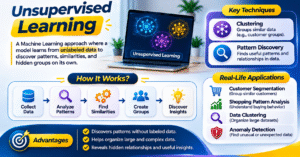
Unsupervised Learning is an important approach in Machine Learning where a computer learns from data without predefined labels or correct answers.
In simple terms, the system receives data and tries to discover patterns, similarities, relationships, and hidden groups on its own.
Think about a large collection of objects placed in front of you without any instructions. You may naturally group similar objects together based on their characteristics. Unsupervised Learning works in a similar way—it analyzes data and looks for meaningful structures.
🧠 How Does Unsupervised Learning Work?
The basic process can be understood as:
📊 Collect Data → 🔎 Analyze Patterns → 🧩 Find Similarities → 👥 Create Groups → 💡 Discover Insights
Unlike Supervised Learning, the model is not given the correct answer during training. Instead, algorithms examine the data and identify relationships or structures within it.
👥 What Is Clustering?
Clustering is one of the most common techniques used in Unsupervised Learning. It groups data points that have similar characteristics.
🛒 For example, an e-commerce company can analyze customer behavior and automatically group customers with similar shopping habits.
These groups can help businesses understand their customers and create more personalized strategies.
🔍 Common Applications of Unsupervised Learning
Unsupervised Learning can be useful in many real-world situations.
👥 Customer Segmentation: Grouping customers based on similar behaviors or preferences.
🛒 Shopping Pattern Analysis: Discovering patterns in purchasing behavior.
📊 Data Clustering: Organizing large datasets into meaningful groups.
🔎 Pattern Discovery: Finding hidden relationships within complex datasets.
🛡️ Anomaly Detection: Helping identify unusual or unexpected patterns in data.
🌍 Real-World Example
Imagine an online shopping platform has information about thousands of customers, but none of them have been assigned to specific groups.
An Unsupervised Learning algorithm can analyze their activities and discover groups based on similarities.
For example:
🛍️ Group 1: Frequent shoppers
💻 Group 2: Electronics-focused shoppers
👗 Group 3: Fashion-focused shoppers
📅 Group 4: Occasional shoppers
These groups can help businesses better understand customer behavior and make more informed decisions.
⚡ Advantages of Unsupervised Learning
✅ Can discover patterns without labeled data.
✅ Helps organize large datasets into meaningful groups.
✅ Can reveal hidden relationships and customer behavior.
✅ Useful for data exploration and discovering new insights.
However, interpreting the results can sometimes be challenging because there is no predefined correct answer to compare against.
💡 Final Thoughts
The main idea behind Unsupervised Learning is to discover structure within data without being given predefined answers.
While Supervised Learning learns from labeled examples, Unsupervised Learning explores data independently to find patterns, similarities, relationships, and groups.
🚀 When the answers are hidden inside the data, Unsupervised Learning can help bring those patterns to the surface.
🔍 Unsupervised Learning: Machines बिना Labels के Data से कैसे सीखती हैं?
Unsupervised Learning Machine Learning की एक important approach है, जिसमें computer को ऐसे data से सीखने के लिए train किया जाता है जिसमें पहले से कोई labels या correct answers मौजूद नहीं होते।
Simple words में, machine को सिर्फ data दिया जाता है और system खुद उसमें मौजूद patterns, similarities और hidden groups को identify करने की कोशिश करता है।
इसे ऐसे समझें जैसे आपके सामने अलग-अलग रंग, आकार और features वाली बहुत सारी चीज़ें रखी हों। आपको कोई instruction नहीं दिया गया, फिर भी आप similarities देखकर उन्हें अलग-अलग groups में organize कर सकते हैं। Unsupervised Learning भी कुछ इसी तरह data को समझने की कोशिश करती है।
🧠 Unsupervised Learning कैसे काम करती है?
इसका basic process कुछ इस तरह समझा जा सकता है:
📊 Collect Data → 🔎 Analyze Patterns → 🧩 Find Similarities → 👥 Create Groups → 💡 Discover Insights
यहाँ model को यह नहीं बताया जाता कि सही answer क्या है। Instead, algorithm data के अंदर मौजूद relationships और patterns को खुद discover करता है।
👥 Clustering क्या है?
Unsupervised Learning में Clustering एक popular technique है। इसमें similar data points को एक ही group या cluster में रखा जाता है।
🛒 उदाहरण के लिए, एक e-commerce company अपने customers के shopping behavior को analyze कर सकती है। System ऐसे customers को एक group में रख सकता है जिनकी shopping habits similar हैं।
इससे business को customers को बेहतर तरीके से समझने और personalized strategies बनाने में मदद मिल सकती है।
🔍 Unsupervised Learning के Common Applications
Unsupervised Learning का इस्तेमाल कई real-world situations में किया जाता है।
👥 Customer Segmentation: Similar behavior वाले customers के groups बनाना।
🛒 Shopping Pattern Analysis: Customers की purchasing habits में patterns ढूँढना।
📊 Data Clustering: Large datasets को meaningful groups में organize करना।
🔎 Pattern Discovery: ऐसे hidden relationships identify करना जो manually दिखाई नहीं देते।
🛡️ Anomaly Detection: Data में unusual या अलग behavior को identify करने में मदद करना।
🌍 Real-Life Example
मान लीजिए एक online shopping platform के पास हजारों customers का data है, लेकिन customers को किसी category में पहले से divide नहीं किया गया है।
Unsupervised Learning algorithm customer activity को analyze करके अलग-अलग groups discover कर सकता है।
उदाहरण के लिए:
🛍️ Group 1: Frequently shopping customers
💻 Group 2: Mostly electronics buyers
👗 Group 3: Fashion-focused customers
📅 Group 4: Occasional shoppers
इन groups की मदद से business customer behavior को बेहतर समझ सकता है।
⚡ Unsupervised Learning के फायदे
✅ बिना labeled data के patterns discover कर सकती है।
✅ Large datasets को meaningful groups में organize करने में मदद करती है।
✅ Hidden relationships और customer behavior समझने में useful है।
✅ Data exploration और business insights के लिए powerful approach हो सकती है।
हालाँकि, इसके results को interpret करना कभी-कभी challenging हो सकता है क्योंकि model को पहले से कोई correct answer नहीं दिया जाता।
💡 Final Thoughts
Unsupervised Learning का main idea है—data को बिना predefined answers के समझना।
जहाँ Supervised Learning में machine को बताया जाता है कि सही answer क्या है, वहीं Unsupervised Learning में machine खुद patterns, similarities और groups discover करने की कोशिश करती है।
🚀 जब data में answers छिपे हों, Unsupervised Learning उन hidden patterns को सामने लाने में मदद कर सकती है।