🎯 Supervised Learning: How Machines Learn from Labeled Data
Supervised Learning is one of the most widely used approaches in Machine Learning. It allows a computer system to learn from labeled data, where the correct answer or expected output is already known.
Think of it like teaching a student with a set of solved examples. The student studies those examples, understands the patterns, and then tries to solve new questions. In a similar way, a supervised learning model learns from existing data and uses that knowledge to make predictions on new information.
🧠 How Does Supervised Learning Work?
The process usually follows a few important steps:
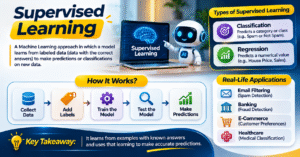
📊 Collect Data → 🏷️ Add Labels → 🧠 Train the Model → 🔍 Test the Model → 📈 Make Predictions
During training, the model compares its predictions with the known answers. It then adjusts itself to reduce errors and improve its performance.
For example, imagine training a model to identify spam emails. The system can be given thousands of emails already labeled as “Spam” or “Not Spam.” By studying these examples, it can learn patterns that help classify new emails.
🔢 Main Types of Supervised Learning
Supervised Learning is commonly used for two major types of tasks.
1. Classification
Classification is used when the output belongs to a specific category.
📧 Spam or Not Spam
🩺 Positive or Negative Diagnosis
💳 Fraudulent or Genuine Transaction
📱 Relevant or Irrelevant Message
The model learns from labeled examples and assigns new data to one of the predefined categories.
2. Regression
Regression is used when the goal is to predict a numerical value.
🏠 House Price Prediction
📈 Sales Forecasting
🌡️ Temperature Prediction
💰 Revenue Estimation
For example, a regression model can analyze previous house prices, locations, sizes, and other factors to estimate the price of a new property.
🌍 Real-World Applications
Supervised Learning is already being used in many areas of our daily lives.
📧 Email Filtering: Identifying spam and unwanted messages.
🏦 Banking: Detecting potentially fraudulent transactions.
🛒 E-Commerce: Predicting customer preferences and product demand.
🏥 Healthcare: Supporting the classification and analysis of medical information.
📊 Business: Forecasting sales and analyzing customer behavior.
🚗 Transportation: Supporting systems that classify objects and predict certain outcomes.
⚡ Advantages of Supervised Learning
Supervised Learning offers several useful benefits:
✅ Can make accurate predictions when trained with quality data.
✅ Works well for classification and numerical prediction tasks.
✅ Performance can be measured using known outcomes.
✅ Useful across many industries and applications.
However, its effectiveness depends heavily on the quality, quantity, and relevance of the training data. Poor or biased data can lead to unreliable predictions.
💡 Final Thoughts
Supervised Learning is essentially about learning from examples where the correct answers are already available.
By studying labeled data, a Machine Learning model can discover useful patterns and apply them to new situations. From spam detection and fraud prevention to sales forecasting and recommendation systems, Supervised Learning plays an important role in modern AI.
🚀 Give a machine the right examples, and it can learn patterns that help turn data into useful predictions.
🎯 Supervised Learning: Machines Labeled Data से कैसे सीखती हैं?
Supervised Learning Machine Learning की सबसे commonly used approaches में से एक है। इसमें computer को ऐसे labeled data से train किया जाता है, जहाँ हर example के साथ उसका सही answer या output पहले से दिया होता है।
इसे एक simple example से समझें। जैसे एक teacher student को solved questions दिखाकर सिखाता है, उसी तरह Supervised Learning में machine को पहले से दिए गए examples से सीखने का मौका मिलता है। फिर machine अपनी learning का इस्तेमाल नए data पर prediction करने के लिए करती है।
🧠 Supervised Learning कैसे काम करती है?
इसका basic process कुछ इस तरह समझा जा सकता है:
📊 Data Collect करें → 🏷️ Labels Add करें → 🧠 Model Train करें → 🔍 Test करें → 📈 Prediction करें
Training के दौरान model अपनी prediction को known answer से compare करता है। अगर prediction गलत होती है, तो model अपने parameters को adjust करने की कोशिश करता है ताकि future predictions बेहतर हो सकें।
📧 उदाहरण के लिए, अगर किसी email system को हजारों emails दिए जाएँ और हर email को “Spam” या “Not Spam” label किया जाए, तो model इन examples से patterns सीख सकता है और नए emails को classify करने में मदद कर सकता है।
🔢 Supervised Learning के मुख्य Types
Supervised Learning को मुख्य रूप से दो categories में समझा जाता है:
1. 📂 Classification
Classification का इस्तेमाल तब किया जाता है जब output किसी specific category या class में आता है।
उदाहरण:
📧 Spam या Not Spam
💳 Fraud या Genuine Transaction
🩺 Positive या Negative Result
📱 Relevant या Irrelevant Message
Model labeled examples से सीखता है और नए data को available categories में classify करता है।
2. 📈 Regression
Regression का इस्तेमाल तब किया जाता है जब हमें किसी numerical value का prediction करना हो।
उदाहरण:
🏠 House Price Prediction
📊 Sales Forecasting
🌡️ Temperature Prediction
💰 Revenue Estimation
मान लीजिए model को पुराने घरों की price, location, size और दूसरे factors का data दिया गया है। इन patterns को देखकर model नए घर की estimated price predict करने में मदद कर सकता है।
🌍 Supervised Learning के Real-Life Applications
Supervised Learning आज कई industries और everyday technologies में इस्तेमाल हो रही है।
📧 Email Filtering: Spam और unwanted emails को identify करने में मदद।
🏦 Banking: Suspicious या potentially fraudulent transactions को detect करने में support।
🛒 E-Commerce: Customer preferences और product demand को predict करने में मदद।
🏥 Healthcare: Medical information की classification और analysis में assistance।
📊 Business: Sales forecasting और customer behavior analysis में उपयोग।
🚗 Transportation: Objects और different situations को classify करने वाले intelligent systems में support।
⚡ Supervised Learning के फायदे
Supervised Learning के कई important advantages हैं:
✅ Quality data मिलने पर accurate predictions दे सकती है।
✅ Classification और numerical prediction दोनों के लिए useful है।
✅ Known answers के साथ model की performance measure की जा सकती है।
✅ Healthcare, Banking, Business और E-Commerce जैसी कई industries में इसका उपयोग होता है।
लेकिन एक important बात याद रखना जरूरी है—model की performance काफी हद तक training data की quality पर depend करती है। अगर data गलत, incomplete या biased है, तो predictions भी प्रभावित हो सकती हैं।
💡 Final Thoughts
Simple words में, Supervised Learning का मतलब है machines को ऐसे examples से सीखाना जिनके सही answers पहले से मौजूद हों।
Machine labeled data में patterns identify करती है और फिर उसी learning का इस्तेमाल नए data पर predictions या classifications करने के लिए करती है।
🚀 सही examples और quality data के साथ Machine Learning data को useful predictions में बदलने की powerful capability रखती है।