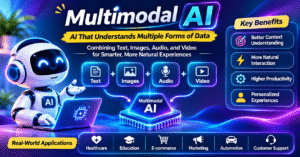
🧠 Multimodal AI: When AI Understands More Than Just Text
🚀 Combining Text, Images, Audio, and Video for Smarter AI Experiences
Artificial Intelligence is evolving rapidly. Earlier AI systems were often designed to work mainly with text or structured data. Today, AI is moving toward a more advanced approach—understanding and combining different types of information.
This is where Multimodal AI comes in.
Multimodal AI can work with multiple forms of input, such as text, images, audio, video, and other data formats, helping AI systems build a richer understanding of a situation.
🧩 What Is Multimodal AI?
In simple terms, Multimodal AI is a type of Artificial Intelligence that can process and understand more than one form of data.
For example, a multimodal system may be able to:
- 📝 Understand written text
- 🖼️ Analyse images
- 🎙️ Process spoken language and audio
- 🎥 Understand video content
- 📊 Combine different information sources
Instead of looking at information from only one perspective, the AI can combine multiple inputs to understand the broader context.
🔍 How Does Multimodal AI Work?
Multimodal AI processes different data formats and combines the information into a unified understanding.
📝 Text Understanding
AI can analyse documents, instructions, questions, conversations, and written content.
👁️ Image Understanding
AI can identify objects, text, patterns, and visual details within images.
🎙️ Audio Processing
AI can process speech, conversations, and other audio information to extract useful meaning.
🎥 Video Understanding
AI can analyse video content to identify activities, events, and changes over time.
🔗 Information Fusion
One of the most important capabilities is combining information from different modalities.
For example, a user could upload a product image and ask, “What can you tell me about this product?”
The AI can use both the image and the question to create a more relevant response.
🌟 Benefits of Multimodal AI
🧠 Better Context Understanding
Multiple forms of information can provide AI with a more complete picture of a situation.
💬 More Natural Interaction
Humans naturally communicate through text, voice, images, gestures, and visual context. Multimodal AI can make interactions feel more natural by supporting different types of inputs.
⚡ Faster Information Processing
Combining different data formats in a single workflow can help organisations process information more efficiently.
🎯 Personalised Experiences
By understanding multiple inputs, AI can potentially provide more relevant and personalised assistance.
🏢 Where Can Multimodal AI Be Used?
🏥 Healthcare
Multimodal systems can support professionals by analysing medical images alongside patient information and clinical notes.
🎓 Education
Students can interact with AI using text, images, voice, and video, creating more flexible learning experiences.
🛒 E-commerce
Customers can upload product images and ask questions to receive more relevant product information and assistance.
📢 Marketing
Businesses can analyse customer feedback, images, videos, and written content to discover useful marketing insights.
🚗 Automotive
Vehicles can combine information from cameras, sensors, and voice interfaces to support smarter driving and assistance systems.
💻 Customer Support
AI can potentially analyse a customer’s message, voice description, and uploaded image together to provide more useful support.
🤖 Multimodal AI vs. Traditional AI
Traditional AI systems often focus on a specific type of input.
Multimodal AI takes a broader approach.
Traditional AI:
Text → Understanding → Response
Multimodal AI:
Text + Image + Audio + Video → Combined Understanding → Intelligent Response
This ability to connect different forms of information makes Multimodal AI useful for many modern applications.
⚠️ Challenges of Multimodal AI
Like any emerging technology, Multimodal AI also comes with challenges.
🔐 Privacy: Images, audio, and personal information can contain sensitive data.
🎯 Accuracy: Correctly interpreting multiple types of information can be technically complex.
⚙️ Computing Requirements: Advanced multimodal systems may require significant computing resources.
🛡️ Security: Organisations need strong security and access controls when working with multiple data sources.
🔮 The Future of Multimodal AI
The future of AI could become more natural and interactive as multimodal capabilities continue to develop.
We may see AI systems that can read, see, listen, understand context, and respond across different types of information.
This could create new possibilities in healthcare, education, robotics, entertainment, customer service, and business.
💡 Final Thoughts
Multimodal AI represents an important step toward more capable and context-aware Artificial Intelligence.
It is not simply about making AI better at understanding text. It is about connecting different forms of information to create a more complete understanding of the world.
The future of AI may not be about one type of data—it may be about bringing different types of information together. 🚀
🧠 Multimodal AI: जब AI Text से आगे बढ़कर दुनिया को समझता है
🚀 Text, Images, Audio और Video को एक साथ समझने वाली Next-Gen AI Technology
Artificial Intelligence ने technology को तेजी से बदल दिया है। पहले AI systems मुख्य रूप से text और structured data के साथ काम करते थे। लेकिन आज AI की capabilities काफी आगे बढ़ रही हैं।
अब AI सिर्फ text पढ़ने तक सीमित नहीं है। Modern AI systems text, images, audio, video और अन्य types of information को समझने और combine करने की दिशा में आगे बढ़ रहे हैं।
इसी concept को Multimodal AI कहा जाता है।
🧩 Multimodal AI क्या है?
Simple words में, Multimodal AI ऐसा Artificial Intelligence system है जो एक से ज्यादा types of data को समझ और process कर सकता है।
उदाहरण के लिए, एक Multimodal AI system एक ही interaction में:
- 📝 Text को समझ सकता है
- 🖼️ Image को analyse कर सकता है
- 🎙️ Audio को process कर सकता है
- 🎥 Video को समझ सकता है
- 📊 Data और visual information को combine कर सकता है
इससे AI को किसी situation का ज्यादा complete context समझने में मदद मिल सकती है।
🔍 Multimodal AI कैसे काम करता है?
Multimodal AI अलग-अलग data formats से information लेकर उन्हें एक common understanding में combine करने की कोशिश करता है।
📝 Text Understanding
AI written instructions, documents, questions और conversations को analyse कर सकता है।
👁️ Image Understanding
Images में objects, text, patterns और visual details को identify करने में मदद मिल सकती है।
🎙️ Audio Processing
Speech, conversations और sounds को process करके useful information निकाली जा सकती है।
🎥 Video Understanding
Video में होने वाली activities और events को analyse करने की capability AI को ज्यादा context दे सकती है।
🔗 Information Fusion
सबसे important part है अलग-अलग modalities की information को combine करना।
उदाहरण के लिए, अगर user एक product की image upload करके पूछता है, “इस product के बारे में बताओ,” तो AI image और text दोनों को साथ समझकर response तैयार कर सकता है।
🌟 Multimodal AI के फायदे
🧠 Better Understanding
जब AI को सिर्फ text के बजाय multiple types of information मिलती है, तो उसे context को ज्यादा effectively understand करने में मदद मिल सकती है।
💬 More Natural Interaction
Humans naturally text, voice, images और gestures का combination इस्तेमाल करते हैं। Multimodal AI interactions को ज्यादा natural बनाने में मदद कर सकता है।
⚡ Faster Information Processing
Different formats की information को एक workflow में analyse करना कई use cases में productivity बढ़ा सकता है।
🎯 Personalised Experiences
Multiple inputs को समझकर AI users को ज्यादा relevant और personalised assistance दे सकता है।
🏢 Multimodal AI का इस्तेमाल कहाँ हो सकता है?
🏥 Healthcare
Medical images, patient information और clinical notes को analyse करने में professionals को support मिल सकता है।
🎓 Education
Students text, images, voice और video के माध्यम से learning कर सकते हैं। AI अलग-अलग learning styles के अनुसार assistance दे सकता है।
🛒 E-commerce
Customers product images और text questions के combination से बेहतर product information प्राप्त कर सकते हैं।
📢 Marketing
Images, videos, customer feedback और written content को analyse करके marketing teams को useful insights मिल सकते हैं।
🚗 Automotive
Vehicles में cameras, sensors और voice systems से आने वाली information को combine करके smarter assistance विकसित की जा सकती है।
💻 Customer Support
Customer की voice, uploaded image और text description को एक साथ analyse करके support experience बेहतर किया जा सकता है।
🤖 Multimodal AI vs Traditional AI
Traditional AI system अक्सर एक specific type of input पर focus करता है।
Multimodal AI का approach ज्यादा flexible है।
Traditional AI:
Text → Understanding → Response
Multimodal AI:
Text + Image + Audio + Video → Combined Understanding → Intelligent Response
यही difference Multimodal AI को कई modern applications के लिए powerful बनाता है।
⚠️ Multimodal AI की Challenges
इस technology के साथ कुछ important challenges भी हैं।
🔐 Privacy: Images, voice और personal information sensitive हो सकती है।
🎯 Accuracy: अलग-अलग formats की information को सही तरीके से interpret करना complex हो सकता है।
⚙️ Computing Power: Multimodal systems को operate करने के लिए significant computing resources की जरूरत पड़ सकती है।
🛡️ Security: Multiple data sources के कारण security और access control पर extra ध्यान देना जरूरी है।
🔮 Multimodal AI का Future
Future में AI और ज्यादा natural और interactive हो सकता है।
हम ऐसे systems देख सकते हैं जो देख सकें, सुन सकें, पढ़ सकें और context के आधार पर respond कर सकें।
इससे AI assistants, education, healthcare, robotics, entertainment और business applications में नए possibilities create हो सकती हैं।
💡 Final Thoughts
Multimodal AI AI technology को एक नई direction दे रहा है।
यह सिर्फ “AI that understands text” तक सीमित नहीं है। इसका goal अलग-अलग forms of information को connect करके दुनिया को ज्यादा complete context में समझना है।
The future of AI may not be about one type of data—it may be about bringing every type of information together. 🚀