🔎 Retrieval-Augmented Generation (RAG)
How AI Becomes More Reliable When It Can Access the Right Information
Artificial intelligence has become remarkably good at understanding questions and generating natural-sounding answers. But there is one important challenge: What happens when the AI needs information that is private, updated, or outside its existing knowledge?
This is where Retrieval-Augmented Generation (RAG) becomes valuable.
RAG combines the power of large language models with information retrieval. Instead of asking an AI model to answer a question using only its trained knowledge, a RAG system can first search relevant external information and then use that information to generate a response.
In simple terms:
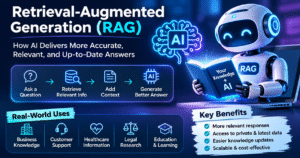
Ask → Search → Retrieve → Understand → Answer
🧠 What Is Retrieval-Augmented Generation?
Retrieval-Augmented Generation (RAG) is an AI architecture that connects a language model with an external knowledge source.
When a user asks a question, the system searches a collection of relevant information—such as documents, databases, websites, manuals, or company knowledge bases.
The most relevant information is then provided to the language model as context. The model uses that context to generate a more relevant and informative response.
Think of RAG as giving an AI assistant a smart research library that it can consult whenever it needs additional information.
⚙️ How Does RAG Work?
A typical RAG system follows a simple but powerful workflow.
1️⃣ User Query
Everything starts with a question.
For example:
“What is our company’s refund policy?”
The system first understands what the user is asking for.
2️⃣ 🔍 Information Retrieval
The RAG system searches its connected knowledge sources for information related to the question.
These sources could include:
- PDF documents
- Product manuals
- Company policies
- FAQs
- Websites
- Databases
- Internal knowledge bases
3️⃣ 🧩 Relevant Context
Instead of sending every available document to the AI, the system identifies the most relevant pieces of information.
This selected information becomes the context for the language model.
4️⃣ 🤖 Response Generation
The language model then uses the retrieved context to create a natural-language answer.
The result is an AI response that is based not only on the model’s general capabilities but also on the information retrieved for the specific question.
📚 Why Do We Need RAG?
Traditional AI models have an important limitation: they may not automatically have access to your organization’s private information or the latest information in a specific knowledge base.
Imagine a company has thousands of documents containing:
- HR policies
- Product information
- Customer FAQs
- Technical manuals
- Internal procedures
An employee asks:
“How many work-from-home days are allowed under our current policy?”
A general AI model may not know the company’s internal policy.
A RAG-powered assistant can search the company’s approved knowledge base, retrieve the relevant policy section, and use it to formulate an answer.
This makes RAG particularly useful for organizations that want to connect AI with their own knowledge.
💡 Real-World Applications of RAG
🏢 Business Knowledge Assistants
Companies can connect internal documents to AI-powered assistants.
Employees can ask questions in natural language instead of manually searching through hundreds of files.
🛒 Customer Support
RAG can help customer-support systems retrieve information from product documentation, FAQs, troubleshooting guides, and support resources.
This can make it easier for customers to find relevant answers quickly.
⚕️ Healthcare Information Systems
RAG can assist with retrieving information from approved medical and healthcare knowledge sources.
For high-stakes healthcare use cases, information should always be reviewed and validated by qualified professionals.
⚖️ Legal Research
Large collections of contracts, regulations, policies, and legal documents can be difficult to search manually.
RAG can help identify relevant information from these large collections and present it in a more accessible format.
🎓 Education
Students can interact with course materials, notes, textbooks, and other learning resources through an AI assistant.
Instead of searching through multiple documents, they can ask questions using everyday language.
🚀 Key Benefits of RAG
✅ More Relevant Responses
By providing the AI with information related to the user’s specific question, RAG can produce more context-aware responses.
🔄 Easier Knowledge Updates
When the underlying knowledge base changes, information can often be updated without retraining the entire language model.
🔐 Access to Private Knowledge
Organizations can build AI applications around their own approved documents and knowledge sources.
💰 Practical and Scalable
For many applications, updating a knowledge base can be more practical than retraining a large AI model whenever information changes.
🔎 Faster Information Discovery
RAG can reduce the effort required to search through large collections of documents and find relevant information.
⚠️ Is RAG a Perfect Solution?
Not necessarily.
A RAG system is only as effective as the information it retrieves and the way that information is processed.
If the retrieval system finds irrelevant, outdated, or incorrect information, the final response may also be unreliable.
That is why successful RAG implementations require more than just an LLM.
Important components include:
Data quality → Document processing → Chunking → Embeddings → Retrieval → Ranking → Generation → Evaluation
Each part can influence the quality of the final answer.
🔮 The Future of RAG
RAG is evolving beyond simple text-based document retrieval.
Future RAG systems can increasingly work with different types of information, including text, images, tables, audio, and other data formats.
Combined with multimodal AI and AI agents, retrieval systems can become much more capable.
Imagine asking an AI assistant:
“Find the latest information about this project, compare it with our previous reports, and explain what changed.”
Instead of simply generating an answer from memory, the system could retrieve relevant sources, compare the information, and present the findings in an understandable way.
That is where the real potential of RAG begins to emerge.
🎯 Final Takeaway
Retrieval-Augmented Generation is more than a way to improve AI responses. It is a bridge between powerful language models and the information they need to work effectively.
A language model provides the ability to understand and generate natural language.
RAG provides a way to connect that ability with relevant external knowledge.
In simple terms:
🤖 An LLM can understand and generate information. RAG helps it find the right information to work with.
The future of AI will not depend only on building bigger models. It will also depend on connecting those models to accurate, relevant, and trusted information at the right moment.
🔎 Retrieval-Augmented Generation (RAG)
जब AI को सिर्फ जवाब नहीं, सही जानकारी भी चाहिए
आज के समय में AI tools सिर्फ सवालों के जवाब देने तक सीमित नहीं हैं। लेकिन एक बड़ी challenge अभी भी बनी हुई है—AI को सही और relevant information कहाँ से मिलेगी?
यहीं पर Retrieval-Augmented Generation (RAG) काम आता है।
RAG एक ऐसी AI technique है जो Large Language Model (LLM) को answer generate करने से पहले relevant information को external sources से retrieve करने की capability देती है। इससे AI केवल अपने trained knowledge पर depend नहीं करता, बल्कि जरूरत के अनुसार documents, databases, websites या company knowledge से information खोज सकता है।
🧠 RAG क्या है?
Retrieval-Augmented Generation को आसान भाषा में समझें तो यह AI के लिए एक smart search + answer system है।
जब कोई user सवाल पूछता है, तो RAG system पहले उस सवाल से related information खोजता है। इसके बाद retrieved information को AI model के सामने context के रूप में रखा जाता है, और AI उसी context की मदद से ज्यादा relevant answer तैयार करता है।
👉 यानी:
User Question → Information Retrieval → Relevant Context → AI Response
इस approach का सबसे बड़ा फायदा यह है कि AI को हर answer के लिए केवल अपने pre-trained knowledge पर निर्भर नहीं रहना पड़ता।
⚙️ RAG कैसे काम करता है?
RAG system को आमतौर पर कुछ important steps में समझा जा सकता है।
1️⃣ User Query
सबसे पहले user अपना सवाल पूछता है।
उदाहरण के लिए:
“हमारी company की refund policy क्या है?”
2️⃣ 🔍 Information Retrieval
System company के available documents या knowledge base में relevant information खोजता है।
यह information PDFs, FAQs, websites, internal documents या databases में हो सकती है।
3️⃣ 🧩 Relevant Context
Retrieved information में से सबसे relevant content चुना जाता है और AI model को दिया जाता है।
4️⃣ 🤖 Response Generation
अब LLM उस context को समझकर natural language में answer generate करता है।
इस तरह final response ज्यादा context-aware और useful हो सकता है।
📚 RAG की जरूरत क्यों पड़ी?
Traditional AI models की एक limitation यह है कि उनका knowledge हमेशा आपके latest या private data से connected नहीं होता।
मान लीजिए किसी business के पास हजारों documents हैं—HR policies, product manuals, customer FAQs और internal reports।
अगर employee पूछता है:
“Work-from-home policy में कितने days allowed हैं?”
तो सामान्य AI model के पास company की private policy की जानकारी शायद नहीं होगी।
लेकिन RAG system company के knowledge base से relevant policy खोजकर उसी के आधार पर answer दे सकता है।
यही RAG को practical AI applications के लिए बेहद useful बनाता है।
💡 RAG के Real-World Applications
🏢 Business Knowledge Assistant
Companies अपने internal documents को searchable AI knowledge base में बदल सकती हैं।
Employees natural language में सवाल पूछकर policies, processes और documents से information प्राप्त कर सकते हैं।
🛒 Customer Support
RAG-powered chatbot product manuals, FAQs और support documents से information retrieve करके customers के questions का जवाब दे सकता है।
⚕️ Healthcare Information Systems
Structured and approved medical information sources के साथ RAG systems information retrieval को आसान बना सकते हैं। हालांकि healthcare में responses को qualified professionals और trusted sources से validate करना जरूरी है।
⚖️ Legal Research
Large collections of legal documents, contracts और regulations में relevant information खोजने में RAG useful हो सकता है।
🎓 Education
Students course material, notes और reference documents से questions पूछ सकते हैं और relevant study content जल्दी खोज सकते हैं।
🚀 RAG के प्रमुख फायदे
✅ More Relevant Answers
AI को question से related external context मिलता है, जिससे response ज्यादा relevant हो सकता है।
🔄 Updated Information
Knowledge base को update करने पर system नए information sources को retrieve कर सकता है, बिना पूरे language model को फिर से train किए।
🔐 Private Knowledge Access
RAG organizations को controlled environments में internal documents के साथ AI applications बनाने में मदद करता है।
💰 Cost Efficiency
हर नई information के लिए model को retrain करने के बजाय knowledge source को update करना कई use cases में ज्यादा practical हो सकता है।
🔎 Better Information Discovery
Users को hundreds या thousands of documents manually search करने की जरूरत कम हो सकती है।
⚠️ क्या RAG हर समस्या का solution है?
नहीं।
RAG की quality काफी हद तक उसके retrieval system और knowledge sources पर depend करती है।
अगर system ने गलत या irrelevant information retrieve कर ली, तो AI का final answer भी inaccurate हो सकता है।
इसलिए एक effective RAG system में सिर्फ LLM ही important नहीं है। Data quality, document processing, chunking, embeddings, retrieval strategy और evaluation भी उतने ही महत्वपूर्ण हैं।
🔮 The Future of RAG
RAG तेजी से modern AI applications का important component बन रहा है।
Future में RAG systems सिर्फ text documents तक सीमित नहीं रहेंगे। वे text, images, tables, audio और other data formats से information retrieve करके multimodal answers generate करने में सक्षम हो सकते हैं।
इसके साथ advanced retrieval techniques, better ranking systems और AI agents RAG को और powerful बना सकते हैं।
कल्पना कीजिए कि आप अपने पूरे business knowledge को एक intelligent assistant से connect कर दें—और वह सिर्फ answer ही न दे, बल्कि सही source तक भी आपको guide करे।
यही RAG की असली potential है।
🎯 Final Takeaway
Retrieval-Augmented Generation (RAG) AI को smarter बनाने का सिर्फ एक तरीका नहीं है—यह AI को relevant information तक पहुँचाने का framework है।
जब powerful language models को trusted knowledge sources के साथ combine किया जाता है, तो AI applications ज्यादा useful, context-aware और business-focused बन सकती हैं।
Simple words में:
🤖 LLM समझता है कि क्या कहना है, जबकि RAG उसे यह जानने में मदद करता है कि किस information के आधार पर कहना है।
AI का future सिर्फ बड़े models बनाने में नहीं है।
सही information को सही समय पर सही model तक पहुँचाना भी उतना ही important है।