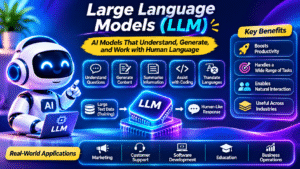
🧠 Large Language Models (LLM): The Technology Behind Modern AI
🚀 From Understanding Language to Generating Human-Like Responses
Artificial Intelligence has become an important part of modern technology. People now use AI to ask questions, write emails, generate ideas, summarise information, and even assist with software development.
Behind many of these capabilities is a powerful technology known as Large Language Models, or LLMs.
LLMs have transformed how computers work with human language and have become a key foundation for many modern AI applications.
🧩 What Is a Large Language Model?
A Large Language Model is an AI system trained on large amounts of text data to learn language patterns and generate useful text-based responses.
Rather than simply storing sentences, an LLM learns relationships between words, phrases, concepts, and context.
This allows it to perform a wide range of language-related tasks, including answering questions, generating content, summarising documents, and assisting with coding.
⚙️ How Do LLMs Work?
LLMs rely on advanced Machine Learning, Deep Learning, and neural network technologies.
📚 1. Training on Large Amounts of Data
During training, an LLM processes large datasets containing text from many different sources. It learns patterns in language and how different pieces of information relate to each other.
🔤 2. Processing Tokens
Text is broken into smaller units called tokens. The model processes these tokens and learns how they relate to one another.
🧠 3. Understanding Context
Modern LLMs can consider surrounding words and broader context to determine what a user is asking.
For example, the meaning of a word can change depending on the sentence in which it appears.
✍️ 4. Generating Responses
When a user provides a prompt, the model uses what it learned during training to generate a response that fits the context of the request.
🌟 What Can LLMs Do?
LLMs can support a wide range of language-based tasks.
✍️ Content Creation
They can help generate blog posts, emails, product descriptions, marketing copy, and creative ideas.
💬 Conversational AI
LLMs power many modern chatbots and AI assistants, allowing users to interact using natural language.
📄 Summarisation
Long documents, reports, and articles can be condensed into shorter summaries that are easier to understand.
🌍 Language Translation
LLMs can assist with translation and other multilingual language tasks.
💻 Coding Assistance
Developers can use LLMs to generate code, explain programming concepts, identify bugs, and create technical documentation.
🏢 How Businesses Use LLMs
LLMs are becoming useful across many business functions.
📢 Marketing: Creating content, campaign ideas, and customer communications.
💬 Customer Support: Assisting with FAQs and preparing responses to customer questions.
📊 Business Operations: Summarising reports, analysing documents, and organising information.
💻 Software Development: Supporting coding, debugging, testing, and documentation.
🎓 Education: Creating learning materials, explanations, and personalised study assistance.
🔍 LLMs vs. Traditional Search
Traditional search systems are primarily designed to find relevant information from available sources.
LLMs focus heavily on understanding language and generating responses.
For example:
Traditional Search:
“Find information about Machine Learning.”
LLM:
“Explain Machine Learning in simple terms and give me examples.”
Modern AI systems can also combine search capabilities with LLMs, allowing them to retrieve information and then present it in a more conversational format.
⚠️ Challenges of LLMs
Despite their capabilities, LLMs are not perfect.
🎯 Accuracy
An LLM can sometimes generate information that sounds convincing but is incorrect. Important information should therefore be verified.
🔐 Privacy
Sensitive or confidential information should be handled carefully when using AI systems.
⚖️ Bias
Biases present in training data can influence model outputs, making responsible development and evaluation important.
💻 Computing Requirements
Training and operating large AI models can require significant computing power and infrastructure.
🔮 The Future of Large Language Models
LLMs are continuing to evolve. Future models may become more efficient, capable, multilingual, context-aware, and specialised.
Their integration with technologies such as Multimodal AI, AI Agents, Robotics, and advanced automation could create even more powerful AI systems.
Instead of simply generating text, future AI systems may be able to understand complex information, work across different data types, and assist users with increasingly sophisticated tasks.
💡 Final Thoughts
Large Language Models have changed the way people interact with Artificial Intelligence.
We are no longer limited to giving computers rigid commands. We can communicate with AI using natural language, ask follow-up questions, explore ideas, and work through complex information.
LLMs are not just changing how machines process language—they are changing how humans interact with technology. 🚀
🧠 Large Language Models (LLM): AI जो इंसानी भाषा को समझने लगा है
🚀 From Understanding Words to Generating Human-Like Responses
आज Artificial Intelligence हमारी daily life का important हिस्सा बन चुका है। हम AI से questions पूछते हैं, emails लिखवाते हैं, ideas generate करते हैं, information summarize करते हैं और coding में भी help लेते हैं।
इन capabilities के पीछे एक important technology है—Large Language Models, जिन्हें short में LLM कहा जाता है।
LLMs ने AI को human language के साथ काम करने का एक powerful तरीका दिया है और modern AI applications के development में इनका बड़ा role है।
🧩 What Is a Large Language Model?
Simple words में, Large Language Model एक AI model है जिसे बहुत बड़े मात्रा में text data पर train किया जाता है ताकि वह human language के patterns को समझकर useful text generate कर सके।
LLM words को सिर्फ dictionary की तरह नहीं देखता। यह language में मौजूद patterns, context और relationships को learn करने की कोशिश करता है।
इसी वजह से LLM questions का जवाब देने, content generate करने, summarise करने और कई language-related tasks में useful हो सकता है।
⚙️ How Do LLMs Work?
LLM के पीछे advanced Machine Learning और Deep Learning techniques काम करती हैं।
📚 1. Training on Large Amounts of Data
LLMs को बहुत बड़े datasets पर train किया जाता है। Training के दौरान model language के patterns और relationships सीखता है।
🔤 2. Understanding Tokens
Text को छोटे units, जिन्हें tokens कहा जाता है, में process किया जा सकता है।
Model इन tokens के relationships को analyse करके context को समझने की कोशिश करता है।
🧠 3. Understanding Context
LLM केवल एक word को अलग से नहीं देखता। वह आसपास के words और पूरे context को consider करके meaning समझने की कोशिश करता है।
✍️ 4. Generating Responses
जब user prompt देता है, model learned patterns के आधार पर एक relevant response generate करता है।
🌟 What Can LLMs Do?
LLMs कई तरह के language-based tasks में मदद कर सकते हैं।
✍️ Content Creation
Blogs, emails, product descriptions, social media copy और creative ideas generate करने में सहायता।
💬 Conversational AI
AI chatbots और virtual assistants को natural language में users के साथ interact करने में मदद।
📄 Summarisation
Long documents और articles को shorter, easier-to-understand summaries में बदलने में सहायता।
🌍 Translation
Different languages के बीच text translation और language-related tasks में मदद।
💻 Coding Assistance
Developers को code generate करने, explain करने, debug करने और documentation तैयार करने में support।
🏢 Business में LLMs का इस्तेमाल
LLMs businesses के कई departments में productivity improve करने में useful हो सकते हैं।
📢 Marketing: Content ideas, campaign copy और customer communication।
💬 Customer Support: FAQs और customer queries के लिए AI-assisted responses।
📊 Business Operations: Reports, summaries और internal documents को process करने में मदद।
💻 Software Development: Coding और technical documentation support।
🎓 Education: Learning material, explanations और study assistance।
🔍 LLM और Traditional Search में Difference
Traditional search engines generally web pages या documents में relevant information खोजने पर focus करते हैं।
LLMs का primary strength language understanding और generation है।
For example:
Search:
“Find information about Machine Learning.”
LLM:
“Explain Machine Learning in simple language with examples.”
हालांकि modern AI systems search और LLM capabilities को combine भी कर सकते हैं, जिससे information retrieval और language generation दोनों का फायदा मिल सकता है।
⚠️ Challenges of LLMs
LLMs powerful हैं, लेकिन perfect नहीं हैं।
🎯 Accuracy
कभी-कभी LLM convincing लेकिन incorrect information generate कर सकता है। इसलिए important information को verify करना जरूरी है।
🔐 Privacy
Sensitive या confidential information के साथ AI tools use करते समय privacy और security का ध्यान रखना चाहिए।
⚖️ Bias
Training data में मौजूद biases model के outputs को प्रभावित कर सकते हैं।
💻 Computing Requirements
Large models को train और operate करने के लिए significant computing resources की जरूरत हो सकती है।
🔮 The Future of LLMs
LLMs लगातार evolve हो रहे हैं। Future models ज्यादा capable, efficient, multilingual और context-aware हो सकते हैं।
LLMs का combination Multimodal AI, AI Agents और Robotics जैसी technologies के साथ होने पर AI systems और ज्यादा useful बन सकते हैं।
Future में AI सिर्फ text generate करने तक सीमित नहीं रह सकता। यह information को understand करके users और businesses को complex tasks में ज्यादा meaningful assistance दे सकता है।
💡 Final Thoughts
Large Language Models ने Artificial Intelligence के साथ human interaction को एक नई direction दी है।
आज हम AI से सिर्फ commands नहीं देते—हम उससे बात कर सकते हैं, ideas discuss कर सकते हैं और complex information को समझने में मदद ले सकते हैं।
LLMs are not just changing how machines process language—they are changing how humans interact with technology. 🚀