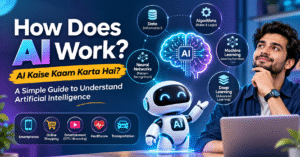
How Does AI Work? A Simple Guide to Understanding Artificial Intelligence 🤖
Understanding the Technology Behind the Intelligence
Artificial Intelligence, commonly known as AI, has become a part of our everyday lives. From voice assistants and personalized recommendations to smart cameras and self-driving technology, AI is changing the way we interact with technology.
But have you ever wondered how AI actually works?
The answer is fascinating. AI combines data, algorithms, computing power, and learning techniques to enable machines to identify patterns, make predictions, understand information, and perform tasks that normally require human intelligence.
Let’s break it down in a simple and engaging way.
🧠 What Is Artificial Intelligence?
Artificial Intelligence is a technology that allows computers and machines to perform tasks that usually require human-like abilities.
These abilities can include:
- Understanding language
- Recognizing images
- Finding patterns
- Making predictions
- Solving problems
- Generating content
- Making decisions based on available information
In simple words, AI helps machines learn from information and use what they learn to produce useful results.
📊 1. AI Starts With Data
Data is one of the most important ingredients of AI.
AI systems can learn from many types of information, such as:
📷 Images
📝 Text
🎵 Audio
🎥 Videos
📈 Numbers and statistics
💬 Human conversations
For example, if an AI system needs to recognize cats in photographs, it can be trained using a large collection of images containing cats.
The more useful and relevant the data, the better the system can learn patterns.
⚙️ 2. Algorithms Help AI Learn
An algorithm is a set of instructions used to process information and solve a problem.
AI algorithms examine data and look for patterns or relationships.
For example, an AI system analyzing thousands of emails may learn that certain words, patterns, or behaviors are commonly associated with spam.
The system doesn’t simply memorize every email. Instead, it tries to identify patterns that can help it classify new emails.
🤖 3. Machine Learning Makes AI Smarter
One of the most important technologies behind modern AI is Machine Learning (ML).
Instead of programming every possible situation manually, machine learning allows computers to learn patterns from data.
For example:
Data → Learning Process → Pattern Recognition → Prediction
Imagine showing a system thousands of pictures of dogs and cats. During training, it gradually learns characteristics that can help distinguish one from the other.
When it receives a new image, it can use those learned patterns to make a prediction.
🧩 4. Neural Networks Mimic Complex Patterns
Neural networks are another important part of modern AI.
They are computational systems inspired loosely by the way biological brains process information.
A neural network contains connected layers that transform information step by step.
For example:
Input → Hidden Layers → Pattern Processing → Output
A neural network trained for image recognition may begin by detecting simple features such as edges and shapes and eventually combine them into more complex patterns.
This makes neural networks particularly useful for tasks involving images, speech, language, and other complex data.
📚 5. Deep Learning Takes It Further
Deep Learning is a type of machine learning that uses neural networks with multiple layers.
These deeper networks can learn highly complex patterns from large amounts of data.
Deep learning plays an important role in technologies such as:
🎙️ Speech recognition
👁️ Image recognition
🌐 Language translation
🚗 Driver-assistance systems
💬 Generative AI
The system improves its ability to recognize patterns through training and optimization.
💬 6. How Does Generative AI Work?
Generative AI can create new content such as text, images, audio, video, and code.
A generative AI model is trained on large amounts of data to learn patterns in how information is structured.
For example, a language model learns relationships between words and concepts. When you provide a prompt, it processes the context and generates a response based on patterns learned during training.
This doesn’t mean the AI thinks exactly like a human.
Instead, it uses complex mathematical models to process information and generate outputs that fit the context.
🔄 7. Training and Improvement
AI models usually go through a training process.
During training, the system processes data and adjusts its internal parameters to improve its performance.
A simplified process looks like this:
Collect Data → Train Model → Test Results → Improve Model → Deploy AI
Developers evaluate the model using data it has not seen during training to understand how well it generalizes to new situations.
🌍 Where Do We See AI in Everyday Life?
You may already be using AI without realizing it.
📱 Smartphones
AI can help with face recognition, photography, voice assistants, and predictive text.
🎬 Streaming Platforms
AI can analyze your viewing habits and recommend movies or shows you may enjoy.
🛒 Online Shopping
Recommendation systems can suggest products based on browsing and purchasing patterns.
🏥 Healthcare
AI can assist professionals with tasks such as analyzing medical images, organizing information, and identifying patterns in health data.
🚘 Transportation
AI can support navigation, traffic prediction, driver-assistance features, and other transportation technologies.
⚠️ Can AI Make Mistakes?
Yes.
AI is powerful, but it is not perfect.
AI systems can produce incorrect, incomplete, or misleading results. Their performance depends on factors such as the quality of their training data, model design, context, and how they are used.
That is why human judgment remains important—especially when AI is used for important decisions.
🔐 Why Responsible AI Matters
As AI becomes more powerful, responsible development and use become increasingly important.
Important considerations include:
🔒 Privacy
⚖️ Fairness
🛡️ Security
📊 Data quality
👨💻 Human oversight
🌍 Social impact
The goal should not simply be to make AI more powerful, but to make it useful, reliable, safe, and responsible.
🚀 The Future of AI
AI is evolving rapidly.
Future AI systems may become better at understanding complex information, assisting professionals, automating repetitive tasks, and helping people solve difficult problems.
However, the most valuable future may not be about AI replacing humans.
It may be about humans and AI working together—combining human creativity, judgment, empathy, and experience with the speed and analytical capabilities of machines.
💡 Final Thoughts
So, how does AI work?
At its core, AI works by combining data, algorithms, mathematical models, computing power, and learning techniques to identify patterns and produce useful outputs.
From the phone in your hand to the recommendations you see online, AI is already influencing everyday life.
Understanding how it works is the first step toward using this technology more effectively—and responsibly.
🤖 AI is not magic. It is technology built to learn patterns, process information, and help solve problems.
🤖 How Does AI Work? AI Kaise Kaam Karta Hai?
Artificial Intelligence को आसान भाषा में समझिए
आज AI (Artificial Intelligence) हमारी daily life का एक important हिस्सा बन चुका है। हम AI का इस्तेमाल smartphones, Google searches, online shopping, social media, voice assistants और कई दूसरे platforms पर करते हैं।
लेकिन क्या आपने कभी सोचा है कि AI आखिर काम कैसे करता है?
क्या मशीन खुद सोचती है?
क्या AI इंसानों की तरह समझता है?
और AI किसी सवाल का जवाब कैसे देता है?
आइए इसे बिल्कुल simple और आसान भाषा में समझते हैं।
🧠 Artificial Intelligence क्या है?
Artificial Intelligence यानी AI ऐसी technology है, जो computers और machines को कुछ ऐसे tasks करने में मदद करती है जिनमें आमतौर पर human intelligence की जरूरत होती है।
AI की मदद से machines:
- 📊 Data को analyze कर सकती हैं
- 🔍 Patterns पहचान सकती हैं
- 🗣️ Human language समझ सकती हैं
- 📷 Images पहचान सकती हैं
- 💡 Predictions कर सकती हैं
- ✍️ Content generate कर सकती हैं
- ⚙️ Problems solve करने में मदद कर सकती हैं
Simple words में कहें तो:
AI machines को information से patterns सीखने और उसके आधार पर useful output देने में मदद करता है।
📊 1. AI की शुरुआत Data से होती है
AI के लिए Data सबसे important चीजों में से एक है।
Data कई forms में हो सकता है:
📷 Images
📝 Text
🎵 Audio
🎥 Videos
📈 Numbers
💬 Conversations
उदाहरण के लिए, अगर किसी AI को बिल्ली और कुत्ते की तस्वीर पहचानना सिखाना है, तो उसे बहुत सारी images से train किया जा सकता है।
इन images को देखकर AI अलग-अलग patterns को पहचानना सीखता है।
⚙️ 2. Algorithms AI को रास्ता दिखाते हैं
Algorithm instructions का एक set होता है, जो computer को बताता है कि information को कैसे process करना है।
AI algorithms data में मौजूद patterns और relationships को identify करने में मदद करते हैं।
उदाहरण के लिए, email system यह सीख सकता है कि कौन-से patterns अक्सर spam emails में दिखाई देते हैं।
इसके बाद वह नए email को देखकर अनुमान लगा सकता है कि वह spam है या नहीं।
🤖 3. Machine Learning AI को सीखने में मदद करता है
Machine Learning यानी ML, AI का एक important हिस्सा है।
इसमें computer को हर situation के लिए manually instructions देने की जरूरत नहीं होती।
Machine Learning system को data से patterns सीखने की क्षमता देता है।
एक simple process को ऐसे समझ सकते हैं:
Data → Learning → Pattern पहचानना → Prediction
यानी जितने useful examples system को मिलते हैं, वह patterns को उतना बेहतर समझने की कोशिश करता है।
🧩 4. Neural Networks क्या होते हैं?
Neural Networks AI में इस्तेमाल होने वाली एक powerful technology है।
इन्हें loosely human brain के information-processing concept से inspired माना जाता है।
Neural network information को अलग-अलग layers में process करता है।
एक simple structure:
Input → Processing → Pattern Recognition → Output
उदाहरण के लिए, image recognition system पहले basic shapes और edges को identify कर सकता है और फिर उन features को combine करके किसी object को पहचानने की कोशिश कर सकता है।
📚 5. Deep Learning क्या है?
Deep Learning, Machine Learning का एक advanced approach है जिसमें multiple layers वाले neural networks का इस्तेमाल किया जाता है।
यह complex patterns को समझने के लिए बहुत useful हो सकता है।
Deep Learning का इस्तेमाल कई technologies में किया जाता है, जैसे:
🎙️ Speech Recognition
📷 Image Recognition
🌐 Language Translation
🚗 Driver Assistance
💬 Generative AI
💬 6. Generative AI कैसे काम करता है?
आजकल Generative AI काफी popular है।
यह technology नया content generate कर सकती है, जैसे:
✍️ Text
🖼️ Images
🎵 Audio
🎥 Video
💻 Code
जब आप AI को कोई prompt देते हैं, तो model उस prompt और available context को process करता है और अपने training से सीखे patterns के आधार पर output generate करता है।
इसका मतलब यह नहीं है कि AI इंसान की तरह exactly सोचता है।
AI mathematical models और learned patterns की मदद से context के अनुसार output generate करता है।
🔄 7. AI को Train कैसे किया जाता है?
AI model को तैयार करने के लिए training process किया जाता है।
एक simple AI training journey कुछ ऐसी हो सकती है:
Data Collect करना → Model Train करना → Test करना → Improve करना → Deploy करना
Training के दौरान model अपने internal parameters को adjust करता है ताकि वह दिए गए task पर बेहतर performance कर सके।
इसके बाद model को नए data पर test किया जाता है ताकि यह देखा जा सके कि वह unseen situations में कितना अच्छा काम करता है।
🌍 AI हमारी Daily Life में कहाँ-कहाँ है?
हो सकता है आप रोज AI का इस्तेमाल करते हों और आपको पता भी न हो।
📱 Smartphones
Face recognition, camera features, voice assistants और predictive text जैसी technologies में AI का इस्तेमाल हो सकता है।
🎬 Entertainment
Netflix, YouTube और दूसरे platforms आपके interests और activity के आधार पर content recommendations दे सकते हैं।
🛒 Online Shopping
Shopping websites आपकी browsing और purchase activity के आधार पर products recommend कर सकती हैं।
🏥 Healthcare
Healthcare में AI medical images को analyze करने, information organize करने और कुछ patterns identify करने में professionals की सहायता कर सकता है।
🚗 Transportation
AI navigation, traffic prediction और driver-assistance technologies में भी important role निभा सकता है।
⚠️ क्या AI हमेशा सही होता है?
नहीं।
AI powerful technology है, लेकिन यह perfect नहीं है।
कभी-कभी AI:
❌ गलत information दे सकता है
❌ Context को गलत समझ सकता है
❌ Incomplete answer दे सकता है
❌ Misleading result generate कर सकता है
इसलिए important situations में human judgment और verification अभी भी बहुत जरूरी हैं।
🔐 Responsible AI क्यों जरूरी है?
AI जितना powerful होता जा रहा है, उतना ही जरूरी है कि इसे responsibly use किया जाए।
कुछ important बातें हैं:
🔒 Privacy – लोगों के data की सुरक्षा
⚖️ Fairness – bias को कम करना
🛡️ Security – technology का सुरक्षित इस्तेमाल
📊 Data Quality – बेहतर और reliable data
👨💻 Human Oversight – जरूरी decisions में इंसानी निगरानी
AI का goal सिर्फ powerful बनना नहीं होना चाहिए।
Goal होना चाहिए:
Useful + Reliable + Safe + Responsible AI
🚀 AI का Future कैसा हो सकता है?
AI technology तेजी से evolve हो रही है।
आने वाले समय में AI complex information को समझने, repetitive काम को automate करने और professionals को difficult problems solve करने में और ज्यादा मदद कर सकता है।
लेकिन AI का future सिर्फ “Humans vs AI” नहीं है।
असल opportunity शायद “Humans + AI” में है।
इंसानों की creativity, emotions, experience और judgment के साथ AI की speed और data-processing capabilities मिलकर नए possibilities create कर सकती हैं।
💡 Final Thoughts
तो आखिर AI कैसे काम करता है?
Simple भाषा में, AI data, algorithms, mathematical models और computing power का इस्तेमाल करके patterns को पहचानता है और उनके आधार पर useful output generate करता है।
आज AI हमारे smartphones से लेकर shopping, entertainment, healthcare और education तक कई जगह दिखाई देता है।
AI को समझना सिर्फ technology को समझना नहीं है—यह आने वाले digital future को समझने की दिशा में भी एक important step है।