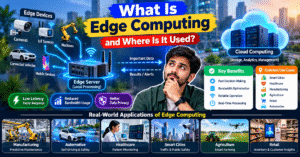
What Is Edge Computing and Where Is It Used?
🚀 Introduction to Edge Computing
In today’s digital world, billions of devices generate massive amounts of data every second. Smart cameras, mobile phones, industrial machines, connected vehicles, and IoT sensors continuously collect and process information. Sending all this data to distant cloud servers can sometimes increase latency, consume network bandwidth, and delay important decisions.
This is where Edge Computing becomes useful.
Edge computing is a modern computing approach that processes data closer to where it is generated, rather than sending every piece of data to a centralized cloud or data center. This helps applications respond faster, reduce unnecessary data transfers, and operate more efficiently.
From smart factories and healthcare monitoring to autonomous vehicles and smart cities, edge computing is becoming an important part of modern digital infrastructure.
In this blog, we will explore what edge computing is, how it works, its benefits, limitations, real-world applications, and how it differs from cloud computing.
🌐 What Is Edge Computing?
Edge computing is a distributed computing model in which data processing takes place near the source of the data. This may happen directly on a device, on a local gateway, or on a nearby edge server.
Instead of sending all raw data to a centralized cloud platform, an edge system can analyze information locally and transmit only important results or selected data to the cloud.
For example, a smart security camera can analyze video footage locally and send an alert only when it detects suspicious activity. This reduces the need to continuously upload every video frame to a remote server.
In simple terms: Edge computing brings computing resources closer to users, devices, and machines to support faster responses and more efficient data processing.
⚙️ How Does Edge Computing Work?
Edge computing works by distributing computing tasks across devices, local networks, edge servers, and cloud platforms.
1. Data Collection
Devices such as sensors, cameras, smartphones, and industrial machines collect information from their surroundings.
2. Local Data Processing
An edge device or nearby edge server processes the data close to its source. It may filter information, run an AI model, or identify important events.
3. Immediate Decision-Making
The system can respond locally when quick action is required. For example, a machine may stop automatically when a sensor detects an unsafe operating condition.
4. Selective Cloud Communication
Relevant information, summaries, alerts, or selected records can be sent to a cloud platform for long-term storage, advanced analytics, or coordination across multiple locations.
5. Monitoring and Management
Cloud platforms can help manage edge devices, distribute software updates, monitor system health, and analyze data collected from multiple edge locations.
This combination allows organizations to use local processing for speed while benefiting from the cloud’s broader computing and storage capabilities.
🧩 Key Components of Edge Computing
Edge computing systems typically include several components that work together.
📡 1. Edge Devices
These are devices that generate data or perform processing near the data source.
Examples include smart cameras, IoT sensors, industrial controllers, connected vehicles, and smartphones.
🖥️ 2. Edge Servers and Gateways
Edge servers and gateways provide additional computing power near devices. They can process data from multiple sensors, run applications, and connect local equipment with cloud services.
🌐 3. Network Connectivity
Networks such as Ethernet, Wi-Fi, 4G, and 5G enable communication between devices, edge systems, and cloud platforms. Some edge applications can also continue performing local tasks when connectivity is temporarily unavailable.
☁️ 4. Cloud Infrastructure
Cloud platforms provide centralized storage, large-scale analytics, model training, device management, and coordination across multiple locations.
🤖 5. AI and Analytics
Artificial intelligence and analytics tools can process data at the edge to detect patterns, identify objects, predict equipment failures, or trigger automated actions.
🌟 Benefits of Edge Computing
Edge computing offers several advantages for applications that require fast responses and efficient data processing.
⚡ 1. Low Latency
Latency is the time it takes for data to travel through a system and for a response to be produced.
By processing information locally, edge computing can reduce the delay associated with sending data to a distant cloud server and waiting for a response.
This is particularly important for industrial automation, robotics, connected vehicles, and real-time monitoring.
📉 2. Reduced Bandwidth Usage
Transmitting large volumes of raw data to the cloud can consume significant network bandwidth.
Edge computing allows devices to filter, compress, or summarize data before sending it elsewhere. This can reduce network traffic and communication costs.
🔒 3. Improved Data Privacy
Sensitive information can sometimes be processed locally instead of being transferred to a centralized cloud platform.
For example, a healthcare device may analyze certain readings locally and transmit only selected results. However, edge computing does not automatically guarantee privacy; proper security and data-handling practices are still necessary.
🔌 4. Better Operation During Connectivity Problems
Some edge applications can continue processing data even when their connection to the cloud is interrupted.
For example, a local industrial controller can continue executing its configured control logic during a temporary network outage.
The degree of offline functionality depends on the application’s design and local resources.
📈 5. Faster Decision-Making
Local processing allows systems to analyze data and take action without always depending on a remote data center.
This is useful when delays could affect safety, productivity, or user experience.
💰 6. Potential Cost Savings
Reducing unnecessary data transfers and cloud processing can lower costs in some deployments. However, organizations must also consider the cost of edge hardware, maintenance, software updates, and security.
🏭 Where Is Edge Computing Used?
Edge computing is used across many industries where local processing, low latency, or reduced data transfer is important.
🏭 1. Manufacturing and Industrial Automation
Factories use edge computing to monitor machinery, analyze sensor readings, detect unusual operating conditions, and support predictive maintenance.
For example, an edge system can identify abnormal vibration in a motor and alert maintenance staff before a potential equipment failure.
This can help reduce downtime and improve operational efficiency.
🚗 2. Autonomous and Connected Vehicles
Modern vehicles generate data from cameras, radar, lidar, and other sensors.
Processing this information inside the vehicle supports functions such as object detection, lane monitoring, and obstacle response. These time-critical functions cannot depend entirely on a distant cloud server.
Edge computing can also support traffic analysis and communication between connected vehicles and nearby infrastructure.
🏥 3. Healthcare and Medical Devices
Healthcare devices can use edge processing to analyze vital signs, detect unusual readings, and support timely alerts.
Hospitals may also process medical images and sensor data locally to reduce communication delays.
Clinical decisions must still follow appropriate medical validation, safety requirements, and professional oversight.
🏙️ 4. Smart Cities
Smart cities use connected devices to manage traffic, monitor public infrastructure, and improve the efficiency of urban services.
For example, an edge-enabled traffic system can analyze vehicle movement near an intersection and adjust traffic signals according to its configured rules.
Local processing can reduce the need to send every camera frame to a central data center.
🏠 5. Smart Homes and IoT Devices
Smart speakers, home security systems, thermostats, and connected appliances can perform certain tasks locally.
For example, a smart thermostat can analyze room temperature and control heating or cooling without sending every sensor reading to the cloud.
Local processing can also help some smart home devices respond when internet connectivity is limited.
📹 6. Video Surveillance and Security
Edge-enabled cameras can analyze video feeds to detect motion, recognize permitted objects, or identify predefined security events.
Instead of transmitting all video continuously, a camera may send selected clips or alerts to a monitoring platform.
This can reduce bandwidth usage, although storage and privacy requirements still need careful management.
📡 7. Telecommunications and 5G Networks
Telecommunication providers can deploy edge infrastructure close to users to support applications that benefit from low latency.
Examples include interactive cloud applications, real-time analytics, and certain industrial communication systems.
Important: 5G and edge computing are complementary technologies, but 5G does not automatically mean that an application uses edge computing.
🛒 8. Retail and E-commerce
Retailers can use edge systems to analyze store traffic, monitor inventory, and support connected checkout systems.
For example, an edge device can process information from shelf sensors and notify staff when stock is running low.
This can help improve operational efficiency and customer experience.
🌾 9. Agriculture and Smart Farming
Smart farming systems use sensors, cameras, and connected equipment to monitor soil moisture, temperature, irrigation, and crop conditions.
An edge device can analyze sensor readings locally and trigger irrigation when soil moisture falls below a configured threshold.
This is especially useful in locations where internet connectivity is unreliable.
🎮 10. Gaming and Interactive Applications
Edge infrastructure can bring application processing closer to users, helping reduce network delays for some cloud gaming and interactive experiences.
Actual performance depends on network conditions, server placement, hardware, and application design.
⚔️ Edge Computing vs Cloud Computing
Edge computing and cloud computing are complementary approaches, but they serve different purposes.
| Feature | Edge Computing | Cloud Computing |
|---|---|---|
| Data Processing | Near the data source | Centralized or regional cloud infrastructure |
| Latency | Often lower for local tasks | Depends on network distance and service |
| Bandwidth | Can reduce data transfers | May require substantial data transfer |
| Computing Resources | Usually limited at each edge location | Can provide large, scalable resources |
| Internet Dependency | Some tasks can run locally | Cloud-dependent tasks require connectivity |
| Data Handling | Can support local data processing | Supports centralized storage and analytics |
| Best For | Time-sensitive and location-specific tasks | Large-scale processing and centralized services |
The best architecture often combines both approaches: edge computing handles immediate local tasks, while cloud computing supports large-scale analytics, storage, and centralized management.
⚠️ Limitations of Edge Computing
Although edge computing offers many benefits, it also introduces technical and operational challenges.
💸 1. Higher Initial Investment
Organizations may need to purchase edge servers, gateways, sensors, and specialized hardware.
The initial investment can be significant, especially when devices must be deployed across many locations.
🔧 2. Complex Management
Managing hundreds or thousands of distributed edge devices can be more difficult than managing a centralized system.
Organizations need processes for device monitoring, software updates, configuration management, and troubleshooting.
🔐 3. Security Risks
Edge devices may be installed in factories, public spaces, vehicles, or remote locations where physical access is harder to control.
Weak passwords, outdated software, and insecure communication can create security vulnerabilities. Strong authentication, encryption, secure updates, and device monitoring are important.
🖥️ 4. Limited Computing Resources
Small edge devices generally have less processing power, memory, and storage than large cloud platforms.
Complex AI models or intensive workloads may need to run on more powerful edge servers or in the cloud.
🔄 5. Data Synchronization Challenges
When data is processed locally across many locations, keeping records consistent with centralized systems can become difficult.
Organizations must plan how to handle delayed updates, conflicting records, duplicate events, and temporary network outages.
🛠️ 6. Maintenance Requirements
Distributed hardware requires physical maintenance, replacement, and monitoring.
This can increase operational complexity, especially in remote agricultural, industrial, and transportation environments.
🔮 Future of Edge Computing
Edge computing is expected to remain important as connected devices, industrial automation, and AI-powered applications continue to develop.
Several trends are shaping its future:
- Edge AI: Running AI models locally for faster inference and reduced data transfer.
- 5G and Multi-access Edge Computing (MEC): Bringing computing capabilities closer to mobile and connected devices.
- Industrial IoT: Improving machine monitoring, automation, and predictive maintenance.
- Smart Infrastructure: Supporting local analysis for traffic management, buildings, and energy systems.
- Privacy-Aware Processing: Enabling certain types of sensitive data to be analyzed closer to where they are generated.
The growth of edge computing will depend on practical factors such as cost, security, hardware capabilities, network availability, and the requirements of individual applications.
🏁 Conclusion
Edge computing is a distributed computing approach that processes data closer to where it is generated. By reducing dependence on distant cloud servers for time-sensitive tasks, it can improve responsiveness, reduce unnecessary data transfers, and support local decision-making.
Its applications range from smart factories and connected vehicles to healthcare, smart cities, retail, and agriculture.
However, organizations must also consider hardware costs, security, maintenance, limited resources, and data synchronization challenges.
Final Verdict: Edge computing is particularly valuable when applications need fast local responses, efficient bandwidth usage, or continued operation during certain network disruptions. For many modern systems, combining edge computing with cloud infrastructure offers a practical balance between responsiveness and large-scale computing power.
❓ Frequently Asked Questions (FAQs)
1. What is edge computing in simple terms?
Edge computing means processing data close to where it is generated instead of sending all of it to a distant cloud server.
2. What are the main benefits of edge computing?
The main benefits include lower latency for local processing, reduced bandwidth usage, faster decision-making, and the ability to support certain offline operations.
3. Where is edge computing commonly used?
It is used in manufacturing, healthcare, connected vehicles, smart cities, agriculture, retail, video surveillance, telecommunications, and IoT systems.
4. What is the difference between edge computing and cloud computing?
Edge computing processes data near its source, while cloud computing provides centralized or regional computing and storage resources. Both approaches can work together.
5. Is edge computing related to IoT?
Yes. Edge computing is commonly used with IoT devices to process sensor data locally, reduce network traffic, and support faster responses.
6. Does edge computing require an internet connection?
Not always. Some edge applications can continue local processing without an active internet connection, but cloud synchronization and remote services may require connectivity.
7. What is Edge AI?
Edge AI refers to running artificial intelligence models on edge devices or nearby edge servers rather than relying entirely on centralized cloud processing.
8. Is edge computing secure?
Edge computing can support privacy and local data processing, but security depends on device configuration, encryption, access control, software updates, and ongoing monitoring.
What Is Edge Computing and Where Is It Used? (Edge Computing क्या है?)
🚀 Introduction – Edge Computing क्या है?
आज के digital world में Smart Devices, IoT Sensors, Cameras और Connected Vehicles हर सेकंड बड़ी मात्रा में data generate करते हैं। इस data को process करने के लिए अगर हर बार दूर स्थित Cloud Server पर भेजा जाए, तो response मिलने में देरी हो सकती है और network bandwidth का ज्यादा इस्तेमाल हो सकता है।
इसी समस्या को कम करने के लिए Edge Computing का इस्तेमाल किया जाता है। यह एक modern computing technology है, जिसमें data को उसके source के करीब ही process किया जाता है, बजाय इसके कि हर बार पूरा data किसी दूर के cloud server पर भेजा जाए।
उदाहरण के लिए, एक smart security camera अपने आसपास होने वाली गतिविधियों को locally analyze कर सकता है और केवल suspicious activity मिलने पर alert भेज सकता है।
इस blog में हम समझेंगे कि Edge Computing क्या है, यह कैसे काम करता है, इसके फायदे और limitations क्या हैं, और इसका इस्तेमाल किन industries में किया जाता है।
🌐 Edge Computing क्या है?
Edge Computing एक distributed computing model है, जिसमें data processing data generate होने वाली जगह के पास की जाती है। यह processing किसी smart device, local gateway या nearby edge server पर हो सकती है।
Traditional cloud-based systems में data को अक्सर centralized cloud infrastructure पर भेजकर process किया जाता है। इसके विपरीत, Edge Computing में data का analysis local level पर किया जा सकता है, जिससे response time कम करने और unnecessary data transfer को घटाने में मदद मिलती है।
आसान भाषा में: Edge Computing का मतलब है computing power को users, devices और machines के करीब लाना, ताकि data को जल्दी process किया जा सके और समय पर decision लिया जा सके।
💡 Edge Computing का आसान उदाहरण
मान लीजिए किसी factory में कई machines लगी हुई हैं। इन machines पर लगे sensors लगातार temperature और vibration का data collect करते हैं।
अगर किसी motor में abnormal vibration होने लगे, तो edge device तुरंत data analyze करके maintenance team को alert भेज सकता है। इसके लिए हर sensor reading को दूर स्थित cloud server पर भेजना जरूरी नहीं है।
इस तरह Edge Computing machine failure का जल्दी पता लगाने और production downtime कम करने में मदद कर सकती है।
⚙️ How Does Edge Computing Work?
Edge Computing कई components के combination से काम करता है। इसमें data collection, local processing, decision-making और cloud communication शामिल होते हैं।
1. 📡 Data Collection
सबसे पहले sensors, cameras, smartphones और अन्य connected devices data collect करते हैं।
2. 🖥️ Local Data Processing
Collected data को device, local gateway या nearby edge server पर process किया जाता है। यहाँ data filtering, analysis और AI-based detection जैसे tasks किए जा सकते हैं।
3. ⚡ Quick Decision-Making
अगर कोई important event detect होता है, तो system तुरंत action ले सकता है। उदाहरण के लिए, unsafe temperature मिलने पर machine को stop करने का signal दिया जा सकता है।
4. ☁️ Cloud Communication
जरूरी data, reports और alerts को cloud platform पर भेजा जा सकता है, जहाँ long-term storage और advanced analytics की जा सकती है।
5. 🔄 Monitoring and Management
Cloud platform की मदद से अलग-अलग edge devices को monitor करना, software updates देना और system performance analyze करना आसान हो सकता है।
इस approach से local processing की speed और cloud computing की storage तथा processing capabilities का फायदा एक साथ लिया जा सकता है।
🧩 Edge Computing के मुख्य Components
Edge Computing system में कई components मिलकर काम करते हैं।
📱 1. Edge Devices
ये ऐसे devices होते हैं जो data generate करते हैं या उसके source के पास processing करते हैं।
Examples: Smart Cameras, IoT Sensors, Smartphones, Connected Vehicles और Industrial Controllers.
🖥️ 2. Edge Servers and Gateways
Edge servers और gateways nearby computing resources provide करते हैं। ये कई devices से data collect करके process कर सकते हैं और local network को cloud से connect कर सकते हैं।
🌐 3. Network Connectivity
Ethernet, Wi-Fi, 4G और 5G जैसी technologies devices, edge servers और cloud platforms के बीच communication में मदद करती हैं।
☁️ 4. Cloud Infrastructure
Cloud infrastructure का इस्तेमाल centralized storage, advanced analytics, AI model training और multiple edge locations को manage करने के लिए किया जा सकता है।
🤖 5. AI and Analytics
AI और analytics tools edge devices पर data analyze करके objects detect करने, unusual activities पहचानने और equipment failures का अनुमान लगाने में मदद कर सकते हैं।
🌟 Benefits of Edge Computing (Edge Computing के फायदे)
Edge Computing उन applications के लिए काफी उपयोगी है, जहाँ fast response और efficient data processing की जरूरत होती है।
⚡ 1. Low Latency – जल्दी Response
Latency का मतलब है data भेजने और response मिलने के बीच लगने वाला समय।
जब data को locally process किया जाता है, तो दूर स्थित server तक data भेजने और response वापस आने में लगने वाली देरी कम हो सकती है।
यह Industrial Automation, Robotics, Connected Vehicles और Real-Time Monitoring जैसे applications के लिए महत्वपूर्ण है।
📉 2. Reduced Bandwidth Usage
अगर हर device लगातार बड़ी मात्रा में raw data cloud पर भेजे, तो network bandwidth का ज्यादा इस्तेमाल होता है।
Edge Computing data को filter, compress और summarize करके unnecessary data transfer कम कर सकती है। इससे कुछ applications में network costs भी कम हो सकती हैं।
🔐 3. Better Data Privacy
Sensitive data को locally process करने से उसे हर बार centralized cloud पर भेजने की जरूरत कम हो सकती है।
उदाहरण के लिए, healthcare device कुछ readings का analysis locally कर सकती है और केवल जरूरी results भेज सकती है।
हालाँकि, केवल Edge Computing इस्तेमाल करने से data पूरी तरह secure नहीं हो जाता। Proper encryption, access control और security measures भी जरूरी हैं।
🔌 4. Network Problems में बेहतर काम
कुछ edge applications internet connection temporarily बंद होने पर भी local processing जारी रख सकती हैं।
उदाहरण के लिए, factory का local controller network failure के दौरान भी अपने configured control tasks execute कर सकता है।
यह सुविधा application की design और available local resources पर निर्भर करती है।
📈 5. Faster Decision-Making
Edge Computing की मदद से system data analyze करके जल्दी action ले सकता है।
इससे time-sensitive applications में productivity, safety और operational efficiency बेहतर करने में मदद मिल सकती है।
💰 6. Potential Cost Savings
Raw data को लगातार cloud पर भेजने और process करने की जरूरत कम होने से कुछ deployments में खर्च घट सकता है।
लेकिन edge hardware, installation, maintenance और security पर होने वाले खर्च को भी ध्यान में रखना चाहिए।
🏭 Where Is Edge Computing Used? (Edge Computing का इस्तेमाल कहाँ होता है?)
Edge Computing का इस्तेमाल कई industries में किया जाता है, जहाँ fast processing, low latency या local decision-making जरूरी होती है।
🏭 1. Manufacturing and Industrial Automation
Factories में Edge Computing का इस्तेमाल machines की monitoring, sensor data analysis और predictive maintenance के लिए किया जाता है।
उदाहरण के लिए, edge system motor में unusual vibration detect करके maintenance team को alert कर सकता है, जिससे संभावित machine failure और production downtime को कम करने में मदद मिल सकती है।
🚗 2. Autonomous and Connected Vehicles
Modern vehicles में cameras, radar और अन्य sensors लगातार data generate करते हैं।
इस data को vehicle के अंदर process करने से object detection, lane monitoring और obstacle response जैसे tasks में मदद मिलती है। ऐसे time-sensitive tasks पूरी तरह दूर स्थित cloud server पर निर्भर नहीं हो सकते।
🏥 3. Healthcare and Medical Devices
Healthcare में Edge Computing का इस्तेमाल patient monitoring devices, medical sensors और कुछ medical imaging applications में किया जा सकता है।
उदाहरण के लिए, monitoring device unusual vital-sign readings detect करके healthcare staff को alert भेज सकती है।
Clinical decisions के लिए appropriate medical validation और professional oversight जरूरी रहता है।
🏙️ 4. Smart Cities
Smart Cities में Edge Computing का इस्तेमाल traffic management, public safety और infrastructure monitoring के लिए किया जाता है।
उदाहरण के लिए, traffic cameras के पास लगा edge system vehicles की संख्या analyze करके configured rules के अनुसार traffic signals adjust करने में मदद कर सकता है।
🏠 5. Smart Homes and IoT Devices
Smart Speakers, Thermostats, Security Cameras और connected appliances में local processing का इस्तेमाल किया जा सकता है।
उदाहरण के लिए, smart thermostat room temperature के अनुसार heating या cooling control कर सकता है, बिना हर sensor reading को cloud पर भेजे।
📹 6. Video Surveillance and Security
Edge-enabled security cameras video footage को locally analyze करके motion या predefined suspicious activity detect कर सकती हैं।
इसके बाद system केवल selected clips, events या alerts monitoring platform पर भेज सकता है। इससे network traffic कम हो सकता है।
📡 7. Telecommunications and 5G Networks
Telecom companies users के करीब edge infrastructure deploy कर सकती हैं, जिससे low-latency applications को support करने में मदद मिलती है।
इसका इस्तेमाल real-time analytics, connected devices और कुछ industrial applications में किया जा सकता है।
ध्यान दें: 5G और Edge Computing एक-दूसरे के complementary technologies हैं, लेकिन 5G network होने का मतलब यह नहीं है कि हर application Edge Computing का इस्तेमाल कर रही है।
🛒 8. Retail and E-commerce
Retail stores में Edge Computing का इस्तेमाल inventory monitoring, customer traffic analysis और connected checkout systems के लिए किया जा सकता है।
उदाहरण के लिए, shelf sensors से data analyze करके system staff को low-stock products के बारे में alert दे सकता है।
🌾 9. Agriculture and Smart Farming
Smart Farming में sensors और connected devices soil moisture, temperature और irrigation conditions monitor करते हैं।
Edge device sensor readings analyze करके soil moisture निर्धारित level से नीचे जाने पर irrigation system को activate कर सकती है।
यह उन farming areas में उपयोगी हो सकता है जहाँ internet connectivity कमजोर रहती है।
🎮 10. Gaming and Interactive Applications
Edge infrastructure users के करीब application processing उपलब्ध करा सकता है। इससे कुछ cloud gaming और interactive applications में network delay कम करने में मदद मिल सकती है।
Actual performance network quality, server location और application design पर निर्भर करती है।
⚔️ Edge Computing vs Cloud Computing
Edge Computing और Cloud Computing दोनों modern computing के महत्वपूर्ण हिस्से हैं, लेकिन दोनों की working अलग होती है।
| Feature | Edge Computing | Cloud Computing |
|---|---|---|
| Data Processing | Data source के करीब | Centralized या regional infrastructure पर |
| Latency | Local tasks में अक्सर कम | Network distance पर निर्भर |
| Bandwidth | Data transfer कम कर सकती है | Large data transfer की जरूरत हो सकती है |
| Computing Power | प्रत्येक edge location पर सीमित हो सकती है | बड़े scalable resources उपलब्ध |
| Internet Dependency | कुछ tasks offline चल सकते हैं | Cloud-dependent tasks के लिए connectivity जरूरी |
| Main Purpose | Fast local processing | Large-scale computing और storage |
| Best Use Cases | IoT, automation, real-time systems | Data analytics, centralized applications |
निष्कर्ष: Edge Computing और Cloud Computing एक-दूसरे के alternatives ही नहीं, बल्कि complementary technologies भी हैं। Edge पर immediate tasks process किए जा सकते हैं, जबकि cloud पर long-term storage, advanced analytics और centralized management किया जा सकता है।
⚠️ Limitations of Edge Computing (Edge Computing की चुनौतियाँ)
Edge Computing के कई फायदे हैं, लेकिन इसे implement करने से पहले कुछ limitations समझना जरूरी है।
💸 1. High Initial Investment
Edge servers, gateways, sensors और specialized hardware खरीदने में शुरुआती खर्च हो सकता है।
अगर कई factories या remote locations पर devices deploy करने हों, तो installation cost काफी बढ़ सकती है।
🔧 2. Complex Management
सैकड़ों या हजारों edge devices को manage करना challenging हो सकता है।
इनकी monitoring, software updates, configuration और troubleshooting के लिए proper management system की जरूरत होती है।
🔐 3. Security Risks
Edge devices कई बार factories, vehicles और public locations में लगाए जाते हैं, जहाँ physical access को control करना मुश्किल हो सकता है।
Weak passwords, outdated software और insecure communication security risks बढ़ा सकते हैं। इसलिए encryption, authentication और regular updates जरूरी हैं।
🖥️ 4. Limited Computing Resources
छोटे edge devices में processing power, memory और storage सीमित हो सकती है।
इसलिए complex AI models या intensive computing tasks के लिए powerful edge servers या cloud infrastructure की जरूरत पड़ सकती है।
🔄 5. Data Synchronization Challenges
जब data अलग-अलग edge locations पर process होता है, तो उसे central system के साथ consistent रखना चुनौतीपूर्ण हो सकता है।
Network outages, duplicate records और conflicting updates को handle करने के लिए proper data synchronization strategy जरूरी है।
🛠️ 6. Maintenance Requirements
Distributed edge hardware को समय-समय पर maintain, update या replace करना पड़ सकता है।
Remote locations में devices की servicing और troubleshooting operational complexity बढ़ा सकती है।
🔮 Future of Edge Computing
Connected devices, Industrial IoT और AI-based applications के बढ़ने के साथ Edge Computing की importance भी बढ़ रही है।
भविष्य में इसके कुछ प्रमुख trends हो सकते हैं:
- 🤖 Edge AI: AI models को devices या nearby servers पर run करके faster inference करना।
- 📡 5G and MEC: Mobile users और connected devices के करीब computing resources उपलब्ध कराना।
- 🏭 Industrial IoT: Machines की monitoring और predictive maintenance को बेहतर बनाना।
- 🏙️ Smart Infrastructure: Traffic, buildings और energy systems का local analysis करना।
- 🔒 Privacy-Aware Processing: Sensitive data को source के करीब process करने के विकल्प बढ़ाना।
हालाँकि, Edge Computing का adoption hardware cost, security, network availability और application requirements पर निर्भर करेगा।
🏁 Conclusion – अंतिम निष्कर्ष
Edge Computing एक modern distributed computing technology है, जो data को उसके source के करीब process करती है। इससे time-sensitive applications में response तेज करने, network bandwidth का इस्तेमाल कम करने और local decision-making को support करने में मदद मिल सकती है।
इसका इस्तेमाल Manufacturing, Healthcare, Smart Cities, Connected Vehicles, Retail और Agriculture जैसी industries में किया जा रहा है।
हालाँकि, hardware cost, security, maintenance और limited computing resources जैसी चुनौतियाँ भी मौजूद हैं।
Final Verdict: Edge Computing उन applications के लिए एक अच्छा विकल्प है, जिन्हें fast local response, efficient data processing और कुछ परिस्थितियों में offline operation की जरूरत होती है। कई modern systems में Edge Computing और Cloud Computing को साथ इस्तेमाल करना एक practical solution हो सकता है।
❓ Frequently Asked Questions (FAQs)
1. What is Edge Computing in simple words?
Edge Computing का मतलब है data को उसके source के करीब process करना, बजाय इसके कि हर बार पूरा data दूर स्थित cloud server पर भेजा जाए।
2. What are the main benefits of Edge Computing?
इसके मुख्य फायदे हैं lower latency, reduced bandwidth usage, faster decision-making और कुछ applications में network interruption के दौरान local processing।
3. Where is Edge Computing used?
इसका इस्तेमाल Manufacturing, Healthcare, Smart Cities, Connected Vehicles, Agriculture, Retail, Video Surveillance और IoT applications में किया जाता है।
4. What is the difference between Edge Computing and Cloud Computing?
Edge Computing data source के करीब processing करती है, जबकि Cloud Computing centralized या regional computing और storage resources उपलब्ध कराती है। दोनों को साथ इस्तेमाल किया जा सकता है।
5. Is Edge Computing related to IoT?
हाँ, Edge Computing का इस्तेमाल IoT devices के साथ अक्सर किया जाता है। यह sensor data को locally process करने और network traffic कम करने में मदद कर सकती है।
6. Does Edge Computing require an internet connection?
हर बार नहीं। कुछ edge applications internet connection के बिना local tasks execute कर सकती हैं, लेकिन cloud synchronization और remote services के लिए connectivity जरूरी हो सकती है।
7. What is Edge AI?
Edge AI का मतलब है Artificial Intelligence models को edge devices या nearby edge servers पर run करना, ताकि हर बार data को cloud पर भेजने की जरूरत कम हो।
8. Is Edge Computing secure?
Edge Computing local data processing और privacy में मदद कर सकती है, लेकिन security device configuration, encryption, access control और regular software updates पर निर्भर करती है।