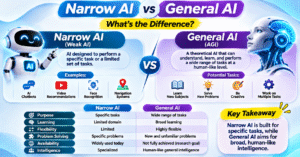
🤖 Narrow AI vs General AI: What’s the Difference?
Artificial Intelligence has become a part of our everyday lives.
We use AI in chatbots, voice assistants, recommendation systems, face recognition, navigation apps, and content creation tools.
But have you ever wondered how intelligent these systems really are?
Can an AI system perform only one specific task, or could it eventually understand and handle many different tasks like a human?
This brings us to an important comparison:
Narrow AI vs General AI
Let’s understand the difference in simple terms.
🎯 What is Narrow AI?
Narrow AI, also known as Weak AI, is an AI system designed to perform a specific task or a limited range of tasks.
It can become extremely effective at its particular job, but its abilities are generally limited to the tasks it was designed or trained for.
📱 Examples of Narrow AI
You may already use Narrow AI every day:
💬 AI Chatbots
📱 Face Recognition
🎬 Video Recommendations
🛒 Product Recommendations
🗣️ Voice Assistants
📧 Spam Filters
🗺️ Navigation Systems
For example, a face-recognition system can become very good at identifying faces.
But that does not mean the same system can automatically become a doctor, write a business strategy, or teach a class.
💡 In simple words:
Narrow AI = AI that is highly specialized for particular tasks.
🌍 What is General AI?
Artificial General Intelligence (AGI) is a theoretical concept describing an AI system that could understand and perform a wide variety of intellectual tasks at a human-like level.
Imagine an AI that could:
🧠 Learn new subjects
📚 Understand different types of information
💡 Solve unfamiliar problems
🎨 Create and reason creatively
🗣️ Communicate naturally
🔄 Apply knowledge from one situation to another
Instead of being built for one specific task, General AI would aim to have broad and flexible intelligence.
🤔 Does General AI Exist Today?
Not as a fully achieved technology.
AGI remains an active area of research and discussion.
Today’s AI systems can perform many impressive tasks, but they are not generally considered to have achieved human-level general intelligence.
⚔️ Narrow AI vs General AI
The biggest difference between the two is their capability and flexibility.
| Feature | Narrow AI | General AI |
|---|---|---|
| 🎯 Purpose | Specific tasks | Wide range of tasks |
| 🧠 Learning | Limited domain | Broad learning |
| 🔄 Flexibility | Limited | Highly flexible |
| 💡 Problem Solving | Specific problems | New and unfamiliar problems |
| 🌍 Availability | Widely used today | Not fully achieved |
| 🤖 Intelligence | Specialized | Human-like general intelligence |
💬 A Simple Example
Imagine you have an AI designed specifically to play chess.
It could become extremely good at chess and even compete at a very high level.
But if you suddenly ask:
“Create a business plan for my company.”
That chess-focused system would not automatically know how to do it.
This is an example of the limitation of Narrow AI.
Now imagine an AI that could play chess, create a business plan, learn a new language, research a topic, and solve a completely unfamiliar problem.
That is much closer to the concept of General AI.
⚡ Benefits of Narrow AI
One of the biggest strengths of Narrow AI is specialization.
It can perform specific tasks quickly and efficiently.
Key Benefits
⏱️ Saves Time
AI can automate repetitive tasks.
🎯 Task-Focused Performance
It can be highly effective within its specific domain.
⚙️ Automation
Businesses can automate routine processes.
📊 Data Analysis
AI can process large amounts of information and identify patterns.
💼 Business Support
AI can help improve workflows and customer experiences.
This is why Narrow AI is already widely used by businesses and individuals.
🚀 The Potential of General AI
If AGI is successfully developed in the future, its potential impact could be enormous.
A highly capable General AI could potentially assist with:
🔬 Scientific research
🎓 Personalized education
💡 Complex problem-solving
🏥 Healthcare research
💻 Software development
🌍 Large-scale decision support
However, developing such systems would also raise important questions about safety, ethics, control, responsibility, and human oversight.
⚠️ An Important Point
Modern AI tools can perform many different tasks, which can sometimes make them appear like General AI.
But performing multiple tasks does not automatically mean that an AI system has achieved human-level general intelligence.
It is important to understand both what an AI system can do and where its limitations are.
🎯 Final Thoughts
The biggest difference between Narrow AI and General AI is their scope.
Narrow AI is designed to perform specific tasks and is already a practical part of modern technology.
General AI, on the other hand, represents the goal of creating a system with broad, flexible, human-like intelligence.
🤖 In simple terms:
Narrow AI = Extremely good at specific tasks.
General AI = Designed to understand and learn across many different tasks.
The journey of AI is still evolving, and the development of increasingly capable systems could shape the future of technology, business, and society.
💬 What do you think would be the biggest change if General AI becomes a reality?
🤖 Narrow AI vs General AI: क्या अंतर है?
आज Artificial Intelligence हमारी daily life का हिस्सा बन चुका है।
हम AI chatbots, voice assistants, recommendation systems, face recognition और content-generation tools जैसी technologies का इस्तेमाल करते हैं।
लेकिन क्या आपने कभी सोचा है कि ये AI वास्तव में कितना intelligent है?
क्या कोई AI सिर्फ एक specific काम कर सकता है, या फिर वह इंसान की तरह अलग-अलग situations को समझकर कई तरह के काम कर सकता है?
यहीं से आता है एक important comparison:
Narrow AI vs General AI
आइए इसे आसान भाषा में समझते हैं।
🎯 Narrow AI क्या है?
Narrow AI, जिसे Weak AI भी कहा जाता है, ऐसा AI system है जिसे किसी specific task या limited range of tasks के लिए design किया जाता है।
यह अपने particular काम में बहुत अच्छा perform कर सकता है, लेकिन इसकी capabilities एक निश्चित सीमा तक होती हैं।
📱 Narrow AI के Examples
आप रोज़ाना कई जगह Narrow AI का इस्तेमाल कर सकते हैं:
💬 AI Chatbots
📱 Face Recognition
🎬 Video Recommendations
🛒 Product Recommendations
🗣️ Voice Assistants
📧 Spam Filters
🗺️ Navigation Systems
उदाहरण के लिए, एक face-recognition system हजारों चेहरों को पहचान सकता है।
लेकिन इसका मतलब यह नहीं है कि वही system अचानक कोई medical diagnosis या business strategy तैयार कर सकता है।
💡 आसान भाषा में:
Narrow AI = एक specific काम में expert AI.
🌍 General AI क्या है?
Artificial General Intelligence (AGI) एक ऐसी theoretical AI concept है जो इंसानों की तरह अलग-अलग प्रकार के intellectual tasks को समझ और perform कर सके।
कल्पना कीजिए कि एक ही AI system:
🧠 नई चीजें सीख सके
📚 अलग-अलग subjects समझ सके
💡 नए problems solve कर सके
🎨 Creative काम कर सके
🗣️ Natural conversation कर सके
🔄 अपनी learning को अलग situations में apply कर सके
यानी उसे हर नए काम के लिए अलग-अलग AI system की जरूरत न पड़े।
🤔 क्या General AI आज मौजूद है?
पूरी तरह से नहीं।
AGI अभी research और development का एक important goal है।
आज के AI systems कई impressive काम कर सकते हैं, लेकिन उन्हें generally human-level general intelligence वाला system नहीं माना जाता।
⚔️ Narrow AI vs General AI
दोनों के बीच सबसे बड़ा difference उनकी capability और flexibility है।
| Feature | Narrow AI | General AI |
|---|---|---|
| 🎯 Purpose | Specific tasks | कई तरह के tasks |
| 🧠 Learning | Limited domain | Broad learning |
| 🔄 Flexibility | Limited | बहुत ज्यादा |
| 💡 Problem Solving | Specific problems | नए problems भी |
| 🌍 Real-world Use | आज widely used | अभी theoretical |
| 🤖 Human-like Intelligence | नहीं | लक्ष्य human-like intelligence |
💬 एक आसान Example
मान लीजिए आपके पास एक AI है जो सिर्फ chess खेलने के लिए बनाया गया है।
वह chess में world-class performance दे सकता है।
लेकिन अगर आप उससे कहें—
“मेरे लिए एक business plan बनाओ.”
तो वह जरूरी नहीं कि यह काम कर पाए।
यही Narrow AI की limitation है।
अब imagine कीजिए एक AI ऐसा हो जो chess भी खेल सके, business plan भी समझ सके, नई language भी सीख सके और किसी बिल्कुल नए problem को भी solve कर सके।
यह concept General AI के ज्यादा करीब होगा।
⚡ Narrow AI के फायदे
Narrow AI की सबसे बड़ी strength है specialization।
यह किसी specific task को बहुत efficiently perform कर सकता है।
इसके फायदे:
⏱️ Time बचा सकता है
🎯 Specific tasks में accurate हो सकता है
⚙️ Repetitive काम automate कर सकता है
📊 Large data analyze कर सकता है
💼 Business processes को improve कर सकता है
इसीलिए आज businesses और individuals बड़े scale पर Narrow AI का इस्तेमाल कर रहे हैं।
🚀 General AI की Potential
अगर future में AGI successfully develop होती है, तो इसका impact बहुत बड़ा हो सकता है।
एक advanced General AI theoretically:
🔬 Research में मदद कर सकती है
🎓 Education को personalize कर सकती है
💡 Complex problems solve कर सकती है
🏥 Healthcare research में assistance दे सकती है
💻 Different types of software tasks संभाल सकती है
लेकिन इसके साथ safety, ethics, control और responsibility जैसे important questions भी जुड़ेंगे।
⚠️ एक जरूरी बात
आज के advanced AI tools को देखकर कभी-कभी लगता है कि वे General AI बन चुके हैं।
लेकिन ऐसा कहना सही नहीं होगा।
कोई AI कई अलग-अलग tasks perform कर सकता है, फिर भी इसका मतलब यह नहीं कि उसमें human-level general intelligence मौजूद है।
AI की capabilities को समझते समय उसकी limitations और reliability को भी ध्यान में रखना जरूरी है।
🎯 Final Thoughts
Narrow AI और General AI के बीच सबसे बड़ा difference यह है कि Narrow AI को specific tasks के लिए बनाया जाता है, जबकि General AI का goal इंसानों जैसी broad intelligence हासिल करना है।
आज हमारी दुनिया में Narrow AI practical reality है।
वहीं General AI अभी future research का एक बड़ा goal है।
🤖 आसान शब्दों में:
Narrow AI = एक काम में बहुत अच्छा।
General AI = अलग-अलग काम समझने और सीखने की क्षमता।
AI की journey अभी जारी है, और आने वाले वर्षों में यह technology कितनी आगे जाती है, यह देखना बेहद interesting होगा।
💬 आपके हिसाब से General AI आने के बाद दुनिया में सबसे बड़ा बदलाव किस field में होगा?