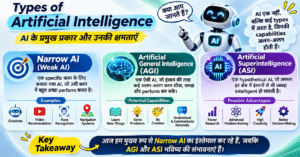
🤖 Types of Artificial Intelligence
Artificial Intelligence is not just one type of technology.
When people hear the word AI, they often imagine chatbots, robots, or tools that can create images. But AI is actually a much broader field with different types and capabilities.
Some AI systems are designed to perform one specific task, while more advanced concepts aim to handle a wide range of human-like intellectual activities.
So, what are the different types of Artificial Intelligence?
Let’s understand them in simple terms.
🧠 AI Can Be Classified in Different Ways
Artificial Intelligence is commonly classified based on how capable a system is and how it behaves or processes information.
A simple capability-based classification includes:
🔹 Narrow AI
🔹 General AI
🔹 Super AI
Let’s explore each one.
🎯 1. Narrow AI
Narrow AI, also called Weak AI, is AI designed to perform a specific task or a limited set of tasks.
This is the type of AI we use most often today.
For example:
📱 Face recognition
🎬 Video recommendations
🗣️ Voice assistants
📧 Spam detection
🛒 Product recommendations
🗺️ Navigation systems
💬 AI chatbots
A Narrow AI system can become very good at its specific task, but it does not have general human-like intelligence.
For example, an AI designed to recognize faces cannot automatically become a doctor, teacher, or pilot without being specifically designed and trained for those tasks.
💡 Simple Example
Think of a calculator.
A calculator can perform mathematical operations extremely quickly, but it cannot understand a conversation or recognize a person.
Narrow AI works in a similar way—it can be highly capable within its specific purpose.
🌍 2. Artificial General Intelligence
Artificial General Intelligence (AGI) is a theoretical form of AI that would have the ability to understand and perform a wide variety of intellectual tasks at a human-like level.
Imagine an AI that could:
🧠 Learn new subjects
📚 Understand different types of information
💡 Solve unfamiliar problems
🎨 Be creative
🗣️ Communicate naturally
🔄 Apply knowledge from one area to another
Unlike Narrow AI, AGI would not be limited to one specific task.
🤔 Does AGI Exist Today?
Not as a generally accepted, fully achieved technology.
AGI remains an active area of research and discussion.
Today’s AI systems can perform many impressive tasks, but that does not necessarily mean they have achieved human-level general intelligence.
🚀 3. Artificial Superintelligence
Artificial Superintelligence (ASI) is a hypothetical form of AI that would surpass human intelligence across a very broad range of areas.
In theory, such a system could potentially outperform humans in:
🔬 Scientific reasoning
🧠 Problem-solving
📊 Data analysis
🎨 Creativity
📚 Learning
⚙️ Complex decision-making
ASI does not currently exist.
It is mainly discussed as a future possibility and raises important questions about safety, control, ethics, and the relationship between humans and advanced AI systems.
🔄 Another Way to Understand AI: Based on Functionality
AI can also be described based on how a system responds to information and interacts with its environment.
⚡ 1. Reactive Machines
Reactive AI systems respond to current inputs without storing memories of past experiences.
They focus mainly on the information available at the moment.
A classic example is a chess-playing system that evaluates the current board position and chooses a move.
These systems can be effective at specific tasks but have limited ability to learn from past experiences.
🧠 2. Limited Memory AI
Limited Memory AI can use information from previous data or experiences for a limited period or specific purpose.
Many modern AI applications fit into this category.
Examples include:
🚗 Driver-assistance systems
🎬 Recommendation systems
🛒 Shopping recommendations
📱 Some personalization features
These systems can use historical information to improve their predictions or responses.
👀 3. Theory of Mind AI
Theory of Mind AI is a concept involving machines that could understand human emotions, intentions, beliefs, and social behavior in a much deeper way.
For example, such an AI might understand not just what a person says, but also their emotional state and intention.
This remains an area of research rather than a fully developed everyday technology.
🤖 4. Self-Aware AI
Self-Aware AI is a hypothetical concept involving machines that would have their own form of consciousness or self-awareness.
This is currently a concept explored mainly in theoretical discussions and science fiction.
There is no established evidence that today’s AI systems are genuinely self-aware.
🧩 What Type of AI Do We Use Today?
Most AI applications available today are forms of Narrow AI.
For example, when you use an AI tool to:
✍️ Write content
🖼️ Generate an image
🎥 Create a video
🎙️ Convert speech to text
📊 Analyze information
💬 Answer questions
the system is designed and trained to perform particular kinds of tasks.
Modern Generative AI can perform many different tasks, but that does not automatically mean it is Artificial General Intelligence.
🌟 Why Understanding AI Types Matters
Understanding the different types of AI helps us separate what AI can actually do today from what is still a future possibility.
It also helps us understand why one AI system may be excellent at one task but unable to perform another task without additional training or development.
As AI continues to evolve, knowing its capabilities and limitations will become increasingly important.
🎯 Final Thoughts
Artificial Intelligence is a huge and rapidly developing field.
From today’s Narrow AI to the theoretical possibilities of AGI and Superintelligence, AI represents a wide spectrum of ideas and technologies.
The important thing is to understand that not every AI system is the same.
Some are designed for one specific task. Others are being developed to handle increasingly complex and diverse problems.
🚀 The future of AI is still being written.
And understanding its different types is the first step toward understanding where this technology could take us next.
💬 Which type of AI do you think will have the biggest impact on our future?
🤖 Types of Artificial Intelligence: AI के प्रकार
आज Artificial Intelligence यानी AI हमारी जिंदगी का हिस्सा बन चुका है।
हम AI का इस्तेमाल questions के answers पाने, images बनाने, videos create करने, recommendations लेने और information analyze करने के लिए कर रहे हैं।
लेकिन क्या आपको पता है कि हर AI एक जैसा नहीं होता?
AI की capability और उसके काम करने के तरीके के आधार पर इसे अलग-अलग types में समझा जा सकता है।
आइए आसान भाषा में जानते हैं Artificial Intelligence के मुख्य प्रकार।
🎯 1. Narrow AI – एक खास काम के लिए AI
Narrow AI, जिसे Weak AI भी कहा जाता है, किसी particular task या limited काम को करने के लिए बनाया जाता है।
आज हम जिस AI का सबसे ज्यादा इस्तेमाल करते हैं, उसका बड़ा हिस्सा इसी category में आता है।
इसके examples हैं:
📱 Face Recognition
🎬 Video Recommendations
🗣️ Voice Assistants
📧 Spam Detection
🛒 Product Recommendations
🗺️ Navigation Systems
💬 AI Chatbots
Narrow AI अपने specific काम में बहुत अच्छा perform कर सकता है, लेकिन वह हर तरह का काम इंसान की तरह नहीं कर सकता।
💡 आसान Example
मान लीजिए एक AI system सिर्फ चेहरा पहचानने के लिए बनाया गया है।
वह हजारों faces को पहचान सकता है, लेकिन इसका मतलब यह नहीं है कि वह automatically doctor, teacher या accountant का काम भी कर पाएगा।
यानी—
Narrow AI = एक खास काम में expert AI.
🌍 2. Artificial General Intelligence – इंसान जैसी General Intelligence
Artificial General Intelligence यानी AGI एक ऐसी theoretical AI है जो इंसानों की तरह अलग-अलग तरह के intellectual tasks को समझ और perform कर सके।
कल्पना कीजिए कि एक AI:
🧠 नई चीजें सीख सके
📚 अलग-अलग subjects समझ सके
💡 नए problems solve कर सके
🎨 Creative ideas दे सके
🗣️ Natural conversation कर सके
🔄 एक काम से मिली learning को दूसरे काम में use कर सके
यानी उसे हर नए काम के लिए अलग-अलग system की जरूरत न पड़े।
🤔 क्या AGI आज मौजूद है?
नहीं, पूरी तरह से नहीं।
AGI अभी research और discussion का एक बड़ा topic है।
आज के AI systems कई complex tasks कर सकते हैं, लेकिन उन्हें generally human-level general intelligence वाला system नहीं माना जाता।
🚀 3. Artificial Superintelligence – इंसानों से भी आगे?
Artificial Superintelligence यानी ASI एक hypothetical concept है।
इसका मतलब ऐसी AI से है जो लगभग हर intellectual area में human intelligence से काफी आगे निकल जाए।
Theory के अनुसार ऐसी AI—
🔬 Scientific research में
🧠 Complex problem-solving में
📊 Data analysis में
🎨 Creativity में
📚 Learning में
⚙️ Decision-making में
इंसानों से बेहतर performance कर सकती है।
लेकिन सबसे important बात—
⚠️ ASI अभी मौजूद नहीं है।
यह फिलहाल एक future possibility और theoretical concept है।
अगर कभी ऐसी technology विकसित होती है, तो इससे safety, ethics, control और human society से जुड़े कई important questions सामने आ सकते हैं।
🔄 AI को उसके काम करने के तरीके से भी समझ सकते हैं
AI को सिर्फ उसकी capability के आधार पर ही नहीं, बल्कि उसके function करने के तरीके के आधार पर भी समझा जाता है।
⚡ 1. Reactive Machines
Reactive AI सिर्फ current situation या available information के आधार पर response देता है।
यह past experiences को उसी तरह याद करके use नहीं करता जैसे इंसान करता है।
उदाहरण के तौर पर, कोई chess-playing system current board को देखकर अगली चाल choose कर सकता है।
यानी—
Current Input → Analysis → Response
🧠 2. Limited Memory AI
Limited Memory AI कुछ previous information या data का इस्तेमाल करके बेहतर prediction या response दे सकता है।
आज के कई AI applications में इस तरह की functionality देखने को मिलती है।
Examples:
🚗 Driver-Assistance Systems
🎬 Recommendation Systems
🛒 Online Shopping Recommendations
📱 Personalized Services
यह systems available data के आधार पर अपने results को improve करने में मदद कर सकते हैं।
👀 3. Theory of Mind AI
Theory of Mind AI एक advanced concept है।
इसका goal ऐसी AI बनाना है जो इंसानों के:
❤️ Emotions
🧠 Beliefs
💭 Intentions
🗣️ Social Behavior
को ज्यादा गहराई से समझ सके।
उदाहरण के लिए, AI सिर्फ यह न समझे कि आपने क्या कहा, बल्कि यह भी समझ सके कि आप किस emotion या intention के साथ कह रहे हैं।
यह अभी research का हिस्सा है और पूरी तरह developed technology नहीं है।
🤖 4. Self-Aware AI
Self-Aware AI AI का एक hypothetical concept है।
इसमें ऐसी machine की कल्पना की जाती है जिसमें किसी प्रकार की self-awareness या consciousness हो।
यानी machine सिर्फ information process न करे, बल्कि अपने existence को भी समझे।
लेकिन आज की AI systems के बारे में ऐसा मानने का कोई established evidence नहीं है कि वे वास्तव में self-aware या conscious हैं।
📱 आज हम किस प्रकार की AI इस्तेमाल करते हैं?
आज इस्तेमाल होने वाली ज्यादातर AI technologies को broadly Narrow AI के रूप में समझा जा सकता है।
जब आप AI की मदद से—
✍️ Content लिखते हैं
🖼️ Image बनाते हैं
🎥 Video create करते हैं
🎙️ Speech को text में बदलते हैं
📊 Data analyze करते हैं
💬 Questions के answers लेते हैं
तो system एक या कई specific capabilities के लिए designed और trained होता है।
💡 याद रखें:
Generative AI का मतलब automatically AGI नहीं है।
Generative AI text, images, audio, video और code जैसे content generate कर सकता है, लेकिन इससे यह साबित नहीं होता कि वह human-level general intelligence रखता है।
🌟 AI के Types समझना क्यों जरूरी है?
AI के अलग-अलग types को समझने से हमें यह पता चलता है कि आज AI वास्तव में क्या कर सकता है और future में क्या possible हो सकता है।
कई बार हम AI को देखकर सोचते हैं कि machine हर काम कर सकती है।
लेकिन reality यह है कि अलग-अलग AI systems की capabilities और limitations अलग होती हैं।
इसलिए AI को समझने के लिए सिर्फ उसकी power देखना जरूरी नहीं है।
उसकी limitations समझना भी उतना ही important है।
🎯 Final Thoughts
Artificial Intelligence एक बहुत बड़ा और तेजी से विकसित होने वाला field है।
Narrow AI से लेकर theoretical AGI और Superintelligence तक, AI के कई अलग-अलग concepts हैं।
आज हम mostly ऐसे AI systems इस्तेमाल कर रहे हैं जो specific tasks में बहुत powerful हैं।
लेकिन future में AI कितना आगे जाएगा, यह technology, research और responsible development पर depend करेगा।
🚀 एक बात तय है—
AI का evolution अभी खत्म नहीं हुआ है। असली कहानी अभी आगे लिखी जानी बाकी है।
💬 आपके हिसाब से future में AI का कौन-सा type सबसे ज्यादा powerful हो सकता है?