🤖 History and Evolution of AI
Today, Artificial Intelligence can write content, create images, answer questions, analyze information, generate videos, and help businesses make smarter decisions.
But AI did not become this powerful overnight.
Behind today’s AI tools is a long journey of research, experiments, breakthroughs, challenges, and innovation.
So, where did AI actually begin?
Let’s take a simple journey through the history and evolution of Artificial Intelligence.
🕰️ Where Did the Idea of AI Begin?
The idea of creating machines that could think and behave intelligently is much older than modern computers.
For decades, scientists, mathematicians, and inventors imagined machines that could solve problems, understand language, and make decisions.
However, AI became a serious scientific field during the 20th century, when computers started becoming more powerful.
🧠 The 1950s – The Foundation of AI
One of the most important names in the early history of AI is Alan Turing.
In 1950, Turing published an influential paper that asked an important question:
“Can machines think?”
He also introduced the idea that became known as the Turing Test, a way of considering whether a machine could demonstrate human-like conversational behavior.
This helped start serious discussions about machine intelligence.
💡 1956 – The Birth of Artificial Intelligence
The year 1956 is considered a major milestone in AI history.
During a research workshop at Dartmouth College, computer scientist John McCarthy used the term “Artificial Intelligence.”
Researchers believed that machines could eventually be designed to:
🧠 Learn
🔎 Solve problems
💬 Understand language
📚 Use knowledge
🎯 Make decisions
This marked the beginning of AI as a recognized field of research.
💻 The 1960s – Early AI Programs
During the 1960s, researchers began developing computer programs designed to solve specific problems.
Some early AI systems focused on:
- Mathematical reasoning
- Logical problem-solving
- Language processing
- Game playing
One famous example was ELIZA, an early computer program designed to simulate a conversation with a human.
It was very simple compared with today’s AI, but it demonstrated an exciting possibility: computers could interact with people using language.
❄️ The 1970s and 1980s – The AI Winter
Early excitement about AI was followed by major challenges.
Computers at the time had limited processing power, limited memory, and access to far less data than modern systems.
Many ambitious AI predictions could not be achieved.
As expectations fell, funding and interest in some areas of AI research declined.
This period became known as the “AI Winter.”
However, AI research did not stop completely. Scientists continued working on new approaches.
🏢 The 1980s – Expert Systems
During the 1980s, Expert Systems became an important area of AI.
These systems were designed to solve specific problems by using knowledge and rules provided by human experts.
For example, an expert system could use a collection of rules to help analyze a particular technical or medical problem.
Although these systems had limitations, they showed businesses that AI could have practical applications.
♟️ The 1990s – A New AI Breakthrough
The 1990s brought new progress in computing power and AI research.
One of the most famous moments came in 1997, when IBM’s chess computer Deep Blue defeated world chess champion Garry Kasparov in a match.
This was a major milestone.
It showed that computers could perform extremely well in complex strategic tasks.
🌐 The 2000s – Big Data Changes Everything
The growth of the Internet created something AI desperately needed:
More data.
People started generating enormous amounts of digital information through websites, smartphones, online services, photos, videos, and social media.
At the same time, computers became faster and storage became cheaper.
This combination of:
More Data + More Computing Power + Better Algorithms
helped Machine Learning become increasingly powerful.
📱 The 2010s – AI Enters Everyday Life
During the 2010s, AI moved beyond research labs and became part of everyday technology.
You started seeing AI in:
📱 Smartphones
🎬 Video recommendations
🛒 Online shopping
🗣️ Voice assistants
📸 Face recognition
🗺️ Navigation apps
📧 Spam filters
AI was becoming something ordinary people could interact with every day.
🧠 The Rise of Deep Learning
One of the biggest developments during this period was the rapid growth of Deep Learning.
Deep learning uses neural networks with multiple layers to learn patterns from large amounts of data.
It dramatically improved performance in areas such as:
- Image recognition
- Speech recognition
- Natural language processing
- Recommendation systems
This became one of the foundations of modern AI.
🤖 The 2020s – The Rise of Generative AI
The latest major chapter in AI’s evolution is Generative AI.
Unlike traditional systems that mainly classify or predict information, generative AI can create new content.
For example, AI can now help generate:
📝 Text
🖼️ Images
🎥 Videos
🎵 Music
💻 Computer code
💡 Creative ideas
AI assistants and conversational AI have also made advanced AI technology accessible to millions of people.
You no longer need to be a computer scientist to interact with AI.
🚀 AI Evolution at a Glance
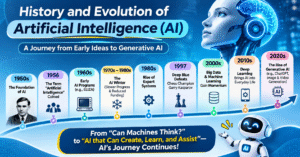
The journey of AI can be summarized like this:
1950s → Early ideas about machine intelligence
⬇️
1956 → The term “Artificial Intelligence” emerges
⬇️
1960s → Early AI programs
⬇️
1970s–80s → AI Winter and Expert Systems
⬇️
1990s → Major computing and AI breakthroughs
⬇️
2000s → Internet, Big Data and Machine Learning
⬇️
2010s → Deep Learning and everyday AI
⬇️
2020s → Generative AI and AI assistants
🌍 What Does the Future of AI Look Like?
The evolution of AI is far from over.
AI is continuing to develop across areas such as:
🏥 Healthcare
🎓 Education
💼 Business
🔬 Scientific Research
🚗 Transportation
🎨 Creative Industries
💻 Software Development
Future AI systems may become more capable, personalized, and deeply integrated into everyday life.
At the same time, important questions around privacy, safety, bias, security, jobs, and responsible AI development will become increasingly important.
🎯 Final Thoughts
The history of Artificial Intelligence is a story of big ideas, unexpected challenges, breakthroughs, and continuous innovation.
From asking “Can machines think?” to creating systems that can generate text, images, code, audio, and video, AI has come a remarkably long way.
And the most exciting part?
🚀 The history of AI is still being written.
We may be living through one of the most important chapters in the evolution of technology.
What do you think the next big breakthrough in AI will be? 💬
🤖 History and Evolution of AI: AI का इतिहास और विकास
आज हम Artificial Intelligence (AI) की मदद से images बना सकते हैं, questions के answers पा सकते हैं, videos create कर सकते हैं और complex information को कुछ seconds में समझ सकते हैं।
लेकिन क्या आपने कभी सोचा है कि AI की शुरुआत कहाँ से हुई?
आज की powerful AI technology एक दिन में नहीं बनी। इसके पीछे कई दशकों की research, experiments और technological development की कहानी है।
आइए जानते हैं AI के सफर के बारे में—शुरुआत से लेकर आज के Generative AI तक।
🕰️ AI की शुरुआत का विचार कहाँ से आया?
Artificial Intelligence का concept नया जरूर लगता है, लेकिन intelligent machines का idea काफी पुराना है।
लोग लंबे समय से ऐसी machines की कल्पना करते रहे हैं जो इंसानों की तरह सोच सकें, सीख सकें और problems solve कर सकें।
लेकिन AI को एक scientific field के रूप में develop करने की शुरुआत 20वीं century में तेजी से हुई।
🧠 1950s – AI की नींव
AI के इतिहास में Alan Turing का नाम बहुत महत्वपूर्ण है।
1950 में उन्होंने एक प्रसिद्ध paper में यह सवाल उठाया कि—
“Can machines think?”
उन्होंने यह समझने का तरीका भी propose किया कि क्या कोई machine इंसान की तरह बातचीत कर सकती है।
इसी idea से आगे चलकर Turing Test की concept सामने आई।
यह AI के इतिहास में एक important milestone माना जाता है।
💡 1956 – “Artificial Intelligence” नाम आया
साल 1956 AI के इतिहास में बहुत खास माना जाता है।
एक research workshop में John McCarthy ने पहली बार “Artificial Intelligence” term का इस्तेमाल किया।
यहीं से AI को एक अलग research field के रूप में पहचान मिलने लगी।
Researchers का सपना था कि machines को इस तरह बनाया जाए कि वे—
🧠 सोच सकें
📚 सीख सकें
🔎 problems solve कर सकें
💬 language समझ सकें
यह AI journey का एक बड़ा turning point था।
💻 1960s – शुरुआती AI Programs
1960s में researchers ने ऐसे computer programs बनाने शुरू किए जो simple problems solve कर सकते थे।
कुछ systems mathematical problems, language processing और logical reasoning जैसे tasks पर काम कर रहे थे।
इसी दौर में ELIZA जैसे early conversational programs भी सामने आए।
ELIZA इंसानों के साथ text-based conversation करने की कोशिश करता था।
हालांकि यह आज के ChatGPT जैसा intelligent system नहीं था, लेकिन इसने दिखाया कि computers इंसानों के साथ conversation का simulation कर सकते हैं।
❄️ 1970s–1980s – AI Winter
AI research में शुरुआती excitement के बाद कई challenges सामने आए।
उस समय computers की processing power limited थी और available data भी आज की तुलना में बहुत कम था।
AI systems से जो expectations थीं, technology उन्हें पूरी तरह पूरा नहीं कर पा रही थी।
इसके कारण AI research और funding में कमी आई।
इस period को “AI Winter” कहा जाता है।
AI Winter का मतलब यह नहीं था कि AI पूरी तरह बंद हो गया था। Research जारी रही, लेकिन progress और investment अपेक्षाकृत धीमी हो गई।
🏢 1980s – Expert Systems का दौर
1980s में Expert Systems काफी popular हुए।
इन systems को किसी particular field के experts की knowledge और rules के आधार पर बनाया जाता था।
उदाहरण के लिए, कोई system medical symptoms या business problems से जुड़ी information के आधार पर possible conclusions देने में मदद कर सकता था।
यह AI के practical business applications की दिशा में एक important step था।
♟️ 1990s – AI ने दिखाई नई ताकत
1990s में computers की power बढ़ने लगी और AI research ने फिर से momentum पकड़ना शुरू किया।
साल 1997 में IBM का Deep Blue chess computer world chess champion Garry Kasparov को match में हराने में सफल रहा।
यह moment पूरी दुनिया के लिए काफी interesting था।
इसने दिखाया कि computers complex strategic games में भी powerful performance दे सकते हैं।
🌐 2000s – Data और Internet ने बदला AI
2000s में Internet तेजी से बढ़ा।
लोगों ने पहले से कहीं ज्यादा digital data create करना शुरू किया।
इसके साथ computers की processing power और storage capabilities भी improve हुईं।
AI के लिए यह बहुत बड़ा बदलाव था।
अब machines को train करने के लिए पहले की तुलना में कहीं ज्यादा data available था।
इसी समय Machine Learning का importance तेजी से बढ़ा।
📱 2010s – AI हमारी Daily Life में आया
2010s में AI सिर्फ research laboratories तक सीमित नहीं रहा।
AI हमारी daily life का हिस्सा बनने लगा।
📱 Smartphones
🎬 Video recommendations
🛒 Online shopping
🗣️ Voice assistants
📸 Face recognition
🚗 Navigation systems
इन सभी areas में AI का इस्तेमाल बढ़ने लगा।
इसी दौर में Deep Learning ने भी AI की capabilities को काफी आगे बढ़ाया।
🧠 2012 – Deep Learning का बड़ा बदलाव
2012 के आसपास deep learning ने image recognition जैसे tasks में बहुत impressive results दिखाने शुरू किए।
Neural networks और बड़ी मात्रा में data का इस्तेमाल करके machines images और patterns को पहले से बेहतर तरीके से पहचानने लगीं।
इस development ने modern AI revolution को तेज करने में बड़ी भूमिका निभाई।
🤖 2020s – Generative AI का दौर
अब हम AI के एक नए phase में हैं—Generative AI।
Generative AI सिर्फ information analyze नहीं करता, बल्कि नया content generate भी कर सकता है।
आज AI की मदद से हम—
📝 Articles और text लिख सकते हैं
🖼️ Images generate कर सकते हैं
🎥 Videos create कर सकते हैं
🎵 Music बना सकते हैं
💻 Code लिखने में assistance ले सकते हैं
💡 New ideas generate कर सकते हैं
Chatbots और AI assistants ने AI को आम लोगों तक और भी आसानी से पहुंचा दिया है।
🚀 AI का Evolution एक नजर में
AI का सफर कुछ इस तरह समझ सकते हैं:
1950s → AI के शुरुआती ideas
⬇️
1956 → Artificial Intelligence term popular हुई
⬇️
1960s → शुरुआती AI programs
⬇️
1970s–80s → AI Winter और Expert Systems
⬇️
1990s → Powerful computer systems और Deep Blue
⬇️
2000s → Internet + Big Data + Machine Learning
⬇️
2010s → Deep Learning और everyday AI
⬇️
2020s → Generative AI और AI assistants
🌍 AI का Future कहाँ जा रहा है?
AI का evolution अभी खत्म नहीं हुआ है।
Technology लगातार improve हो रही है और AI को healthcare, education, business, science, transportation और creative industries में नए तरीकों से इस्तेमाल किया जा रहा है।
लेकिन AI का future सिर्फ technology पर depend नहीं करेगा।
Responsible development, privacy, safety और human decision-making भी उतने ही important होंगे।
🎯 आखिर में…
Artificial Intelligence का सफर “Can machines think?” जैसे सवाल से शुरू होकर आज ऐसे systems तक पहुंच चुका है जो text, images, audio और कई तरह का digital content generate कर सकते हैं।
AI ने कई बार progress और challenges दोनों देखे हैं।
और सबसे interesting बात यह है कि—
🚀 AI की history अभी खत्म नहीं हुई है… शायद हम इसके सबसे exciting chapter में हैं।
आज का AI आने वाले वर्षों में किस रूप में बदलेगा, यह देखना बेहद interesting होगा।
💬 आपके हिसाब से AI का अगला बड़ा बदलाव क्या होगा?