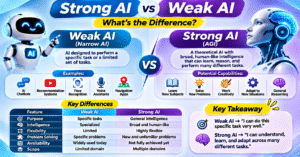
🤖 Strong AI vs Weak AI: What’s the Difference?
Artificial Intelligence has become a part of our everyday lives. From chatbots and voice assistants to recommendation systems and face recognition, AI is helping machines perform tasks that once required human intelligence.
But not all AI systems have the same level of capability.
You may have heard the terms Weak AI and Strong AI. What do they actually mean?
Let’s break it down in simple terms.
🎯 What is Weak AI?
Weak AI, also known as Narrow AI, is designed to perform a specific task or a limited range of tasks.
It can become extremely good at its particular job, but its abilities are generally limited to the area it was designed or trained for.
📱 Examples of Weak AI
You interact with Weak AI more often than you may realize:
💬 AI Chatbots
📱 Face Recognition
🎬 Recommendation Systems
🗣️ Voice Assistants
📧 Spam Filters
🗺️ Navigation Apps
🛒 Product Recommendations
For example, a recommendation system can analyze your viewing or shopping history and suggest content or products you may like.
However, it cannot automatically become a doctor, teacher, or business strategist.
💡 In simple words:
Weak AI = AI designed for specific tasks.
🧠 What is Strong AI?
Strong AI is a concept describing an AI system with broad, human-like intelligence.
Instead of being limited to one particular task, Strong AI would theoretically be able to understand, learn, reason, and solve many different types of problems.
Imagine an AI that could:
🧠 Learn new subjects
📚 Understand different types of information
💡 Solve unfamiliar problems
🗣️ Communicate naturally
🎨 Work creatively
🔄 Apply knowledge to new situations
This idea is closely related to the concept of Artificial General Intelligence (AGI).
🤔 Does Strong AI Exist Today?
Not as a fully achieved technology.
Strong AI or AGI remains a major area of research and discussion.
Today’s AI systems can perform many impressive tasks, but that does not necessarily mean they possess human-level general intelligence.
⚔️ Strong AI vs Weak AI
| Feature | Weak AI | Strong AI |
|---|---|---|
| 🎯 Purpose | Specific tasks | General intelligence |
| 🧠 Intelligence | Specialized | Broad and human-like |
| 🔄 Flexibility | Limited | Highly flexible |
| 💡 Problem Solving | Specific problems | New and unfamiliar problems |
| 📱 Availability | Widely used today | Not fully achieved |
| 🌍 Scope | Limited domain | Multiple domains |
💬 A Simple Example
Imagine an AI system designed specifically to play chess.
It could become extremely good at chess.
But if you ask it:
“Create a marketing campaign for my business.”
It would not automatically know how to do it.
That is a limitation of Weak AI.
Now imagine an AI that could play chess, create a marketing strategy, learn a new language, research a topic, and solve an unfamiliar problem.
That would be much closer to the concept of Strong AI.
⚡ Benefits of Weak AI
Weak AI is already a practical technology and provides many benefits.
⏱️ Saves Time
AI can automate repetitive tasks and help people work faster.
🎯 Specialized Performance
AI can be highly effective within a specific area.
📊 Data Processing
AI can analyze large amounts of data and identify patterns.
💼 Business Support
Businesses can use AI for customer service, marketing, automation, and analysis.
📱 Everyday Convenience
Recommendations, voice assistants, smart search, and other AI-powered features can make everyday tasks easier.
🚀 The Potential of Strong AI
If Strong AI or AGI is successfully developed in the future, its potential impact could be enormous.
It could theoretically assist with:
🔬 Scientific research
🏥 Healthcare research
🎓 Personalized education
💻 Complex software development
🌍 Large-scale problem solving
💡 Creative and strategic work
However, advanced AI would also raise important questions about safety, ethics, control, privacy, and human oversight.
⚠️ A Common Misunderstanding
A common misconception is that an AI system becomes Strong AI simply because it can perform many different tasks.
That’s not necessarily true.
An AI can have multiple capabilities while still being a specialized system.
Strong AI refers to a much broader concept involving general, flexible, human-like intelligence.
Understanding the difference between capability and general intelligence is important when discussing the future of AI.
🌟 The Simplest Way to Understand the Difference
Think of it this way:
Weak AI → “I can do this specific task very well.”
Strong AI → “I can understand, learn, and adapt across many different tasks.”
That is the key difference.
🎯 Final Thoughts
Weak AI is already all around us. It powers many of the apps, websites, tools, and services we use every day.
Strong AI, on the other hand, remains a future possibility and an important area of AI research.
As Artificial Intelligence continues to evolve, the question is no longer just about making machines better at individual tasks.
The bigger question is:
🚀 How far can we take machine intelligence?
The answer may shape the future of technology—and society itself.
💬 Do you think Strong AI will become a reality someday?
🤖 Strong AI vs Weak AI: क्या अंतर है?
Artificial Intelligence की दुनिया में आपने Weak AI और Strong AI जैसे terms जरूर सुने होंगे।
लेकिन इन दोनों का मतलब क्या है?
क्या Weak AI कम powerful होता है और Strong AI ज्यादा powerful?
सिर्फ इतना समझना काफी नहीं है।
असल difference यह है कि Weak AI specific tasks पर focused होता है, जबकि Strong AI का concept ऐसी intelligence को describe करता है जो इंसानों की तरह broadly समझ और reasoning कर सके।
आइए इसे आसान भाषा में समझते हैं।
🎯 What is Weak AI?
Weak AI, जिसे Narrow AI भी कहा जाता है, ऐसा AI है जिसे किसी specific task या limited set of tasks के लिए बनाया जाता है।
यह अपने काम में बहुत अच्छा perform कर सकता है, लेकिन इसकी intelligence एक particular purpose तक सीमित होती है।
📱 Weak AI के Examples
आप रोज़ाना Weak AI के कई examples देख सकते हैं:
💬 AI Chatbots
📱 Face Recognition
🎬 Recommendation Systems
🗣️ Voice Assistants
📧 Spam Filters
🗺️ Navigation Apps
🛒 Product Recommendations
उदाहरण के लिए, Netflix या YouTube जैसा recommendation system आपकी पसंद के हिसाब से videos suggest कर सकता है।
लेकिन वह अपने आप doctor, lawyer या teacher की तरह हर तरह का काम नहीं कर सकता।
💡 आसान शब्दों में:
Weak AI = Specific काम के लिए बनाया गया AI.
🧠 What is Strong AI?
Strong AI एक concept है जिसमें ऐसी AI की कल्पना की जाती है जो इंसानों की तरह general intelligence, reasoning और understanding रख सके।
यानी ऐसी AI जो सिर्फ एक काम करने के बजाय कई अलग-अलग situations को समझ सके।
कल्पना कीजिए कि एक AI:
🧠 नई चीजें खुद सीख सके
📚 अलग-अलग subjects समझ सके
💡 नए और unfamiliar problems solve कर सके
🗣️ इंसानों की तरह naturally communicate कर सके
🎨 Creative तरीके से सोच सके
🔄 अपनी knowledge को नई situations में apply कर सके
यही Strong AI के concept के करीब है।
🤔 क्या Strong AI आज मौजूद है?
पूरी तरह से नहीं।
Strong AI को अक्सर Artificial General Intelligence (AGI) के concept से जोड़ा जाता है।
AGI अभी research और development का एक major goal है।
आज के AI systems कई impressive tasks perform कर सकते हैं, लेकिन इसका मतलब यह नहीं कि उन्होंने human-level general intelligence हासिल कर ली है।
⚔️ Strong AI vs Weak AI
| Feature | Weak AI | Strong AI |
|---|---|---|
| 🎯 Purpose | Specific tasks | General intelligence |
| 🧠 Intelligence | Specialized | Broad & human-like |
| 🔄 Flexibility | Limited | Highly flexible |
| 💡 Problem Solving | Known/specific tasks | New & unfamiliar problems |
| 📱 Availability | Widely used today | Not fully achieved |
| 🌍 Scope | Limited domain | Multiple domains |
💬 एक आसान Example
मान लीजिए आपके पास एक AI है जो सिर्फ chess खेलने के लिए बनाया गया है।
वह chess में बहुत अच्छा हो सकता है।
लेकिन अगर आप उससे कहें:
“मेरे लिए एक marketing campaign बनाओ.”
तो वह automatically marketing expert नहीं बन जाएगा।
यह Weak AI का example है।
अब imagine कीजिए एक AI ऐसा हो जो chess भी खेले, marketing strategy भी समझे, नई language भी सीखे और बिल्कुल नए problem को भी solve करे।
यह concept Strong AI के ज्यादा करीब होगा।
⚡ Weak AI के फायदे
Weak AI आज practical technology है और इसके कई benefits हैं।
⏱️ Time Saving
Repetitive tasks को automate करके time बचाया जा सकता है।
🎯 Specialization
AI अपने specific task में बहुत efficient हो सकता है।
📊 Data Processing
Large amounts of data को quickly analyze किया जा सकता है।
💼 Business Support
Businesses customer service, marketing और automation में AI का इस्तेमाल कर सकते हैं।
📱 Everyday Convenience
Recommendations, voice assistants और smart features हमारी daily life को आसान बना सकते हैं।
🚀 Strong AI की Potential
अगर future में Strong AI या AGI develop होती है, तो इसका impact बहुत बड़ा हो सकता है।
यह theoretically:
🔬 Scientific research में मदद कर सकती है
🏥 Healthcare research को support कर सकती है
🎓 Personalized education provide कर सकती है
💻 Complex software problems solve कर सकती है
🌍 Large-scale challenges को analyze कर सकती है
💡 नए ideas और solutions generate कर सकती है
लेकिन इसके साथ AI safety, ethics, control और human oversight जैसे important issues भी सामने आएंगे।
⚠️ Strong AI को लेकर Confusion
एक common misunderstanding यह है कि जो AI बहुत सारे काम कर सकता है, वह automatically Strong AI है।
ऐसा जरूरी नहीं है।
किसी AI system की कई capabilities हो सकती हैं, लेकिन इससे यह साबित नहीं होता कि उसमें human-like general intelligence या consciousness है।
इसलिए AI की capabilities को समझते समय उसके actual design और limitations को देखना जरूरी है।
🌟 Strong AI vs Weak AI – सबसे आसान Difference
इसे एक line में समझना हो तो:
Weak AI → “मैं यह काम बहुत अच्छा कर सकता हूँ।”
Strong AI → “मैं अलग-अलग तरह के काम समझकर सीख सकता हूँ।”
यही दोनों concepts के बीच सबसे important difference है।
🎯 Final Thoughts
Weak AI आज हमारे आसपास मौजूद है और smartphones, websites, apps और businesses में बड़े scale पर इस्तेमाल हो रहा है।
Strong AI, दूसरी तरफ, अभी एक advanced concept और research goal है।
AI technology तेजी से आगे बढ़ रही है, इसलिए आने वाले वर्षों में Strong AI और AGI को लेकर research और discussions और भी interesting हो सकते हैं।
🚀 AI का future सिर्फ ज्यादा powerful machines के बारे में नहीं है—बल्कि यह समझने के बारे में भी है कि intelligence को technology में कितनी दूर तक replicate किया जा सकता है।
💬 आपके हिसाब से Strong AI future में reality बनेगा?