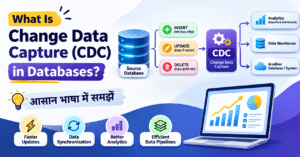
What Is Change Data Capture (CDC) in Databases? A Complete Guide
📌 Introduction to Change Data Capture (CDC)
In modern applications, databases are constantly updated with new records, modified information, and deleted entries. Keeping multiple systems synchronized with these changes can be challenging, especially when dealing with large volumes of data. Change Data Capture (CDC) is a data management technique that identifies changes made to a database and delivers them to other systems for further processing.
CDC helps organizations move updated data efficiently without repeatedly transferring entire database tables. It is widely used in real-time analytics, data integration, reporting systems, and modern data pipelines.
🔍 What Is Change Data Capture (CDC)?
Change Data Capture (CDC) is a technique used to detect and track changes such as INSERT, UPDATE, and DELETE operations in a database. Instead of copying all the data repeatedly, CDC captures only the records that have changed since the previous synchronization.
For example, imagine an e-commerce website where a customer places an order. When a new order is added to the database, a CDC system can detect this change and send the updated information to an analytics platform, reporting dashboard, or another database.
This approach reduces unnecessary data transfers and helps downstream systems receive fresh information more efficiently.
⚙️ How Does Change Data Capture Work?
CDC typically follows a sequence of steps to identify and distribute database changes.
1. 📝 Detect Database Changes
The CDC mechanism monitors database activity and identifies newly inserted, updated, or deleted records. Depending on the implementation, it may use transaction logs, database triggers, or timestamp-based queries.
2. 📥 Capture the Changed Data
After detecting an operation, the system collects relevant information about the change. This may include the affected record, the type of operation, and metadata such as a transaction position or event timestamp.
3. 🔄 Process and Transform Events
Captured changes can be validated, filtered, transformed, or enriched before being delivered to their destination. Some systems process events immediately, while others collect them in batches.
4. 🚀 Deliver Changes to Target Systems
The captured information is sent to another database, a data warehouse, a streaming platform, a cache, or an analytics application.
5. 📊 Keep Systems Synchronized
The destination system applies the changes so that it can maintain an updated view of the source data. Reliable implementations also account for duplicate events, ordering, retries, and recovery after failures.
🧩 Types of Change Data Capture Techniques
Different CDC techniques are suitable for different database environments and business requirements.
📘 1. Log-Based CDC
Log-based CDC reads database transaction logs to identify changes. Since it can capture changes without running a separate query for every modified record, it is often suitable for high-volume and near-real-time data pipelines.
Example: A CDC connector reads committed changes from a MySQL binary log and forwards them to a streaming platform.
Best suited for: Real-time data integration, large databases, and continuous data pipelines.
🔔 2. Trigger-Based CDC
Trigger-based CDC uses database triggers that execute when specific INSERT, UPDATE, or DELETE operations occur. The triggers can write change information into a separate tracking table for later processing.
Example: When a customer updates their email address, a database trigger records the change in an audit table.
Best suited for: Applications that require database-level change tracking and environments where trigger overhead is acceptable.
⏱️ 3. Timestamp-Based CDC
Timestamp-based CDC identifies records using a column such as updated_at or modified_time. A process periodically queries for records modified after the last successful checkpoint.
Example: A scheduled job fetches all customer records updated since its previous run.
Best suited for: Simple integrations, periodic synchronization, and systems with reliable modification timestamps.
Limitation: Timestamp-based approaches may miss hard-deleted records unless deletions are tracked separately. Timestamp precision, clock differences, and checkpoint handling also require careful design.
📂 4. Snapshot-Based Change Detection
Snapshot-based detection compares data captured at different points in time to identify additions, modifications, or removals. Unlike log-based CDC, it does not necessarily capture every intermediate transaction.
Example: A nightly process compares today’s customer table with yesterday’s snapshot to identify changed records.
Best suited for: Batch processing, periodic reconciliation, and systems where continuous change streaming is unnecessary.
🛠️ Popular Tools Used for CDC
Several technologies support CDC implementations and data movement workflows.
🐬 Debezium
Debezium is an open-source distributed platform for capturing database changes. It supports multiple database systems and commonly integrates with Apache Kafka to publish change events to downstream applications.
🔗 Apache Kafka
Apache Kafka is a distributed event-streaming platform that can transport and store CDC events for consumers such as data warehouses, microservices, and analytics applications. It is frequently used alongside CDC connectors.
☁️ Cloud Data Integration Services
Cloud platforms provide managed data replication and integration services that can capture database changes and deliver them to analytical or operational destinations. The available CDC capabilities depend on the specific service, database, and configuration.
🗄️ Database-Native Replication Features
Some database systems expose transaction logs, change tracking, or change-data features that other applications can use to build CDC pipelines. The implementation differs across database products.
🌟 Benefits of Change Data Capture
CDC provides several benefits for businesses and developers working with frequently changing data.
- ⚡ Faster Data Updates: Changed records can be delivered without waiting for a complete table reload.
- 📉 Reduced Data Transfer: Only relevant changes need to be transferred in many CDC implementations.
- 📊 Improved Analytics: Dashboards and analytical systems can receive fresher data.
- 🔄 Data Synchronization: Multiple systems can maintain updated copies of important information.
- 🧱 Scalable Data Pipelines: CDC can support growing workloads when the underlying architecture is designed appropriately.
- 🕒 Lower Processing Overhead: Incremental processing can reduce the work required compared with repeatedly copying entire datasets.
The actual benefits depend on the database workload, CDC method, infrastructure, and destination system.
⚠️ Challenges and Limitations of CDC
Although CDC is powerful, implementing it requires careful planning.
- 🔐 Security and Privacy: Captured events may contain sensitive information and need appropriate access controls.
- 🧠 Complexity: Database logs, schema changes, offsets, and event delivery require proper configuration.
- 🔁 Duplicate Events: Some delivery patterns can produce duplicate events, so consumers may need idempotent processing.
- 📦 Storage Requirements: Transaction logs, event queues, and retained change history can consume additional storage.
- 🛠️ Monitoring and Recovery: Failed connectors, replication delays, and processing errors must be monitored and handled.
- 🧾 Schema Evolution: Changes to database structures must be managed so downstream consumers can continue processing events.
A well-designed CDC pipeline includes monitoring, error handling, recovery procedures, and clear guarantees about event delivery and ordering.
🏢 Real-World Applications of CDC
Change Data Capture is useful across industries where data changes frequently and must be shared between systems.
🛒 E-Commerce
When a customer places an order or changes a product quantity, CDC can deliver the updated information to inventory systems, reporting platforms, and other connected applications.
🏦 Banking and Financial Services
CDC can support data integration and analytical workflows involving account or transaction records. Financial systems still require appropriate consistency, security, auditing, and regulatory controls.
📈 Business Intelligence
CDC can transfer incremental database changes into analytical platforms, helping reporting systems work with fresher information instead of waiting for full data reloads.
🏥 Healthcare Systems
CDC can help synchronize authorized clinical or administrative data across compatible systems. Healthcare implementations must apply strict privacy and access controls.
📱 Microservices Architecture
CDC can publish database changes as events so that other services can react without repeatedly querying the source database. This can help reduce tight coupling between applications.
🔄 CDC vs. Traditional Data Replication
CDC and traditional replication are related concepts, but they are not identical. CDC focuses on identifying and exposing changes, while replication focuses on maintaining a copy of data in another location. CDC can be one of the mechanisms used to implement replication.
| Feature | CDC-Based Processing | Full Data Reload |
|---|---|---|
| Data processed | Changes since a checkpoint | Entire selected dataset |
| Data transfer | Often lower | Can be higher |
| Update frequency | Can be near real time | Usually scheduled or batch-based |
| Initial setup | May require connector configuration | Often simpler to begin |
| Handling deletions | Depends on the CDC method | Can be reflected by replacing the full dataset |
| Typical use | Continuous pipelines and incremental synchronization | Initial loads, periodic refreshes, or reconciliation |
The best approach depends on the size of the dataset, freshness requirements, infrastructure, and operational complexity.
💻 Simple Example of CDC in SQL
Consider a customer table that stores the most recent modification time for each record.
CREATE TABLE customers (
    customer_id INT PRIMARY KEY,
    customer_name VARCHAR(100),
    updated_at TIMESTAMP
);
When a customer record is modified, the application should update its updated_at value. A basic incremental query could retrieve records changed after a saved checkpoint:
SELECT customer_id, customer_name, updated_at
FROM customers
WHERE updated_at > '2026-11-03 00:00:00';
This demonstrates timestamp-based change detection, not a complete log-based CDC implementation. In production, use a reliable checkpoint strategy, handle overlapping time windows and duplicate records, and track deletions separately where required.
🎯 Best Practices for Implementing CDC
Follow these practices to build a reliable CDC pipeline:
- Choose the right method: Select log-based, trigger-based, timestamp-based, or snapshot-based detection according to your requirements.
- Define delivery guarantees: Understand whether your system provides at-most-once, at-least-once, or stronger processing guarantees.
- Make consumers resilient: Design downstream processing to handle retries and duplicate events safely.
- Track checkpoints: Store and recover processing positions or timestamps reliably.
- Monitor pipeline health: Measure replication lag, event throughput, failures, and processing delays.
- Protect sensitive data: Apply encryption, access controls, and data minimization.
- Plan for schema changes: Test how new columns, altered data types, and deleted fields affect downstream applications.
- Test recovery scenarios: Verify that the pipeline can resume correctly after a connector restart or destination outage.
📝 Conclusion
Change Data Capture (CDC) is an important technique for building modern data integration systems. By capturing database changes instead of repeatedly copying entire datasets, CDC can help organizations synchronize systems, improve analytical freshness, and develop more efficient data pipelines.
From e-commerce applications and business intelligence dashboards to distributed architectures, CDC offers a practical approach to moving changing data between systems. Choosing the right technique and implementing reliable monitoring, security, and recovery mechanisms are essential for achieving the best results.
❓ Frequently Asked Questions (FAQs)
1. What does CDC stand for in databases?
CDC stands for Change Data Capture. It is a technique for identifying and delivering database changes to other systems.
2. Is CDC real-time?
CDC can operate in near real time when changes are captured and delivered continuously. Some implementations instead process changes periodically in batches.
3. Is CDC the same as database replication?
No. CDC captures changes, while replication maintains copies of data. CDC can be used as part of a replication solution.
4. Which CDC technique is best?
Log-based CDC is often a strong choice for continuous, high-volume pipelines. Timestamp-based CDC may be simpler for periodic synchronization. The right option depends on database support and application requirements.
5. Can CDC capture deleted records?
Yes, when the chosen method supports deletion events and is configured to capture them. Timestamp-based approaches alone generally cannot detect hard-deleted records.
6. Is CDC useful for data analytics?
Yes. CDC can incrementally deliver database changes to data warehouses and analytical platforms, helping dashboards and reports use fresher data.
7. Is CDC suitable for small projects?
Yes. Even a small application can benefit from CDC, although a scheduled incremental query may be sufficient when real-time processing is not necessary.
🔍 What Is Change Data Capture (CDC) in Databases? – आसान भाषा में समझें
📌 Introduction – Change Data Capture (CDC) क्या है?
आज के digital world में हर application और website में database का इस्तेमाल होता है। जब कोई user नया account बनाता है, अपना नाम update करता है या कोई record delete करता है, तो database में बदलाव होते हैं। इन बदलावों को पहचानने और दूसरे systems तक पहुँचाने की प्रक्रिया को Change Data Capture (CDC) कहा जाता है।
सरल शब्दों में, CDC एक ऐसी technique है जो database में होने वाले changes को track करती है और केवल बदले हुए data को दूसरे systems तक पहुँचाने में मदद करती है। इससे बार-बार पूरा database transfer करने की जरूरत कम हो सकती है और data को updated रखना आसान हो जाता है।
💡 Change Data Capture (CDC) क्या होता है?
Change Data Capture एक database technique है, जिसकी मदद से INSERT, UPDATE और DELETE जैसे operations को identify किया जाता है।
मान लीजिए, आपके पास एक e-commerce website है। जब कोई customer नया order place करता है, तो database में एक नया record जुड़ जाता है। CDC इस बदलाव को detect करके updated information को analytics dashboard, दूसरे database या reporting system तक भेज सकता है।
इसका मुख्य उद्देश्य है कि जब भी source database में कोई महत्वपूर्ण बदलाव हो, तो उससे जुड़े दूसरे systems भी उस बदलाव की जानकारी प्राप्त कर सकें।
⚙️ CDC कैसे काम करता है?
CDC की working process को कुछ आसान steps में समझ सकते हैं।
📝 1. Database Changes को पहचानना
सबसे पहले CDC system database में होने वाले बदलावों को detect करता है। इसमें नया record जोड़ना, पुराने record को update करना या किसी record को delete करना शामिल हो सकता है।
📥 2. Changed Data को Capture करना
बदलाव detect होने के बाद system उससे संबंधित information collect करता है। इसमें record की details, change का प्रकार और transaction से जुड़ा metadata शामिल हो सकता है।
🔄 3. Data को Process करना
Capture किए गए data को जरूरत के अनुसार filter, validate या transform किया जा सकता है। इससे दूसरे systems तक सही format में information पहुँचाना आसान होता है।
🚀 4. दूसरे Systems तक Data पहुँचाना
इसके बाद changed data को target database, data warehouse, analytics platform या किसी दूसरे application तक भेजा जाता है।
📊 5. Data को Synchronize करना
अंत में target system प्राप्त हुए changes को apply करता है, ताकि उसका data source database के साथ updated रह सके।
ध्यान रखें कि सही synchronization के लिए duplicate events, processing failures और data ordering को भी संभालना जरूरी होता है।
🧩 Change Data Capture के मुख्य Types
Database में changes capture करने के कई तरीके होते हैं। सही तरीका database की technology और project की requirements पर निर्भर करता है।
📘 1. Log-Based CDC
Log-Based CDC database के transaction logs को पढ़कर changes identify करता है। यह तरीका बड़े databases और continuous data pipelines के लिए उपयोगी हो सकता है।
Example: MySQL की binary log में होने वाले changes को capture करके दूसरे system तक भेजना।
कहाँ उपयोग होता है? Real-time data integration, data streaming और बड़े database systems में।
🔔 2. Trigger-Based CDC
इस technique में database triggers का उपयोग किया जाता है। जब किसी table में INSERT, UPDATE या DELETE operation होता है, तो trigger change की details को किसी tracking या audit table में store कर सकता है।
Example: Customer अपना mobile number update करता है, तो database trigger उस बदलाव को tracking table में save कर देता है।
कहाँ उपयोग होता है? Audit logging और database-level change tracking में।
⏱️ 3. Timestamp-Based CDC
इस method में updated_at या modified_time जैसे columns का इस्तेमाल करके पता लगाया जाता है कि कौन-से records में बदलाव हुआ है।
Example: एक scheduled job उन सभी customer records को fetch करती है, जो पिछली synchronization के बाद update हुए हैं।
कहाँ उपयोग होता है? Scheduled data synchronization और छोटे या मध्यम स्तर के projects में।
इस method की एक limitation यह है कि अगर कोई record पूरी तरह delete कर दिया जाए, तो केवल timestamp query से उसका पता नहीं चल सकता। इसके लिए अलग deletion tracking की जरूरत हो सकती है।
📂 4. Snapshot-Based Change Detection
इस technique में database के पुराने और नए snapshots की तुलना की जाती है। इससे पता लगाया जा सकता है कि कौन-से records जोड़े गए, बदले गए या हटाए गए।
Example: हर रात आज के customer data की तुलना पिछले दिन के data से करना।
कहाँ उपयोग होता है? Batch processing, periodic reports और data reconciliation में।
🛠️ CDC के लिए Popular Tools
CDC implement करने के लिए कई tools और technologies उपलब्ध हैं।
🐬 Debezium
Debezium एक open-source platform है, जो supported databases में होने वाले changes को capture कर सकता है। इसका उपयोग अक्सर Apache Kafka के साथ data events को दूसरे applications तक पहुँचाने के लिए किया जाता है।
🔗 Apache Kafka
Apache Kafka एक event-streaming platform है, जो CDC events को transport और store करने में मदद करता है। इसका इस्तेमाल data pipelines, microservices और analytics systems में किया जाता है।
☁️ Cloud Data Integration Services
Cloud platforms पर उपलब्ध managed services की मदद से database changes को capture करके data warehouse या दूसरे cloud systems तक पहुँचाया जा सकता है। इनकी capabilities service और database के अनुसार अलग-अलग होती हैं।
🗄️ Database-Native Features
कुछ databases में replication logs, change tracking या change-data features उपलब्ध होते हैं। इनकी मदद से applications database changes को track कर सकती हैं।
🌟 Change Data Capture के फायदे
CDC का उपयोग करने से database management और data integration के कई काम आसान हो सकते हैं।
- ⚡ Faster Data Updates: Data में बदलाव होने के बाद updated information जल्दी दूसरे systems तक पहुँच सकती है।
- 📉 कम Data Transfer: पूरे database को बार-बार copy करने की जरूरत कम हो सकती है।
- 📊 Better Analytics: Reports और dashboards को ज्यादा updated information मिल सकती है।
- 🔄 Data Synchronization: अलग-अलग databases और applications के बीच data synchronize करना आसान हो सकता है।
- 🧱 Efficient Data Pipelines: बड़े data workflows में incremental processing को support किया जा सकता है।
- ⏳ समय की बचत: केवल जरूरी changes process करने से unnecessary processing कम हो सकती है।
हालाँकि, इन फायदों का स्तर CDC method, database workload और system configuration पर निर्भर करता है।
⚠️ CDC की Challenges और Limitations
CDC उपयोगी है, लेकिन इसे implement करते समय कुछ बातों का ध्यान रखना जरूरी है।
- 🔐 Data Security: Captured events में sensitive information हो सकती है, इसलिए access control और encryption जरूरी हैं।
- ⚙️ Configuration Complexity: Database logs, connectors और checkpoints को सही तरीके से configure करना पड़ता है।
- 🔁 Duplicate Events: कुछ systems में एक ही event दोबारा मिल सकता है, इसलिए duplicate handling जरूरी है।
- 📦 Storage Requirements: Transaction logs और event streams के लिए अतिरिक्त storage की जरूरत हो सकती है।
- 🛠️ Monitoring: Pipeline failures और data delays को track करना जरूरी है।
- 🧾 Schema Changes: Database table में नए columns या data types जुड़ने पर downstream systems को update करना पड़ सकता है।
एक reliable CDC pipeline बनाने के लिए proper monitoring, error handling और recovery strategy का होना बहुत जरूरी है।
🏢 CDC के Real-World Applications
Change Data Capture का इस्तेमाल कई industries और applications में किया जा सकता है।
🛒 1. E-Commerce Websites
जब customer order place करता है या product की quantity बदलती है, तो CDC inventory system और reporting dashboard तक updated information पहुँचा सकता है।
🏦 2. Banking Systems
Banking applications में CDC account और transaction data को analytical systems तक पहुँचाने में मदद कर सकता है। ऐसे systems में security, auditing और data consistency का विशेष ध्यान रखना जरूरी है।
📈 3. Business Intelligence और Data Analytics
CDC database से changed records को data warehouse तक पहुँचा सकता है। इससे Power BI जैसे analytics tools के लिए data को ज्यादा updated रखना आसान हो सकता है।
🏥 4. Healthcare Applications
Healthcare systems में CDC authorized medical या administrative data को अलग-अलग systems के बीच synchronize करने में मदद कर सकता है। इसमें patient privacy और data security महत्वपूर्ण हैं।
📱 5. Microservices Architecture
Microservices-based applications में CDC database changes को events के रूप में दूसरे services तक पहुँचा सकता है। इससे अलग-अलग services के बीच integration आसान हो सकता है।
🔄 CDC vs Traditional Data Replication
CDC और traditional data replication एक-दूसरे से जुड़े हुए concepts हैं, लेकिन दोनों का उद्देश्य पूरी तरह समान नहीं है।
CDC database में हुए changes को पहचानता और उपलब्ध कराता है, जबकि replication का मुख्य उद्देश्य data की copy को दूसरे system में maintain करना होता है। CDC का उपयोग replication implement करने के लिए भी किया जा सकता है।
| Feature | CDC-Based Processing | Full Data Reload |
|---|---|---|
| Data Processing | केवल नए changes | पूरा selected dataset |
| Data Transfer | अक्सर कम | ज्यादा हो सकता है |
| Update Frequency | Near real-time भी हो सकती है | अक्सर scheduled |
| Initial Setup | Connectors की configuration जरूरी हो सकती है | शुरुआत करना अपेक्षाकृत आसान |
| Deletion Handling | Method पर निर्भर | Full replacement में deletion reflect हो सकता है |
| Main Use | Continuous data pipelines | Periodic refresh और reconciliation |
इसलिए सही approach चुनते समय project का size, data freshness और infrastructure जरूर consider करना चाहिए।
💻 SQL Example: CDC को आसान तरीके से समझें
मान लीजिए आपके पास एक customers table है, जिसमें customer की जानकारी और last update का समय store होता है।
CREATE TABLE customers (
    customer_id INT PRIMARY KEY,
    customer_name VARCHAR(100),
    updated_at TIMESTAMP
);
जब किसी customer का record update होता है, तो application को updated_at column भी update करना चाहिए।
अब पिछली synchronization के बाद update हुए records को fetch करने के लिए यह query इस्तेमाल कर सकते हैं:
SELECT customer_id, customer_name, updated_at
FROM customers
WHERE updated_at > '2026-11-03 00:00:00';
यह query timestamp-based change detection का एक basic example है। यह अपने आप में complete log-based CDC system नहीं है।
Production application में reliable checkpoints, duplicate handling और deleted records की tracking भी जरूरी हो सकती है।
🎯 CDC Implement करने की Best Practices
अगर आप अपने project में CDC implement करना चाहते हैं, तो इन practices को follow करें।
- 📌 सही CDC Method चुनें: Project की requirements के अनुसार log-based, trigger-based या timestamp-based approach select करें।
- 🔁 Duplicate Events Handle करें: Processing को इस तरह design करें कि एक event दोबारा मिलने पर गलत परिणाम न आए।
- ⏱️ Checkpoints Maintain करें: Processing कहाँ तक पूरी हुई है, इसका record सुरक्षित रखें।
- 📊 Monitoring Setup करें: Replication lag, failures और processing delays को monitor करें।
- 🔐 Security पर ध्यान दें: Sensitive data को सुरक्षित रखने के लिए proper permissions और encryption लागू करें।
- 🧾 Schema Changes Manage करें: Database structure बदलने पर downstream applications की compatibility check करें।
- 🛠️ Recovery Test करें: Connector या destination system fail होने पर pipeline सही तरीके से resume होनी चाहिए।
इन practices की मदद से CDC pipeline को ज्यादा reliable और maintainable बनाया जा सकता है।
📝 Conclusion – CDC क्यों महत्वपूर्ण है?
Change Data Capture (CDC) modern database systems में data integration को बेहतर बनाने की एक महत्वपूर्ण technique है। यह database में होने वाले changes को identify करके दूसरे systems तक पहुँचाने में मदद करती है, जिससे data synchronization और analytics workflows अधिक efficient बन सकते हैं।
चाहे आप e-commerce website बना रहे हों, Power BI dashboard तैयार कर रहे हों या बड़े data pipelines पर काम कर रहे हों, CDC आपके project में useful हो सकता है। सही CDC technique चुनना और security, monitoring तथा error handling पर ध्यान देना एक successful implementation के लिए जरूरी है।
❓ Frequently Asked Questions (FAQs)
1. CDC का Full Form क्या है?
CDC का full form Change Data Capture है। इसका उपयोग database में होने वाले changes को identify और capture करने के लिए किया जाता है।
2. क्या CDC Real-Time में काम करता है?
हाँ, CDC near real-time में काम कर सकता है, यदि changes लगातार capture और deliver किए जा रहे हों। कुछ implementations scheduled batches में भी काम करती हैं।
3. क्या CDC और Replication एक ही हैं?
नहीं। CDC changes को capture करता है, जबकि replication data की copy को दूसरे system में maintain करता है। CDC replication का हिस्सा हो सकता है।
4. कौन-सा CDC Method सबसे अच्छा है?
Continuous और high-volume pipelines के लिए log-based CDC एक अच्छा विकल्प हो सकता है। Simple scheduled synchronization के लिए timestamp-based method उपयोगी हो सकता है।
5. क्या CDC Deleted Records को भी Track कर सकता है?
हाँ, यदि चुनी गई CDC technique deletion events को capture करती है। केवल timestamp query से hard-deleted records का पता आमतौर पर नहीं चलता।
6. क्या CDC Data Analytics में उपयोगी है?
हाँ। CDC database changes को data warehouse और analytics systems तक पहुँचाने में मदद करता है, जिससे reports और dashboards में ज्यादा updated data उपलब्ध हो सकता है।
7. क्या छोटे Projects में CDC का इस्तेमाल कर सकते हैं?
हाँ। लेकिन यदि project में real-time updates की जरूरत नहीं है, तो एक simple incremental query या scheduled synchronization भी पर्याप्त हो सकती है।