🏞️ Data Lake vs Data Warehouse vs Lakehouse: Key Differences Explained
📌 Introduction
In today’s data-driven world, businesses generate enormous amounts of information from websites, mobile applications, online transactions, IoT devices, and enterprise systems. Storing, processing, and analyzing this data effectively is essential for making informed business decisions.
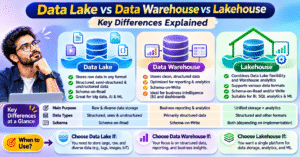
Three popular approaches to managing modern data are Data Lakes, Data Warehouses, and Data Lakehouses. Although all three support data storage and analytics, they differ in architecture, data processing, flexibility, and use cases.
- 🏞️ Data Lake: Stores large volumes of raw data in different formats.
- 🏢 Data Warehouse: Organizes structured, prepared data for reporting and analytics.
- 🏠 Data Lakehouse: Combines flexible data storage with capabilities for managing and analyzing structured data.
Understanding these differences can help businesses choose the right data architecture for their requirements.
🏞️ 1. What Is a Data Lake?
A Data Lake is a centralized storage environment designed to store large amounts of data in its original or raw format. It can accommodate structured, semi-structured, and unstructured data.
For example, an e-commerce company may collect customer records, website logs, product images, JSON files, and application events. A Data Lake can store these different types of information within a common storage environment.
Unlike traditional analytical systems, a Data Lake does not always require data to follow a predefined schema before storage. The structure can be interpreted when the data is accessed or processed. This approach is commonly known as Schema-on-Read.
⚙️ How Does a Data Lake Work?
- 📥 Data Collection: Data is collected from databases, applications, devices, and other sources.
- 🗄️ Data Storage: Raw data is stored in scalable storage, often object storage.
- 🔄 Data Processing: Data is cleaned, transformed, or enriched when required.
- 📊 Data Analysis: Processed data is used for analytics, reporting, and machine learning.
🌟 Benefits of a Data Lake
- 📦 Supports structured, semi-structured, and unstructured data.
- 💰 Can provide cost-effective storage for large datasets.
- 🤖 Supports AI and machine learning workflows.
- 🔍 Preserves raw data for future analysis.
- 📈 Enables large-scale data exploration and processing.
⚠️ Limitations of a Data Lake
A Data Lake requires proper data governance, metadata management, access controls, and quality checks. Without these practices, finding and understanding stored information can become difficult.
An unorganized Data Lake may turn into a Data Swamp, where data exists but is difficult to discover, trust, or use effectively.
🏢 Common Data Lake Use Cases
- IoT sensor data collection
- Website and application log storage
- AI and machine learning projects
- Image, video, and document storage
- Large-scale data exploration
🏢 2. What Is a Data Warehouse?
A Data Warehouse is a centralized data platform designed primarily for business intelligence, reporting, and analytical queries.
Data is typically collected from different sources, cleaned, transformed, and organized into structured tables or models. This helps businesses generate consistent reports and extract meaningful insights.
For example, a retail company may use a Data Warehouse to analyze monthly sales, identify its best-selling products, compare regional revenue, and understand customer purchasing patterns.
Data Warehouses commonly use a Schema-on-Write approach, where data is prepared according to a defined structure before it is stored in the target analytical model.
⚙️ How Does a Data Warehouse Work?
- 📥 Data Collection: Information is collected from business applications and operational databases.
- 🧹 Data Cleaning: Inaccurate, incomplete, or inconsistent records are handled.
- 🔄 Data Transformation: Data is processed using ETL or ELT pipelines.
- 🗄️ Data Organization: Information is structured into analytical tables and models.
- 📊 Reporting: SQL queries and BI tools generate reports and dashboards.
🌟 Benefits of a Data Warehouse
- 📊 Optimized for business reporting and analytics.
- 🧹 Helps maintain consistent data definitions and quality.
- 📈 Supports sales, finance, and customer analysis.
- 🔎 Designed to execute analytical SQL queries efficiently.
- 📋 Enables standardized business metrics and reports.
⚠️ Limitations of a Data Warehouse
- Raw or unstructured data may require additional processing.
- Data transformation and modeling require planning.
- Storage and compute costs can increase with usage.
- Integrating frequently changing data may require additional engineering.
🏢 Common Data Warehouse Use Cases
- Business intelligence dashboards
- Sales and revenue reporting
- Financial analysis
- Customer segmentation
- Business performance monitoring
🏠 3. What Is a Data Lakehouse?
A Data Lakehouse is a modern data architecture that combines the flexible storage capabilities of a Data Lake with data management and analytical capabilities commonly associated with a Data Warehouse.
Its goal is to support diverse data formats while also providing reliable analytical tables, SQL querying, and other data workloads within an integrated environment.
Many Lakehouse implementations use technologies such as open table formats, metadata layers, and transaction management to support features like schema enforcement, consistent data access, and concurrent operations.
For example, an organization may store customer events, sales transactions, and application logs in lake-based storage while maintaining managed analytical tables for SQL reporting and machine learning.
⚙️ How Does a Data Lakehouse Work?
- 📥 Data Ingestion: Data is collected from applications, databases, and external sources.
- 🗄️ Flexible Storage: Data is stored in scalable storage infrastructure.
- 🧱 Table Management: Metadata and table formats help organize analytical datasets.
- 🔄 Data Processing: Data is cleaned, transformed, and validated.
- 📊 Analytics and AI: SQL queries, BI dashboards, and machine learning workloads access the data.
🌟 Benefits of a Data Lakehouse
- 🏞️ Combines flexible storage with managed analytical tables.
- 📊 Supports SQL analytics and business intelligence.
- 🤖 Can support AI and machine learning workflows.
- 🔄 Helps bring different data workloads onto a shared platform.
- 🧩 May reduce unnecessary data duplication in suitable architectures.
⚠️ Limitations of a Data Lakehouse
- Architecture and platform configuration can be complex.
- Metadata, table formats, and governance require management.
- Query performance depends on the platform and workload.
- Not every Lakehouse implementation provides all the capabilities of a traditional Data Warehouse.
🏢 Common Data Lakehouse Use Cases
- Unified data analytics platforms
- AI and machine learning applications
- Large-scale SQL analytics
- Batch and streaming data processing
- Data engineering and business reporting
🔍 Data Lake vs Data Warehouse vs Lakehouse: Key Differences
The following table summarizes the major differences between these three data architectures.
| Feature | Data Lake | Data Warehouse | Data Lakehouse |
|---|---|---|---|
| Primary Purpose | Store raw and diverse data | Business reporting and analytics | Combine flexible storage with analytical data management |
| Data Types | Structured, semi-structured, and unstructured | Primarily structured and modeled data | Structured data and other supported formats |
| Data Processing | Often processed when needed | Commonly transformed before analysis | Supports raw data and managed analytical tables |
| Schema Approach | Often Schema-on-Read | Often Schema-on-Write | Depends on the implementation |
| BI Reporting | May require additional processing | A primary use case | Supported through compatible SQL and BI tools |
| Machine Learning | Useful for raw training data | Useful for prepared analytical datasets | Can support analytics and ML on a shared platform |
| Storage | Often object storage | Managed warehouse storage | Often object storage with a table management layer |
| Governance | Depends on the governance setup | Commonly includes centralized governance capabilities | Depends on the metadata and governance layers |
| Best For | Data collection and exploration | Structured business reporting | Integrated analytics, engineering, and ML |
These are general characteristics. Actual capabilities depend on the selected platform, implementation, and workload.
⚖️ Practical Example: Data Lake vs Data Warehouse vs Lakehouse
Imagine you operate an e-commerce company that collects customer orders, product images, website logs, and sales records.
<box gap={3}> <row align=start gap={3}> <AsyncImage query=”data lake raw data storage database files cloud architecture illustration” aspectRatio=”3:4″ maxWidth=”104px”/> <box flex=”1″ gap={1}> **🏞️ Data Lake — Store Diverse Data**
  Store customer clickstream events, product images, JSON files, and raw transaction records in one scalable storage environment for future processing.
</box>
</row> <divider color=”subtle”/> <row align=start gap={3}> <AsyncImage query=”data warehouse business intelligence sales analytics dashboard database illustration” aspectRatio=”3:4″ maxWidth=”104px”/> <box flex=”1″ gap={1}> **🏢 Data Warehouse — Generate Business Insights**
  Analyze cleaned sales records to identify best-selling products, compare regional revenue, and understand customer purchasing behavior.
</box>
</row> <divider color=”subtle”/> <row align=start gap={3}> <AsyncImage query=”modern data lakehouse architecture unified analytics AI database illustration” aspectRatio=”3:4″ maxWidth=”104px”/> <box flex=”1″ gap={1}> **🏠 Data Lakehouse — Integrate Data Workloads**
  Use an integrated architecture to support raw data, managed analytical tables, SQL queries, and machine learning workflows.
</box>
</row> </box>
This example demonstrates how each architecture serves a different purpose while contributing to a company’s overall data strategy.
🛠️ Popular Technologies and Tools
Several technologies are commonly associated with these data architectures.
🏞️ Data Lake Technologies
- Amazon S3
- Azure Data Lake Storage
- Google Cloud Storage
- Hadoop Distributed File System (HDFS)
🏢 Data Warehouse Technologies
- Amazon Redshift
- Google BigQuery
- Snowflake
- Azure Synapse Analytics
🏠 Data Lakehouse Technologies
- Databricks Lakehouse Platform
- Apache Iceberg
- Delta Lake
- Apache Hudi
These technologies serve different roles. For example, Apache Iceberg, Delta Lake, and Apache Hudi provide table-format or storage-management capabilities rather than functioning as complete managed Data Warehouse services by themselves.
🎯 Which Architecture Should You Choose?
The right choice depends on your business goals, data requirements, budget, and technical infrastructure.
🏞️ Choose a Data Lake If:
- You need to store large amounts of raw data.
- Your project involves AI or machine learning.
- You collect data in many different formats.
- You want flexibility to process data for different purposes later.
🏢 Choose a Data Warehouse If:
- Your primary goal is business reporting.
- You need clean and structured datasets.
- Your team relies heavily on SQL and BI dashboards.
- Consistent business metrics and reporting are priorities.
🏠 Choose a Data Lakehouse If:
- You need flexible storage and reliable analytical tables.
- You want to support BI and machine learning on an integrated platform.
- You want to simplify data workflows across different systems.
- Your team is building a modern data engineering platform.
There is no universal winner. Some organizations use all three approaches together, depending on their workloads and existing infrastructure.
📝 Conclusion
Data Lakes, Data Warehouses, and Data Lakehouses are important approaches to modern data management, but they solve different problems.
A Data Lake provides flexible storage for raw and diverse data. A Data Warehouse organizes prepared data for reporting and business intelligence. A Data Lakehouse combines flexible storage with analytical data management in an integrated architecture.
If your priority is raw data collection and machine learning, a Data Lake may be suitable. If you primarily need structured reporting, a Data Warehouse may be the better fit. If you want to combine data engineering, analytics, and machine learning on a shared platform, a Data Lakehouse may be worth considering.
Ultimately, the best architecture depends on your data volume, budget, team skills, performance requirements, and long-term business goals.
❓ Frequently Asked Questions (FAQs)
1. What Is the Main Difference Between a Data Lake and a Data Warehouse?
A Data Lake stores diverse data in raw or original formats, while a Data Warehouse organizes prepared data for structured analytics and reporting.
2. What Is a Data Lakehouse?
A Data Lakehouse is a data architecture that combines flexible storage with capabilities for managing and analyzing structured data.
3. Is a Data Lakehouse Better Than a Data Warehouse?
Not in every situation. A Data Warehouse may be better suited to structured business reporting, while a Lakehouse can be useful for combining analytics, data engineering, and machine learning workloads.
4. Can a Data Lake Store Unstructured Data?
Yes. A Data Lake can store supported formats such as images, videos, documents, application logs, and JSON files.
5. Can a Data Lakehouse Support Machine Learning?
Yes. Many Lakehouse platforms support data engineering, SQL analytics, and machine learning workflows. Specific capabilities depend on the platform.
6. What Is Schema-on-Read?
Schema-on-Read is an approach in which the structure of data is interpreted when the data is read or processed rather than being fully defined before storage.
7. What Is Schema-on-Write?
Schema-on-Write is an approach in which data is organized according to a defined schema before it is written into the target system or analytical model.
8. Can an Organization Use All Three Architectures?
Yes. An organization may use a Data Lake for raw data collection, a Data Warehouse for enterprise reporting, and Lakehouse technologies for selected analytics and AI workloads.
🏞️ Data Lake vs Data Warehouse vs Lakehouse – What Is the Difference?
📌 Introduction – Data Lake, Data Warehouse aur Lakehouse kya hain?
आज के digital world में businesses हर दिन बड़ी मात्रा में data generate करते हैं। Websites, mobile applications, online transactions, sensors और social media जैसे sources से आने वाले data को store करना और उसका analysis करना जरूरी होता है।
इसी काम के लिए Data Lake, Data Warehouse और Data Lakehouse जैसी data storage architectures का इस्तेमाल किया जाता है।
तीनों का उद्देश्य data को manage करना है, लेकिन इनके working methods और use cases अलग-अलग हैं।
- 🏞️ Data Lake: अलग-अलग formats में raw data store करने के लिए।
- 🏢 Data Warehouse: Structured और analysis-ready data से reporting करने के लिए।
- 🏠 Data Lakehouse: Data Lake की flexibility और Data Warehouse की analytical capabilities को combine करने के लिए।
आइए इन तीनों technologies को आसान examples के साथ समझते हैं।
🏞️ 1. What Is a Data Lake?
Data Lake एक ऐसा storage system है जहाँ बड़ी मात्रा में data को उसके original या raw format में store किया जा सकता है। इसमें structured, semi-structured और unstructured data शामिल हो सकता है।
उदाहरण के लिए, किसी e-commerce company के पास customer records, website logs, product images, JSON files और application events हो सकते हैं। Data Lake इन अलग-अलग types के data को एक ही storage environment में रखने में मदद करता है।
Data Lake में data को store करने से पहले हमेशा predefined structure बनाना जरूरी नहीं होता। Data को बाद में processing और analysis के दौरान interpret किया जा सकता है। इस approach को अक्सर Schema-on-Read कहा जाता है।
⚙️ Data Lake कैसे काम करता है?
- 📥 अलग-अलग sources से data collect किया जाता है।
- 🗄️ Raw data को scalable storage में रखा जाता है।
- 🔄 जरूरत के अनुसार data को clean और transform किया जाता है।
- 📊 Processed data को analytics, machine learning और reporting में इस्तेमाल किया जाता है।
🌟 Data Lake के फायदे
- 📦 अलग-अलग formats का data store कर सकता है।
- 💰 Object storage के साथ बड़े data volumes को cost-effectively manage किया जा सकता है।
- 🤖 Machine learning और AI projects के लिए उपयोगी है।
- 🔍 Raw data को future analysis के लिए preserve किया जा सकता है।
- 📈 Big data processing और data exploration को support करता है।
⚠️ Data Lake की Limitations
अगर data की quality, organization और access controls सही तरीके से manage न किए जाएँ, तो Data Lake एक Data Swamp बन सकता है। इसका मतलब है ऐसा storage environment जहाँ data मौजूद तो होता है, लेकिन उसे ढूँढना, समझना और भरोसे के साथ इस्तेमाल करना मुश्किल होता है।
🏢 Data Lake के Real-World Use Cases
- IoT sensor data collection
- Website और application logs
- AI और machine learning training
- Images, videos और documents का storage
- Large-scale data exploration
🏢 2. What Is a Data Warehouse?
Data Warehouse एक centralized data system है, जिसे मुख्य रूप से reporting, business intelligence और analytical queries के लिए design किया जाता है।
इसमें data आमतौर पर अलग-अलग sources से collect करके clean, transform और structured form में organize किया जाता है। इससे businesses को reliable reports और meaningful insights प्राप्त करने में मदद मिलती है।
उदाहरण के लिए, किसी retail company को यह जानना है कि पिछले छह महीनों में कौन-से products सबसे ज्यादा बिके, किस शहर से ज्यादा revenue आया और कौन-से customers बार-बार खरीदारी करते हैं। Data Warehouse इस तरह के analysis को support कर सकता है।
Data Warehouse में अक्सर Schema-on-Write approach का उपयोग किया जाता है, जहाँ data को store करने से पहले defined structure के अनुसार तैयार किया जाता है।
⚙️ Data Warehouse कैसे काम करता है?
- 📥 Databases और business applications से data collect किया जाता है।
- 🧹 Data को clean और validate किया जाता है।
- 🔄 ETL या ELT processes के माध्यम से data transform किया जाता है।
- 🗄️ Structured data को warehouse में organize किया जाता है।
- 📊 SQL queries और BI tools से reports और dashboards बनाए जाते हैं।
🌟 Data Warehouse के फायदे
- 📊 Business reporting और analytics के लिए optimized।
- 🧹 Data quality और consistency को improve करने में मदद।
- 📈 Sales, finance और customer performance analysis के लिए उपयोगी।
- 🔎 Complex analytical SQL queries को support करता है।
- 📋 Standardized reports और business metrics बनाने में मदद।
⚠️ Data Warehouse की Limitations
- Raw और unstructured data के लिए additional preparation की जरूरत हो सकती है।
- Data transformation और modeling के लिए planning आवश्यक है।
- Platform, compute usage और data volume के अनुसार costs बढ़ सकती हैं।
- कुछ architectures में frequently changing data को integrate करने के लिए अतिरिक्त engineering की जरूरत होती है।
🏢 Data Warehouse के Real-World Use Cases
- Business Intelligence dashboards
- Sales और revenue reporting
- Financial analysis
- Customer segmentation
- Business performance monitoring
🏠 3. What Is a Data Lakehouse?
Data Lakehouse एक modern data architecture है, जो Data Lake की flexible storage capabilities को Data Warehouse जैसी data management और analytics capabilities के साथ combine करने की कोशिश करता है।
इसका उद्देश्य raw और diverse data को scalable storage में रखते हुए उसी environment में reliable analytical tables, SQL queries और अन्य data workloads को support करना है।
कई Lakehouse implementations open table formats, metadata layers और transaction management जैसी technologies का उपयोग करती हैं। इन features से data consistency, schema enforcement और concurrent access को manage करना आसान हो सकता है।
उदाहरण के लिए, एक company अपने sales transactions, customer events और application logs को lake-based storage में रख सकती है। उसी platform पर structured tables बनाकर SQL analytics और machine learning workflows भी चला सकती है।
⚙️ Data Lakehouse कैसे काम करता है?
- 📥 अलग-अलग sources से structured और unstructured data collect किया जाता है।
- 🗄️ Data को scalable storage में रखा जाता है।
- 🧱 Table formats और metadata layers के माध्यम से analytical data organize किया जाता है।
- 🔄 Data processing, validation और transformation की जाती है।
- 📊 SQL analytics, dashboards और machine learning workflows को support किया जाता है।
🌟 Data Lakehouse के फायदे
- 🏞️ Flexible data storage और analytical table management को combine करता है।
- 📊 BI और SQL analytics के लिए उपयोगी हो सकता है।
- 🤖 AI और machine learning workloads को support कर सकता है।
- 🔄 अलग-अलग data workloads को एक shared platform पर लाने में मदद करता है।
- 🧩 Suitable architecture में data duplication और platform complexity कम हो सकती है।
⚠️ Data Lakehouse की Limitations
- Architecture और platform setup complex हो सकता है।
- Metadata, table formats और governance को manage करना जरूरी है।
- Performance workload और query engine पर निर्भर करती है।
- हर Lakehouse implementation सभी Data Warehouse features को समान रूप से provide नहीं करती।
🏢 Data Lakehouse के Real-World Use Cases
- Unified data analytics platforms
- AI और machine learning applications
- Large-scale SQL analytics
- Real-time और batch data processing
- Data engineering और business reporting
🔍 Data Lake vs Data Warehouse vs Lakehouse: Key Differences
अब तीनों architectures के बीच मुख्य अंतर को एक comparison table से समझते हैं।
| Feature | Data Lake | Data Warehouse | Data Lakehouse |
|---|---|---|---|
| Main Purpose | Raw और diverse data storage | Business analytics और reporting | Flexible storage और analytics का combination |
| Data Types | Structured, semi-structured, unstructured | मुख्य रूप से structured और modeled data | Structured तथा अन्य data formats |
| Data Processing | अक्सर बाद में process किया जाता है | आमतौर पर analysis से पहले transform किया जाता है | Raw data और managed analytical tables दोनों |
| Schema Approach | अक्सर Schema-on-Read | अक्सर Schema-on-Write | Implementation के अनुसार दोनों approaches |
| BI Reporting | Additional processing की जरूरत हो सकती है | प्रमुख use case | Supported SQL और BI tools के साथ |
| Machine Learning | Raw data के लिए उपयोगी | Prepared analytical data के लिए उपयोगी | Analytics और ML को एक platform पर support कर सकता है |
| Storage | अक्सर object storage | Managed warehouse storage | अक्सर object storage और table management layer |
| Governance | Governance setup पर निर्भर | Centralized governance capabilities आम हैं | Metadata और governance layer पर निर्भर |
| Best For | Big data collection और exploration | Structured business reporting | Combined data engineering, analytics और ML |
ध्यान दें कि ये सामान्य characteristics हैं। Actual capabilities specific platform और implementation के अनुसार बदल सकती हैं।
⚖️ Data Lake vs Data Warehouse vs Lakehouse: Simple Example
मान लीजिए आप एक e-commerce company चलाते हैं। आपके पास customer orders, product images, website logs और sales reports का data है।
<box gap={3}> <row align=start gap={3}> <AsyncImage query=”data lake raw data storage lake illustration blue database files” aspectRatio=”3:4″ maxWidth=”104px”/> <box flex=”1″ gap={1}> **🏞️ Data Lake – Data Store करना**
  Customer clicks, product images, JSON events और raw transaction files को एक जगह store करना। बाद में जरूरत के अनुसार इन्हें process किया जा सकता है।
</box>
</row> <divider color=”subtle”/> <row align=start gap={3}> <AsyncImage query=”data warehouse business intelligence sales analytics dashboard database illustration” aspectRatio=”3:4″ maxWidth=”104px”/> <box flex=”1″ gap={1}> **🏢 Data Warehouse – Business Insights निकालना**
  Clean और structured sales data से पता लगाना कि कौन-सा product सबसे ज्यादा बिक रहा है और किस region में revenue सबसे अधिक है।
</box>
</row> <divider color=”subtle”/> <row align=start gap={3}> <AsyncImage query=”modern data lakehouse architecture unified analytics AI database illustration” aspectRatio=”3:4″ maxWidth=”104px”/> <box flex=”1″ gap={1}> **🏠 Data Lakehouse – एक Unified Platform**
  Raw data, managed analytical tables, SQL queries और machine learning workflows को एक integrated architecture में support करना।
</box>
</row> </box>
इस example से समझ सकते हैं कि तीनों architectures का उद्देश्य केवल data store करना नहीं है, बल्कि data को business decisions के लिए उपयोगी बनाना भी है।
🛠️ Popular Technologies and Tools
इन architectures को implement करने के लिए कई technologies का इस्तेमाल किया जाता है।
🏞️ Data Lake Technologies
- Amazon S3
- Azure Data Lake Storage
- Google Cloud Storage
- Apache Hadoop Distributed File System (HDFS)
🏢 Data Warehouse Technologies
- Amazon Redshift
- Google BigQuery
- Snowflake
- Azure Synapse Analytics
🏠 Data Lakehouse Technologies
- Databricks Lakehouse Platform
- Apache Iceberg
- Delta Lake
- Apache Hudi
ये technologies अलग-अलग roles निभाती हैं। उदाहरण के लिए, Apache Iceberg, Delta Lake और Apache Hudi table formats या storage-management technologies हैं; ये अपने आप में complete managed warehouse services के समान नहीं हैं।
🎯 Which One Should You Choose?
सही architecture चुनने से पहले अपने project की requirements समझना जरूरी है।
🏞️ Choose a Data Lake If:
- आपको बहुत सारे formats में raw data store करना है।
- आप AI या machine learning projects पर काम कर रहे हैं।
- आपको large-scale data collection और exploration चाहिए।
- आप data को बाद में अलग-अलग तरीकों से process करना चाहते हैं।
🏢 Choose a Data Warehouse If:
- आपका मुख्य उद्देश्य business reporting है।
- आपको clean और structured data चाहिए।
- आप SQL और BI dashboards का बड़े स्तर पर उपयोग करते हैं।
- Business metrics और standardized reports आपकी priority हैं।
🏠 Choose a Data Lakehouse If:
- आपको flexible data storage के साथ reliable analytical tables चाहिए।
- आप BI और machine learning workloads को एक platform पर चलाना चाहते हैं।
- आप अलग-अलग data systems के बीच duplication और complexity कम करना चाहते हैं।
- आपकी team modern data engineering architecture बना रही है।
किसी एक architecture को हर situation में best नहीं कहा जा सकता। कई organizations जरूरत के अनुसार Data Lake, Data Warehouse और Lakehouse technologies को साथ में भी इस्तेमाल करती हैं।
📝 Conclusion
Data Lake, Data Warehouse और Data Lakehouse modern data management की तीन महत्वपूर्ण approaches हैं।
Data Lake raw और diverse data को store करने के लिए flexible environment देता है। Data Warehouse structured data से reporting और business insights निकालने के लिए बनाया जाता है। वहीं Data Lakehouse flexible storage और analytical data management को एक architecture में combine करने की कोशिश करता है।
अगर आपका focus raw data और machine learning है, तो Data Lake उपयोगी हो सकता है। अगर आपको reliable business reporting चाहिए, तो Data Warehouse अच्छा विकल्प हो सकता है। और अगर आपको analytics तथा machine learning के लिए एक integrated data platform चाहिए, तो Data Lakehouse पर विचार कर सकते हैं।
अंत में, सही choice आपके data volume, budget, team skills, performance requirements और business goals पर निर्भर करती है।
❓ Frequently Asked Questions (FAQs)
1. What Is the Main Difference Between a Data Lake and a Data Warehouse?
Data Lake अलग-अलग formats में raw data store करने के लिए flexible होता है, जबकि Data Warehouse structured और prepared data पर analytics तथा reporting के लिए optimized होता है।
2. What Is a Data Lakehouse?
Data Lakehouse एक data architecture है, जो Data Lake की flexible storage capabilities को warehouse-style data management और analytics के साथ combine करने की कोशिश करता है।
3. Is a Data Lakehouse Better Than a Data Warehouse?
हर situation में नहीं। Data Warehouse structured reporting के लिए बेहतर fit हो सकता है, जबकि Lakehouse उन workloads के लिए उपयोगी हो सकता है जिन्हें flexible storage, analytics और machine learning का combination चाहिए।
4. Can a Data Lake Store Unstructured Data?
हाँ। Data Lake images, videos, logs, documents, JSON files और अन्य supported formats में data store कर सकता है।
5. Can a Data Lakehouse Support Machine Learning?
हाँ। कई Lakehouse platforms data engineering, SQL analytics और machine learning workflows को support करते हैं। Exact capabilities platform पर निर्भर करती हैं।
6. What Is Schema-on-Read?
Schema-on-Read में data को store करते समय पूरी structure define करना जरूरी नहीं होता। Data पढ़ते या process करते समय उसका schema interpret किया जाता है।
7. What Is Schema-on-Write?
Schema-on-Write में data को destination system में store करने से पहले defined schema या structure के अनुसार prepare किया जाता है।
8. Can Organizations Use All Three Architectures?
हाँ। कुछ organizations raw data collection के लिए Data Lake, enterprise reporting के लिए Data Warehouse और selected analytics तथा AI workloads के लिए Lakehouse technologies का इस्तेमाल करती हैं।