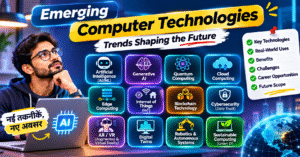
🚀 Emerging Computer Technologies: Trends Shaping the Future
🌐 Introduction
Emerging computer technologies are transforming how we work, communicate, learn, and solve real-world problems. From Artificial Intelligence (AI) and Quantum Computing to Cloud Computing, Blockchain, and Edge Computing, these innovations are creating new opportunities across industries.
As technology continues to evolve, understanding emerging computer technologies is essential for students, developers, IT professionals, and businesses.
💡 What Are Emerging Computer Technologies?
Emerging computer technologies are new or rapidly developing technologies that have the potential to change existing computer systems, applications, and digital services.
These technologies improve automation, data processing, security, connectivity, and decision-making.
🔥 Top Emerging Computer Technologies
🤖 1. Artificial Intelligence (AI) and Machine Learning
Artificial Intelligence enables computers to perform tasks that typically require human intelligence, such as understanding language, recognizing images, and making predictions.
Machine Learning allows systems to learn patterns from data and improve their performance.
📌 Applications:
- 💬 AI chatbots and virtual assistants
- 🏦 Fraud detection in banking
- 🏥 Medical image analysis
- 🎯 Personalized recommendations
- 📊 Predictive analytics and automation
✨ 2. Generative AI and Large Language Models
Generative AI creates new content, including text, images, audio, video, and computer code. Large Language Models (LLMs) can understand and generate human-like language.
📌 Applications:
- 💻 AI-powered coding assistants
- 📝 Automated content generation
- 📚 Document summarization
- 🎧 Intelligent customer support
- 🎓 AI-based learning tools
⚛️ 3. Quantum Computing
Quantum computing uses principles of quantum mechanics to process information differently from classical computers. It uses quantum bits, known as qubits.
Quantum computers may help solve certain complex problems in chemistry, materials science, optimization, and scientific research. However, large-scale, fault-tolerant quantum computing remains a major technical challenge.
📌 Potential applications:
- 🧪 Scientific research
- 🧬 Molecular simulation
- 🔬 Materials discovery
- 📈 Complex optimization
☁️ 4. Cloud Computing
Cloud computing provides computing resources such as servers, databases, storage, and software over the internet.
📌 Benefits:
- 📦 Scalable storage
- 💰 Reduced infrastructure costs
- 🌍 Remote access to applications
- 🔐 Backup and disaster recovery
- ⚙️ Support for AI and data analytics
⚡ 5. Edge Computing
Edge computing processes data closer to where it is generated instead of sending everything to a centralized cloud server.
📌 Applications:
- 🚗 Connected vehicles
- 🏭 Smart factories
- ❤️ Healthcare monitoring devices
- 🏙️ Smart cities
- 📡 Internet of Things (IoT)
📡 6. Internet of Things (IoT)
The Internet of Things connects physical devices to networks so they can collect, exchange, and sometimes act on data.
📌 Examples:
- 🏠 Smart home appliances
- 🌾 Smart agriculture sensors
- 🏭 Industrial monitoring
- ⌚ Wearable devices
- ⚡ Smart energy management
🔗 7. Blockchain Technology
Blockchain is a type of distributed ledger that records transactions across a network. Depending on its design, it can provide shared records that are difficult to alter without detection.
📌 Applications:
- 💳 Digital asset systems
- 📦 Supply-chain tracking
- 🪪 Digital identity management
- 📋 Record verification
🛡️ 8. Cybersecurity and Zero Trust Architecture
Cybersecurity protects computer systems, networks, applications, and sensitive data from unauthorized access and cyberattacks.
Zero Trust is a security approach that verifies access rather than automatically trusting users or devices.
📌 Important security technologies:
- 🔑 Multi-factor authentication
- 🔒 Data encryption
- 🧠 AI-assisted threat detection
- 💻 Endpoint protection
- 👤 Identity and access management
🥽 9. Augmented Reality (AR) and Virtual Reality (VR)
Augmented Reality adds digital elements to the real world, while Virtual Reality creates immersive, computer-generated environments.
📌 Applications:
- 🎓 Interactive education
- 🏥 Medical training
- 🎮 Gaming and entertainment
- 🏗️ Product and building visualization
- 🛠️ Industrial maintenance
🏭 10. Digital Twins
A digital twin is a digital representation of a physical object, process, or system that can be updated using real-world data.
📌 Applications:
- ⚙️ Factory equipment monitoring
- 🏢 Building management
- ⚡ Energy infrastructure
- 🚆 Transportation systems
- 🔧 Predictive maintenance
🤖 11. Robotics and Autonomous Systems
Robotics combines computing, sensors, control systems, and mechanical engineering to automate physical tasks.
📌 Applications:
- 📦 Warehouse automation
- 🏭 Industrial manufacturing
- 🌾 Agricultural robots
- 🚚 Autonomous delivery systems
- 🔬 Scientific research
🌱 12. Sustainable and Energy-Efficient Computing
Sustainable computing focuses on reducing the environmental impact of computing systems.
📌 Key approaches:
- 🔋 Energy-efficient processors
- 🌿 Efficient data centers
- 💻 Optimized software
- ♻️ Electronic-waste recycling
- ⚡ Responsible energy consumption
📊 Comparison of Emerging Computer Technologies
| 💻 Technology | 🎯 Main Purpose | 🚀 Common Applications |
|---|---|---|
| 🤖 Artificial Intelligence | Intelligent analysis and automation | Chatbots, prediction |
| ✨ Generative AI | Creating new content | Coding, writing, image generation |
| ⚛️ Quantum Computing | Specialized complex computation | Scientific research |
| ☁️ Cloud Computing | On-demand computing resources | Hosting, storage |
| ⚡ Edge Computing | Processing data near its source | IoT, real-time monitoring |
| 📡 IoT | Connecting physical devices | Smart homes, agriculture |
| 🔗 Blockchain | Shared, verifiable records | Digital assets, supply chains |
| 🥽 AR and VR | Interactive digital experiences | Training, education |
| 🏭 Digital Twins | Modeling real-world systems | Manufacturing, maintenance |
| 🤖 Robotics | Automating physical tasks | Warehouses, factories |
✅ Benefits of Emerging Computer Technologies
Emerging technologies offer several potential advantages:
- 🚀 Improved Productivity: Automate repetitive tasks and simplify workflows.
- 📊 Better Decision-Making: Analyze large datasets and identify useful patterns.
- 🌐 Enhanced Connectivity: Connect people, devices, and services.
- 🎯 Personalized Experiences: Adapt digital services to individual needs.
- ⚙️ Greater Efficiency: Optimize resources and business operations.
- 💼 New Career Opportunities: Create demand for specialized technical skills.
⚠️ Challenges of Emerging Computer Technologies
🔐 Data Privacy and Security
AI systems, connected devices, and cloud platforms may handle sensitive information. Strong security controls are essential.
💰 High Implementation Costs
Some technologies require specialized hardware, skilled professionals, and significant investment.
📚 Skills Gap
Students and professionals need to continuously develop new technical skills.
⚖️ Ethical Concerns
AI systems can produce inaccurate results or reflect biases in their training data. Human oversight remains important.
🌍 Environmental Impact
Large-scale computing can consume substantial electricity and hardware resources.
💼 Career Opportunities in Emerging Technologies
Students and professionals can explore these career paths:
- 🤖 Artificial Intelligence Engineer
- 🧠 Machine Learning Engineer
- 📊 Data Analyst
- 🗄️ Data Engineer
- ☁️ Cloud Engineer
- 🛡️ Cybersecurity Analyst
- 📡 IoT Developer
- 🦾 Robotics Engineer
- 💻 Software Developer
- 👁️ Computer Vision Engineer
- ⚛️ Quantum Computing Researcher
🎯 How to Start Learning These Technologies
- 📘 Build a foundation in computer science and programming.
- 🐍 Learn Python, SQL, databases, and Git.
- 📊 Study statistics, data analysis, and basic machine learning.
- 💡 Choose a specialization such as AI, cloud computing, cybersecurity, or IoT.
- 🛠️ Build practical projects and publish them on GitHub.
- 🚀 Practice deployment, documentation, and real-world problem-solving.
🔮 Future of Emerging Computer Technologies
The future of computing will likely involve greater integration between AI, cloud platforms, connected devices, cybersecurity, robotics, and specialized computing hardware.
Businesses may use these technologies to improve operations, while researchers continue exploring new approaches to computing and communication.
However, the pace of adoption will vary. Some technologies are already widely deployed, while others still face technical, economic, or regulatory limitations.
❓ Frequently Asked Questions (FAQs)
❓ 1. What are emerging computer technologies?
Emerging computer technologies are new or rapidly advancing technologies that can change how computer systems process information, communicate, automate tasks, and solve problems.
🤖 2. Which emerging technology is most useful for students?
AI, Python programming, cloud computing, data analytics, and cybersecurity are practical starting points. The best choice depends on a student’s interests and career goals.
💡 3. Is Artificial Intelligence an emerging computer technology?
Yes. AI continues to evolve rapidly, particularly in generative AI, multimodal systems, intelligent automation, and AI-assisted software development.
☁️ 4. What is the difference between cloud computing and edge computing?
Cloud computing generally uses remote computing infrastructure, while edge computing processes data closer to the device or location where it is generated.
🎓 5. How can I build a career in emerging technologies?
Learn programming fundamentals, develop relevant technical skills, complete practical projects, create a portfolio, and gain experience through internships or entry-level roles.
📝 Conclusion
Emerging computer technologies are reshaping computing and creating new possibilities across education, healthcare, agriculture, manufacturing, business, and research.
🤖 Artificial Intelligence, ✨ Generative AI, ☁️ Cloud Computing, 🛡️ Cybersecurity, 📡 IoT, ⚡ Edge Computing, and 🦾 Robotics are valuable areas to understand as digital systems continue to evolve.
For students and professionals, the best strategy is to develop strong fundamentals, select a relevant specialization, and keep learning through practical projects and real-world experience.
🚀 उभरती हुई कंप्यूटर तकनीकें (Emerging Computer Technologies): भविष्य की नई तकनीकें
🌐 परिचय (Introduction)
आज के डिजिटल युग में कंप्यूटर तकनीक बहुत तेजी से विकसित हो रही है। Artificial Intelligence (AI), Machine Learning, Cloud Computing, Quantum Computing और Robotics जैसी नई तकनीकें हमारे काम करने, पढ़ने, व्यापार करने और समस्याओं को हल करने के तरीकों को बदल रही हैं।
इन तकनीकों की मदद से काम को तेज़, आसान और अधिक प्रभावी बनाया जा सकता है। विद्यार्थियों, सॉफ्टवेयर डेवलपर्स, IT Professionals और बिज़नेस करने वाले लोगों के लिए इन नई तकनीकों को समझना बहुत ज़रूरी है।
💡 Emerging Computer Technologies क्या हैं?
Emerging Computer Technologies का हिंदी अर्थ है उभरती हुई कंप्यूटर तकनीकें।
ये ऐसी नई या तेजी से विकसित हो रही तकनीकें हैं, जिनमें भविष्य में कंप्यूटर सिस्टम, सॉफ्टवेयर, इंटरनेट और डिजिटल सेवाओं को बदलने की क्षमता होती है।
इनका मुख्य उद्देश्य काम को आसान बनाना, डेटा का बेहतर विश्लेषण करना, सुरक्षा बढ़ाना और नई सुविधाएँ विकसित करना है।
🔥 1. 🤖 Artificial Intelligence (AI) – कृत्रिम बुद्धिमत्ता
Artificial Intelligence यानी कृत्रिम बुद्धिमत्ता ऐसी तकनीक है, जिसकी मदद से कंप्यूटर इंसानों की तरह कुछ बुद्धिमान कार्य कर सकते हैं, जैसे सवालों के जवाब देना, तस्वीरों को पहचानना और डेटा के आधार पर निर्णय लेने में सहायता करना।
📌 AI के उपयोग:
- 💬 Chatbots और Virtual Assistants
- 🏥 बीमारी की पहचान में सहायता
- 🏦 बैंकिंग में धोखाधड़ी का पता लगाना
- 📊 डेटा का विश्लेषण करना
- 🎯 यूज़र की पसंद के अनुसार सुझाव देना
उदाहरण: ChatGPT, AI Assistants और Recommendation Systems.
✨ 2. Generative AI – नई सामग्री बनाने वाली तकनीक
Generative AI ऐसी तकनीक है, जो नए Text, Images, Videos, Audio और Computer Code बनाने में मदद करती है।
आज इसका उपयोग शिक्षा, डिजिटल मार्केटिंग, सॉफ्टवेयर डेवलपमेंट और कंटेंट क्रिएशन में किया जा रहा है।
📌 प्रमुख उपयोग:
- 📝 ब्लॉग और लेख लिखना
- 🎨 नई तस्वीरें और डिज़ाइन बनाना
- 💻 कोड लिखने में सहायता
- 📚 पढ़ाई के नोट्स तैयार करना
- 🎬 वीडियो और अन्य डिजिटल सामग्री बनाने में सहायता
यह तकनीक काम की गति बढ़ा सकती है, लेकिन इसके द्वारा बनाई गई जानकारी की जाँच करना भी ज़रूरी है।
⚛️ 3. Quantum Computing – क्वांटम कंप्यूटिंग
Quantum Computing कंप्यूटिंग की एक उन्नत तकनीक है, जो Quantum Mechanics के सिद्धांतों पर आधारित होती है।
सामान्य कंप्यूटर जानकारी को Bits के रूप में संसाधित करते हैं, जबकि Quantum Computers में Qubits का उपयोग किया जाता है।
भविष्य में यह तकनीक कुछ जटिल वैज्ञानिक और गणितीय समस्याओं को हल करने में उपयोगी हो सकती है।
📌 संभावित उपयोग:
- 🧪 वैज्ञानिक अनुसंधान
- 🧬 नई दवाओं और अणुओं का अध्ययन
- 🔬 नई सामग्री विकसित करने में सहायता
- 📈 जटिल समस्याओं का अनुकूलन
अभी इस तकनीक पर लगातार शोध हो रहा है और बड़े स्तर पर इसका उपयोग कई चुनौतियों से जुड़ा है।
☁️ 4. Cloud Computing – क्लाउड कंप्यूटिंग
Cloud Computing में इंटरनेट के माध्यम से सर्वर, स्टोरेज, डेटाबेस और सॉफ्टवेयर जैसी कंप्यूटिंग सेवाओं का उपयोग किया जाता है।
इस तकनीक की मदद से कंपनियों को हर प्रकार का कंप्यूटर इंफ्रास्ट्रक्चर स्वयं खरीदने और संभालने की आवश्यकता कम हो सकती है।
📌 मुख्य फायदे:
- ☁️ इंटरनेट पर डेटा स्टोर करना
- 💰 इंफ्रास्ट्रक्चर का खर्च कम करना
- 🌍 कहीं से भी सेवाओं का उपयोग करना
- 🔐 डेटा बैकअप और रिकवरी
- ⚙️ वेबसाइट और एप्लिकेशन होस्ट करना
उदाहरण: AWS, Microsoft Azure और Google Cloud.
⚡ 5. Edge Computing – एज कंप्यूटिंग
Edge Computing में डेटा को उस स्थान के पास ही प्रोसेस किया जाता है, जहाँ वह उत्पन्न होता है। इससे हर जानकारी को दूर स्थित क्लाउड सर्वर तक भेजने की आवश्यकता कम हो सकती है।
यह तकनीक उन सिस्टमों के लिए उपयोगी है, जहाँ तुरंत प्रतिक्रिया देना ज़रूरी होता है।
📌 उपयोग:
- 🚗 स्मार्ट और कनेक्टेड वाहन
- 🏭 स्मार्ट फैक्ट्री
- 🏥 स्वास्थ्य निगरानी उपकरण
- 🏙️ स्मार्ट सिटी
- 📡 IoT डिवाइस
📡 6. Internet of Things (IoT) – इंटरनेट से जुड़े उपकरण
Internet of Things यानी IoT ऐसी तकनीक है, जिसमें सेंसर और इंटरनेट की मदद से भौतिक उपकरण डेटा इकट्ठा कर सकते हैं और एक-दूसरे के साथ जानकारी साझा कर सकते हैं।
📌 उदाहरण:
- 🏠 स्मार्ट होम उपकरण
- 🌾 खेती में मिट्टी की नमी मापने वाले सेंसर
- ⌚ स्मार्टवॉच
- 🏭 मशीनों की निगरानी
- ⚡ बिजली की खपत को नियंत्रित करने वाले स्मार्ट सिस्टम
कृषि के क्षेत्र में IoT की मदद से मिट्टी की नमी, तापमान और सिंचाई की स्थिति की निगरानी की जा सकती है।
🔗 7. Blockchain Technology – ब्लॉकचेन तकनीक
Blockchain एक प्रकार की डिजिटल लेज़र तकनीक है, जिसमें लेन-देन या अन्य रिकॉर्ड को एक नेटवर्क में व्यवस्थित रूप से दर्ज किया जाता है।
इसके कुछ डिज़ाइन रिकॉर्ड में बदलाव का पता लगाने और कई पक्षों के बीच साझा जानकारी बनाए रखने में मदद करते हैं।
📌 उपयोग:
- 💳 डिजिटल एसेट और क्रिप्टोकरेंसी सिस्टम
- 📦 सप्लाई चेन की निगरानी
- 🪪 डिजिटल पहचान से जुड़े समाधान
- 📋 रिकॉर्ड का सत्यापन
हर समस्या के लिए Blockchain आवश्यक नहीं है। इसका उपयोग करने से पहले लागत, सुरक्षा और गोपनीयता पर विचार करना चाहिए।
🛡️ 8. Cybersecurity – साइबर सुरक्षा
Cybersecurity का अर्थ है कंप्यूटर, नेटवर्क, सॉफ्टवेयर और डिजिटल जानकारी को साइबर हमलों तथा अनधिकृत पहुँच से सुरक्षित रखना।
आज ऑनलाइन बैंकिंग, डिजिटल पेमेंट और इंटरनेट सेवाओं के बढ़ते उपयोग के कारण साइबर सुरक्षा का महत्व लगातार बढ़ रहा है।
📌 प्रमुख सुरक्षा तकनीकें:
- 🔐 मजबूत पासवर्ड और Multi-Factor Authentication
- 🔒 डेटा एन्क्रिप्शन
- 🛡️ वायरस और मैलवेयर से सुरक्षा
- 🧠 AI की मदद से संदिग्ध गतिविधियों का पता लगाना
- 👤 यूज़र की पहचान और एक्सेस कंट्रोल
🥽 9. AR और VR – वास्तविकता का डिजिटल अनुभव
Augmented Reality (AR) वास्तविक दुनिया में डिजिटल जानकारी या वस्तुओं को जोड़ती है, जबकि Virtual Reality (VR) कंप्यूटर द्वारा बनाया गया एक आभासी वातावरण प्रदान करती है।
📌 उपयोग:
- 🎓 पढ़ाई और प्रशिक्षण
- 🎮 गेमिंग
- 🏥 मेडिकल ट्रेनिंग
- 🏗️ बिल्डिंग और प्रोडक्ट डिज़ाइन
- 🛠️ मशीनों की मरम्मत में सहायता
🏭 10. Digital Twin – डिजिटल प्रतिरूप
Digital Twin किसी वास्तविक मशीन, वस्तु, भवन या प्रक्रिया का डिजिटल मॉडल होता है। इसमें वास्तविक दुनिया से प्राप्त डेटा का उपयोग करके सिस्टम की स्थिति को समझने और उसका विश्लेषण करने में मदद मिलती है।
📌 उपयोग:
- ⚙️ फैक्ट्री की मशीनों की निगरानी
- 🏢 स्मार्ट बिल्डिंग मैनेजमेंट
- ⚡ ऊर्जा प्रणालियों का विश्लेषण
- 🚆 परिवहन व्यवस्था
- 🔧 मशीन खराब होने की संभावना का अनुमान
🤖 11. Robotics – रोबोटिक्स तकनीक
Robotics में कंप्यूटर प्रोग्रामिंग, सेंसर, इलेक्ट्रॉनिक्स और मैकेनिकल सिस्टम की मदद से ऐसे रोबोट बनाए जाते हैं, जो विभिन्न कार्यों को स्वचालित रूप से कर सकते हैं।
📌 उपयोग:
- 🏭 औद्योगिक उत्पादन
- 📦 गोदामों में सामान व्यवस्थित करना
- 🌾 कृषि कार्य
- 🚚 सामान पहुँचाने वाली स्वचालित प्रणालियाँ
- 🔬 वैज्ञानिक अनुसंधान
🌱 12. Green Computing – पर्यावरण-अनुकूल कंप्यूटिंग
Green Computing का उद्देश्य कंप्यूटर और डिजिटल तकनीकों के पर्यावरण पर पड़ने वाले प्रभाव को कम करना है।
इसमें कम बिजली खर्च करने वाले उपकरण, ऊर्जा-कुशल डेटा सेंटर और इलेक्ट्रॉनिक कचरे का उचित प्रबंधन शामिल है।
📌 प्रमुख उपाय:
- 🔋 कम ऊर्जा खर्च करने वाले कंप्यूटर
- 🌿 ऊर्जा-कुशल डेटा सेंटर
- 💻 सॉफ्टवेयर को अधिक प्रभावी बनाना
- ♻️ इलेक्ट्रॉनिक कचरे का सही निपटान
- ⚡ बिजली की खपत कम करना
📊 Emerging Computer Technologies की तुलना
| 💻 तकनीक | 🎯 मुख्य उद्देश्य | 🚀 उपयोग |
|---|---|---|
| 🤖 Artificial Intelligence | बुद्धिमान कार्यों में सहायता | Chatbots, डेटा विश्लेषण |
| ✨ Generative AI | नई डिजिटल सामग्री बनाना | लेखन, डिज़ाइन, कोड |
| ⚛️ Quantum Computing | कुछ जटिल समस्याओं की गणना | वैज्ञानिक अनुसंधान |
| ☁️ Cloud Computing | इंटरनेट पर कंप्यूटिंग सेवाएँ | वेबसाइट, स्टोरेज |
| ⚡ Edge Computing | डेटा के पास प्रोसेसिंग | IoT, रियल-टाइम सिस्टम |
| 📡 IoT | उपकरणों को इंटरनेट से जोड़ना | स्मार्ट खेती, स्मार्ट होम |
| 🔗 Blockchain | साझा डिजिटल रिकॉर्ड | डिजिटल एसेट, सप्लाई चेन |
| 🛡️ Cybersecurity | डिजिटल सिस्टम की सुरक्षा | नेटवर्क और डेटा सुरक्षा |
| 🥽 AR/VR | आभासी और डिजिटल अनुभव | शिक्षा, गेमिंग |
| 🤖 Robotics | कार्यों का स्वचालन | फैक्ट्री, कृषि |
✅ Emerging Computer Technologies के फायदे
इन नई तकनीकों से कई क्षेत्रों में लाभ मिल सकते हैं:
- 🚀 काम की गति: बार-बार किए जाने वाले कार्यों को स्वचालित करना।
- 📊 बेहतर निर्णय: डेटा का विश्लेषण करके उपयोगी जानकारी प्राप्त करना।
- 🌐 बेहतर कनेक्टिविटी: लोगों, उपकरणों और सेवाओं को जोड़ना।
- 💰 समय और संसाधनों की बचत: कार्यप्रणाली को अधिक प्रभावी बनाना।
- 🎯 बेहतर अनुभव: यूज़र की आवश्यकता के अनुसार सेवाएँ देना।
- 💼 रोजगार के अवसर: नई तकनीकी भूमिकाओं और कौशलों की माँग बढ़ना।
⚠️ नई कंप्यूटर तकनीकों की चुनौतियाँ
🔐 1. डेटा सुरक्षा और गोपनीयता
डिजिटल सिस्टम में व्यक्तिगत और व्यावसायिक जानकारी सुरक्षित रखना आवश्यक है।
💰 2. अधिक लागत
कुछ उन्नत तकनीकों को अपनाने के लिए महंगे उपकरण और विशेषज्ञों की आवश्यकता हो सकती है।
📚 3. तकनीकी कौशल की कमी
नई तकनीकों के साथ काम करने के लिए लगातार सीखना और अभ्यास करना पड़ता है।
⚖️ 4. नैतिक समस्याएँ
AI गलत या पक्षपातपूर्ण परिणाम दे सकता है। इसलिए मानवीय निगरानी और परिणामों की जाँच महत्वपूर्ण है।
🌍 5. पर्यावरण पर प्रभाव
बड़े कंप्यूटिंग सिस्टम अधिक बिजली और हार्डवेयर संसाधनों का उपयोग कर सकते हैं।
💼 Emerging Technologies में करियर के अवसर
कंप्यूटर साइंस और IT के विद्यार्थियों के लिए इन क्षेत्रों में करियर के अवसर उपलब्ध हो सकते हैं:
- 🤖 Artificial Intelligence Engineer
- 🧠 Machine Learning Engineer
- 📊 Data Analyst
- 🗄️ Data Engineer
- ☁️ Cloud Engineer
- 🛡️ Cybersecurity Analyst
- 📡 IoT Developer
- 🦾 Robotics Engineer
- 💻 Software Developer
- 👁️ Computer Vision Engineer
🎯 इन तकनीकों को सीखना कैसे शुरू करें?
- 📘 कंप्यूटर साइंस और प्रोग्रामिंग की बुनियादी जानकारी सीखें।
- 🐍 Python, SQL और Database का अभ्यास करें।
- 📊 Data Analysis और Machine Learning की मूल बातें समझें।
- 💡 अपनी रुचि के अनुसार AI, Cloud या Cybersecurity में से कोई क्षेत्र चुनें।
- 🛠️ छोटे-छोटे प्रोजेक्ट बनाएँ और GitHub पर अपलोड करें।
- 🚀 अपने प्रोजेक्ट को ऑनलाइन डिप्लॉय करना सीखें।
💡 सुझाव: सभी तकनीकों को एक साथ सीखने के बजाय पहले बुनियादी कौशल मजबूत करें और फिर अपनी रुचि के क्षेत्र में विशेषज्ञता विकसित करें।
🔮 Emerging Computer Technologies का भविष्य
भविष्य में AI, Cloud Computing, Robotics, Cybersecurity और IoT का उपयोग और अधिक क्षेत्रों में देखने को मिल सकता है।
🏥 स्वास्थ्य सेवाओं में बेहतर विश्लेषण, 🌾 कृषि में स्मार्ट निगरानी, 🏭 उद्योगों में स्वचालन और 🎓 शिक्षा में व्यक्तिगत सीखने के अनुभव जैसी संभावनाएँ इन तकनीकों को महत्वपूर्ण बनाती हैं।
हालाँकि, हर तकनीक समान गति से विकसित नहीं होगी। कुछ तकनीकें पहले से व्यापक रूप से उपयोग हो रही हैं, जबकि कुछ पर अभी शोध जारी है।
❓ अक्सर पूछे जाने वाले प्रश्न (FAQs)
❓ 1. Emerging Computer Technologies क्या हैं?
ये ऐसी नई या तेजी से विकसित होने वाली कंप्यूटर तकनीकें हैं, जो डिजिटल सिस्टम और हमारे काम करने के तरीकों को बदल सकती हैं।
🤖 2. विद्यार्थियों के लिए कौन-सी तकनीक उपयोगी है?
Python, Artificial Intelligence, Data Analytics, Cloud Computing और Cybersecurity अच्छे शुरुआती विकल्प हैं। सही चुनाव विद्यार्थी की रुचि और करियर के लक्ष्य पर निर्भर करता है।
💡 3. क्या AI भविष्य में रोजगार के अवसर बढ़ाएगा?
AI से कुछ कार्यों में बदलाव हो सकता है और नई भूमिकाओं की माँग भी बढ़ सकती है। प्रोग्रामिंग, डेटा, AI टूल्स और समस्या-समाधान जैसे कौशल सीखना उपयोगी हो सकता है।
☁️ 4. Cloud Computing और Edge Computing में क्या अंतर है?
Cloud Computing में डेटा और सेवाओं को आम तौर पर दूर स्थित सर्वर पर प्रोसेस किया जाता है, जबकि Edge Computing में डेटा को उसके स्रोत के पास प्रोसेस किया जाता है।
🎓 5. Emerging Technologies में करियर कैसे बनाएँ?
प्रोग्रामिंग सीखें, अपनी पसंद का क्षेत्र चुनें, प्रैक्टिकल प्रोजेक्ट बनाएँ, GitHub पर पोर्टफोलियो तैयार करें और इंटर्नशिप या शुरुआती नौकरी के अवसर तलाशें।
📝 निष्कर्ष (Conclusion)
🚀 उभरती हुई कंप्यूटर तकनीकें हमारे जीवन, शिक्षा, व्यवसाय, कृषि और उद्योगों में महत्वपूर्ण बदलाव ला रही हैं।
🤖 Artificial Intelligence, ✨ Generative AI, ☁️ Cloud Computing, 📡 IoT, 🛡️ Cybersecurity और 🦾 Robotics जैसी तकनीकों को समझना विद्यार्थियों और IT Professionals के लिए उपयोगी है।
📚 सफलता का सबसे अच्छा तरीका है: बुनियादी ज्ञान मजबूत करना, नियमित अभ्यास करना, प्रैक्टिकल प्रोजेक्ट बनाना और नई तकनीकों के साथ लगातार सीखते रहना।