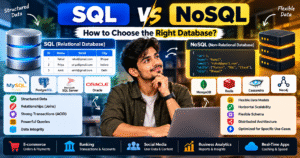
SQL vs NoSQL Databases: How to Choose the Right Database
🚀 Introduction to SQL vs NoSQL Databases
In today’s digital world, applications generate and process enormous amounts of data every day. From e-commerce websites and banking platforms to social media applications and cloud services, databases play a crucial role in storing and managing information.
When building a software application, one of the most important technical decisions is choosing the right database. Two popular database approaches are SQL (relational databases) and NoSQL (non-relational databases).
SQL databases organize data into structured tables and support relationships between different datasets. NoSQL databases support various data models, including documents, key-value pairs, graphs, and wide-column structures.
Both approaches offer unique advantages, and the right choice depends on your application’s data structure, consistency requirements, scalability needs, and development goals.
🗄️ What Is an SQL Database?
An SQL database is a relational database that stores data in tables consisting of rows and columns. SQL stands for Structured Query Language, which is used to create, retrieve, update, and manage relational data.
Relational databases are particularly useful when data has a defined structure and relationships between records must be maintained.
⚙️ Key Features of SQL Databases
- 📊 Structured Data: Organizes information into tables with defined columns and data types.
- 🔗 Relationships: Connects tables using primary keys and foreign keys.
- 🔒 Transactions: Supports reliable transactions and consistency controls, often through ACID properties.
- 🔍 Powerful Queries: Enables filtering, joining, grouping, and aggregating data.
- 🛡️ Data Integrity: Supports constraints and validation rules to maintain data accuracy.
📌 Popular SQL Databases
MySQL: Commonly used for websites, web applications, and content management systems.
PostgreSQL: Suitable for applications requiring advanced SQL features, complex queries, and strong data integrity.
Microsoft SQL Server: Frequently used in enterprise applications and Microsoft-based technology environments.
Oracle Database: Used in enterprise systems that require extensive database management capabilities.
🏢 Example of an SQL Database
Imagine an online shopping application that stores customer details, product information, orders, and payments.
The application can maintain separate tables for customers, products, orders, and payments. Relationships between these tables help ensure that each order belongs to the correct customer and contains the appropriate product information.
This structured approach makes relational databases useful for financial systems, inventory management, booking platforms, and business applications.
📦 What Is a NoSQL Database?
NoSQL databases are non-relational database systems designed to support different ways of storing and accessing data. Depending on the database, information may be stored as documents, key-value pairs, graph relationships, or wide-column records.
Many NoSQL databases support flexible data structures, making them useful for applications where data formats change frequently or where particular workloads require specialized scaling strategies.
⚙️ Key Features of NoSQL Databases
- 🧩 Flexible Data Models: Supports different structures depending on the database type.
- ⚡ Workload Optimization: Can provide efficient access patterns for specific application requirements.
- 📈 Horizontal Scaling: Many NoSQL systems support distributing data across multiple servers.
- 🔄 Flexible Schema: Some systems allow records to contain different fields.
- 🌐 Distributed Architecture: Many NoSQL databases support replication and distributed data storage.
📌 Popular NoSQL Databases
MongoDB: A document database that stores records in flexible, JSON-like documents.
Redis: An in-memory data store commonly used for caching, session management, and other low-latency workloads.
Apache Cassandra: A wide-column database designed for distributed data workloads.
Neo4j: A graph database designed to represent and query relationships between connected entities.
🏢 Example of a NoSQL Database
Imagine a social media platform where users upload posts, images, comments, reactions, and profile information.
Different posts may contain different fields, and the application may need to handle large volumes of changing content. A document database can be a suitable option for storing this type of flexible data.
The final database choice still depends on the application’s query patterns, consistency requirements, and expected workload.
⚖️ SQL vs NoSQL: Key Differences
Although both SQL and NoSQL databases store and manage data, their data models and common use cases differ.
| Feature | SQL Databases | NoSQL Databases |
|---|---|---|
| Data Model | Relational tables | Documents, key-value, graphs, wide-column, and others |
| Schema | Usually predefined | Often flexible, depending on the system |
| Relationships | Commonly managed through keys and joins | Often handled through embedded data, references, or specialized models |
| Transactions | Strong transaction support in many systems | Varies by database and transaction scope |
| Scalability | Vertical and horizontal scaling options | Many systems emphasize distributed or horizontal scaling |
| Query Language | SQL is widely used | Query methods vary by database |
| Data Consistency | Strong consistency is commonly supported | Consistency guarantees vary by database |
| Common Use Cases | Banking, orders, inventory, business systems | Content platforms, caching, distributed applications, graph data |
Important: These are general patterns, not absolute rules. Modern relational databases can scale horizontally, and many NoSQL databases support transactions and strong consistency.
🔍 SQL vs NoSQL: Which One Is Better?
There is no single database that is best for every application. The right choice depends on how your data is organized and how your application needs to access it.
✅ Choose SQL When:
- Your data has a clear and structured relationship.
- Your application requires reliable multi-record transactions.
- Data integrity and relational constraints are important.
- You need complex queries involving joins and aggregations.
- You are building banking, billing, booking, or inventory systems.
Example: PostgreSQL or MySQL can be a strong choice for an application that manages customer accounts, orders, and payments with relational integrity.
✅ Choose NoSQL When:
- Your application handles flexible or frequently changing data structures.
- Your workload fits a document, key-value, graph, or wide-column model.
- You need a database designed for a particular distributed workload.
- Your access patterns benefit from denormalized or specialized data structures.
- You need features such as fast key-value access, flexible documents, or graph traversal.
Example: MongoDB may suit an application that stores varied product attributes in documents, while Redis may suit a caching layer that needs fast access to frequently requested values.
🏗️ Real-World Examples of SQL and NoSQL
🏦 1. Banking Applications
Banking applications often use relational databases for account records, transfers, transaction histories, and other operations that require strong consistency and reliable transaction handling.
🛒 2. E-commerce Platforms
A relational database can manage customers, orders, payments, and inventory. A document database may be useful for product catalogs containing different attributes across product categories.
Some applications use both approaches for different workloads.
💬 3. Social Media Applications
Social platforms manage user profiles, posts, messages, reactions, and connections. Document databases can support flexible content, key-value stores can support caching, and graph databases can represent complex relationships.
📊 4. Business Analytics
Relational databases and analytical data warehouses are commonly used to organize business data and run reporting queries. The best choice depends on data volume, query complexity, and analytical requirements.
🌐 5. Real-Time Applications
Applications involving sessions, frequently accessed values, event streams, or distributed workloads may benefit from specialized NoSQL technologies. The appropriate solution depends on latency, durability, consistency, and availability requirements.
💡 Can You Use SQL and NoSQL Together?
Yes. Many modern applications use both relational and non-relational databases to handle different types of workloads.
For example, an e-commerce application might use PostgreSQL to manage customers, orders, and payments, MongoDB for certain flexible product records, and Redis to cache frequently accessed information.
This architecture is sometimes called polyglot persistence, which means using different data storage technologies according to specific application needs.
However, using multiple databases introduces additional complexity, including data synchronization, monitoring, backups, access control, and operational costs. It is usually best to start with the simplest architecture that meets your requirements.
🔐 Security and Performance Considerations
Database selection should not be based only on speed or scalability. Security, reliability, and operational requirements are equally important.
Consider the following factors:
- 🔒 Security: Use appropriate authentication, access controls, and encryption.
- 💾 Backups: Establish backup and recovery procedures.
- ⚡ Performance: Test real queries and workloads instead of relying only on general performance claims.
- 📈 Scalability: Estimate future data volume, traffic, and resource requirements.
- 🔄 Consistency: Decide how quickly updates must become visible across the system.
- 💰 Cost: Consider hosting, storage, replication, data transfer, and maintenance expenses.
A well-configured database that matches your application’s workload is often more effective than choosing a technology based only on popularity.
❓ Frequently Asked Questions (FAQs)
1. What Is the Main Difference Between SQL and NoSQL?
SQL databases primarily use relational tables, while NoSQL databases support multiple data models, including documents, key-value pairs, graphs, and wide-column structures.
2. Is SQL Better Than NoSQL?
Neither is universally better. SQL is often suitable for structured relational data and complex transactions, while NoSQL can be a better fit for specific flexible-data or distributed workloads.
3. Is MongoDB an SQL or NoSQL Database?
MongoDB is a NoSQL document database that stores records in flexible, JSON-like documents.
4. Is PostgreSQL a SQL or NoSQL Database?
PostgreSQL is a relational database that uses SQL. It also supports features such as JSON and JSONB data types, allowing it to handle certain semi-structured data workloads.
5. Which Database Should Beginners Learn First?
Learning SQL with PostgreSQL or MySQL is an excellent starting point because SQL is widely used in software development, data analytics, and data engineering. After learning relational database fundamentals, beginners can explore MongoDB or other NoSQL systems.
6. Can SQL and NoSQL Databases Be Used in the Same Project?
Yes. An application can use SQL for transactional data and NoSQL for caching, flexible documents, or specialized workloads. The additional complexity should be justified by clear technical requirements.
📝 Conclusion
SQL and NoSQL databases are both important technologies in modern application development. SQL databases offer relational data management, powerful queries, and reliable transaction capabilities, while NoSQL databases provide a range of data models for flexible and specialized workloads.
Before selecting a database, evaluate your data structure, query patterns, consistency needs, scalability requirements, security expectations, and budget.
For beginners and many business applications, starting with PostgreSQL or MySQL is a practical approach. As your application grows or its requirements become clearer, you can evaluate NoSQL technologies where they provide a meaningful advantage.
The best database is not necessarily the most popular one. It is the one that fits your application’s real requirements.
⚖️ SQL vs NoSQL Databases: सही Database कैसे Choose करें?
🚀 Introduction to SQL vs NoSQL Databases
आज के digital world में हर application को data store और manage करने के लिए database की जरूरत होती है। चाहे कोई e-commerce website हो, banking application हो, social media platform हो या business management system, databases इन सभी के लिए महत्वपूर्ण भूमिका निभाते हैं।
जब हम कोई software application develop करते हैं, तो सबसे जरूरी decisions में से एक होता है सही database का चुनाव करना। Database technologies में SQL और NoSQL दो popular approaches हैं।
SQL databases data को structured tables में store करते हैं, जबकि NoSQL databases documents, key-value pairs, graphs और wide-column structures जैसे अलग-अलग formats में data manage कर सकते हैं।
दोनों के अपने advantages और use cases हैं। सही database का चुनाव आपके application के data structure, security, performance, scalability और business requirements पर निर्भर करता है।
🗄️ SQL Database क्या है?
SQL (Structured Query Language) का इस्तेमाल relational databases में data को create, retrieve, update और manage करने के लिए किया जाता है।
Relational databases में information tables के रूप में store होती है, जिनमें rows और columns होते हैं। अलग-अलग tables के बीच relationships भी बनाई जा सकती हैं।
⚙️ SQL Database के मुख्य Features
- 📊 Structured Data: Data को predefined tables, rows और columns में organize किया जाता है।
- 🔗 Relationships: Primary keys और foreign keys की मदद से tables के बीच relationships बनाई जाती हैं।
- 🔒 Transaction Support: कई relational databases ACID properties के साथ reliable transactions support करते हैं।
- 🔍 Powerful Queries: SQL की मदद से data को filter, join, group और analyze किया जा सकता है।
- 🛡️ Data Integrity: Constraints और validation rules data की accuracy बनाए रखने में मदद करते हैं।
📌 Popular SQL Databases
1. MySQL: Websites, web applications और content management systems के लिए popular relational database।
2. PostgreSQL: Advanced queries, complex data relationships और reliable data management के लिए उपयोगी।
3. Microsoft SQL Server: Enterprise applications और Microsoft-based technology environments में इस्तेमाल किया जाता है।
4. Oracle Database: बड़े enterprise systems और complex database workloads के लिए इस्तेमाल किया जाता है।
🏢 SQL Database का Example
मान लीजिए आप एक online shopping website बना रहे हैं। इसमें customers, products, orders और payments की information store करनी है।
आप इन सभी के लिए अलग-अलग tables बना सकते हैं। Primary keys और foreign keys की मदद से orders को सही customers और products से connect किया जा सकता है।
इस तरह का structured approach banking systems, inventory management, billing applications और booking platforms के लिए उपयोगी होता है।
📦 NoSQL Database क्या है?
NoSQL databases ऐसे database systems हैं, जो traditional relational tables के अलावा अलग-अलग data models को support करते हैं।
इनमें data को documents, key-value pairs, graphs या wide-column structures में store किया जा सकता है। कुछ NoSQL databases flexible schema और distributed architecture की सुविधाएं भी देते हैं।
⚙️ NoSQL Database के मुख्य Features
- 🧩 Flexible Data Models: Application की जरूरत के अनुसार अलग-अलग formats में data store किया जा सकता है।
- ⚡ Efficient Data Access: सही workload के लिए optimized data access उपलब्ध कराया जा सकता है।
- 📈 Horizontal Scaling: कई NoSQL systems multiple servers में data distribute करने की सुविधा देते हैं।
- 🔄 Flexible Schema: कुछ databases में अलग-अलग records के fields अलग हो सकते हैं।
- 🌐 Distributed Architecture: कई systems replication और distributed storage को support करते हैं।
📌 Popular NoSQL Databases
1. MongoDB: Document database, जो flexible JSON-like documents में data store करता है।
2. Redis: In-memory data store, जिसका इस्तेमाल caching, session management और low-latency workloads के लिए किया जाता है।
3. Apache Cassandra: Distributed wide-column database, जो बड़े data workloads के लिए बनाया गया है।
4. Neo4j: Graph database, जो connected data और relationships को represent तथा query करने में मदद करता है।
🏢 NoSQL Database का Example
मान लीजिए आप एक social media application बना रहे हैं। इसमें user profiles, posts, comments, reactions और अन्य content store करना है।
अलग-अलग posts में अलग-अलग fields हो सकते हैं। ऐसी situation में document database उपयोगी हो सकता है, क्योंकि यह flexible data structures को support करता है।
हालांकि, सही database का चुनाव data access patterns, consistency requirements और application की जरूरतों को ध्यान में रखकर करना चाहिए।
⚖️ SQL vs NoSQL: मुख्य अंतर
SQL और NoSQL दोनों data को store और manage करते हैं, लेकिन इनके data models और common use cases अलग-अलग होते हैं।
| Feature | SQL Database | NoSQL Database |
|---|---|---|
| Data Structure | Tables, rows और columns | Documents, key-value, graphs आदि |
| Schema | आमतौर पर predefined | कई systems में flexible |
| Relationships | Keys और joins के जरिए | Embedded data, references या specialized models |
| Transactions | मजबूत transaction support आम है | Database के अनुसार अलग-अलग |
| Scalability | Vertical और horizontal दोनों विकल्प | कई systems distributed scaling पर focus करते हैं |
| Query Language | SQL widely used है | Query methods database के अनुसार बदलते हैं |
| Consistency | Strong consistency commonly available | Consistency guarantees अलग-अलग होती हैं |
| Use Cases | Banking, billing, orders, inventory | Caching, flexible content, graph data, distributed workloads |
ध्यान दें: ये general differences हैं, strict rules नहीं। Modern SQL databases भी horizontal scaling support कर सकते हैं और कई NoSQL databases transactions तथा strong consistency भी provide करते हैं।
🔍 SQL vs NoSQL: आपके लिए कौन-सा बेहतर है?
हर application की requirements अलग होती हैं। इसलिए किसी एक database को सभी situations में best नहीं कहा जा सकता।
✅ SQL Database कब Choose करें?
SQL database आपके लिए अच्छा option हो सकता है, अगर:
- आपका data structured है और उसके बीच clear relationships हैं।
- Application में reliable multi-record transactions जरूरी हैं।
- Data integrity और relational constraints महत्वपूर्ण हैं।
- आपको complex queries, joins और aggregations की जरूरत है।
- आप banking, billing, booking या inventory management application बना रहे हैं।
Example: PostgreSQL या MySQL customer accounts, orders और payments को relational structure में manage करने के लिए अच्छे options हो सकते हैं।
✅ NoSQL Database कब Choose करें?
NoSQL database उपयोगी हो सकता है, अगर:
- आपका data structure बार-बार बदलता रहता है।
- Application को document, key-value या graph जैसे specific data models की जरूरत है।
- आपका workload distributed architecture से benefit ले सकता है।
- Flexible documents या specialized data access patterns महत्वपूर्ण हैं।
- आपको caching या low-latency key-value access जैसी सुविधाएं चाहिए।
Example: MongoDB flexible product catalog के लिए उपयोगी हो सकता है, जबकि Redis frequently accessed information को cache करने के लिए इस्तेमाल किया जा सकता है।
🏢 SQL और NoSQL के Real-World Examples
🏦 1. Banking Applications
Banking systems में customer accounts, transactions और financial records को manage करने के लिए relational databases उपयोगी होते हैं, खासकर जहां reliable transactions और consistency जरूरी हैं।
🛒 2. E-commerce Websites
SQL databases customers, orders, payments और inventory manage कर सकते हैं। वहीं, document databases ऐसे product catalogs के लिए उपयोगी हो सकते हैं, जिनमें अलग-अलग categories के products के attributes अलग हों।
एक ही application में दोनों database technologies का इस्तेमाल किया जा सकता है।
💬 3. Social Media Platforms
Social media applications में profiles, posts, messages, reactions और connections जैसे data को manage किया जाता है। Document databases content के लिए, key-value stores caching के लिए और graph databases complex relationships के लिए उपयोगी हो सकते हैं।
📊 4. Business Analytics
Relational databases और analytical data warehouses का इस्तेमाल business data को organize करने और reports तैयार करने के लिए किया जाता है। सही technology data volume और query requirements पर निर्भर करती है।
🌐 5. Real-Time Applications
Real-time applications में sessions, frequently accessed values और distributed events को manage करने के लिए specialized NoSQL technologies उपयोगी हो सकती हैं।
हालांकि, final decision लेने से पहले latency, consistency, availability और durability requirements को समझना जरूरी है।
💡 क्या SQL और NoSQL को एक साथ Use कर सकते हैं?
हाँ, modern applications में SQL और NoSQL दोनों databases का इस्तेमाल किया जा सकता है। इस approach को Polyglot Persistence कहा जाता है।
उदाहरण के लिए, एक e-commerce application में:
- 🗄️ PostgreSQL: Customers, orders और payments manage करने के लिए।
- 📦 MongoDB: Flexible product information store करने के लिए।
- ⚡ Redis: Frequently accessed data को cache करने के लिए।
इस approach से अलग-अलग workloads के लिए suitable database चुना जा सकता है।
हालांकि, multiple databases इस्तेमाल करने से data synchronization, monitoring, backups, security और operational costs की complexity बढ़ सकती है। इसलिए शुरुआत में वही architecture चुनें, जो आपकी actual requirements को पूरा करता हो।
🔐 Database Choose करते समय किन बातों का ध्यान रखें?
Database का चुनाव सिर्फ speed या scalability के आधार पर नहीं करना चाहिए। Security, reliability और maintenance भी महत्वपूर्ण factors हैं।
- 🔒 Security: Authentication, access control और encryption का इस्तेमाल करें।
- 💾 Backups: Regular backups और data recovery की planning करें।
- ⚡ Performance: Real queries और actual workloads के साथ testing करें।
- 📈 Scalability: Future data volume और traffic का अनुमान लगाएं।
- 🔄 Consistency: तय करें कि data updates कितनी जल्दी सभी relevant systems में दिखाई देने चाहिए।
- 💰 Cost: Hosting, storage, replication, data transfer और maintenance expenses को consider करें।
एक अच्छी तरह configured database, जो आपकी application की जरूरतों से match करता है, केवल popular database चुनने से ज्यादा उपयोगी हो सकता है।
❓ Frequently Asked Questions (FAQs)
1. SQL और NoSQL में मुख्य अंतर क्या है?
SQL databases मुख्य रूप से relational tables का इस्तेमाल करते हैं, जबकि NoSQL databases documents, key-value pairs, graphs और wide-column structures जैसे अलग-अलग data models को support करते हैं।
2. क्या SQL, NoSQL से बेहतर है?
नहीं, दोनों के अपने advantages हैं। SQL structured relational data और complex transactions के लिए उपयोगी है, जबकि NoSQL specific flexible-data और distributed workloads के लिए बेहतर fit हो सकता है।
3. MongoDB SQL है या NoSQL?
MongoDB एक NoSQL document database है। इसमें data को flexible, JSON-like documents के रूप में store किया जाता है।
4. PostgreSQL SQL है या NoSQL?
PostgreSQL एक relational database है, जो SQL का इस्तेमाल करता है। यह JSON और JSONB जैसे data types भी support करता है, जिससे semi-structured data के साथ काम किया जा सकता है।
5. Beginners को कौन-सा Database पहले सीखना चाहिए?
Beginners के लिए PostgreSQL या MySQL के साथ SQL सीखना एक अच्छा starting point है। SQL सीखने के बाद MongoDB और अन्य NoSQL databases को explore करना आसान हो सकता है।
6. क्या SQL और NoSQL एक ही Project में इस्तेमाल किए जा सकते हैं?
हाँ, एक application transactional data के लिए SQL और caching या flexible documents के लिए NoSQL इस्तेमाल कर सकती है। लेकिन ऐसा तभी करना चाहिए, जब इससे कोई स्पष्ट technical benefit मिलता हो।
📝 Conclusion: सही Database कैसे Choose करें?
SQL और NoSQL दोनों modern application development की महत्वपूर्ण technologies हैं। SQL relational data management, powerful queries और reliable transactions के लिए उपयोगी है, जबकि NoSQL अलग-अलग data models और specialized workloads के लिए flexibility प्रदान करता है।
Database select करने से पहले अपने data structure, query patterns, consistency requirements, scalability, security और budget को ध्यान में रखें।
Beginners और कई business applications के लिए PostgreSQL या MySQL से शुरुआत करना practical approach है। जैसे-जैसे application की जरूरतें बढ़ती हैं, वैसे-वैसे उन workloads के लिए NoSQL technologies को consider किया जा सकता है, जहां उनका स्पष्ट फायदा हो।
याद रखें: सबसे अच्छा database वह नहीं है जो सबसे ज्यादा popular है, बल्कि वह है जो आपकी application की जरूरतों को सही तरीके से पूरा करता है।