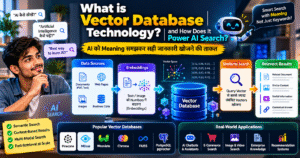
What Is Vector Database Technology and How Does It Power AI Search? 🤖
Introduction 🚀
Artificial Intelligence (AI) is changing how we search for information, interact with chatbots, and discover relevant content online. Traditional search engines usually depend on keywords, while modern AI-powered search systems can understand the meaning and context behind a query. One technology making this possible is the Vector Database.
Vector databases help AI systems store, search, and retrieve information based on semantic similarity. They are widely used in AI chatbots, recommendation engines, image search, and Retrieval-Augmented Generation (RAG) applications.
In this blog, we will explore what vector database technology is, how it works, its benefits, and how it powers modern AI search.
1. What Is a Vector Database? 🧠
A Vector Database is a specialized database designed to store and search vectors—numerical representations of data such as text, images, audio, and documents.
AI models convert information into vectors called embeddings. These embeddings represent important characteristics and semantic relationships within the data.
For example, consider these two sentences:
- “How can I learn artificial intelligence?”
- “What is the best way to study AI?”
Although the words are different, their meanings are similar. An embedding model can represent these sentences as vectors that are close to each other in a mathematical space. A vector database can then retrieve related information based on that similarity.
Unlike traditional keyword search, vector search can identify conceptually related content even when the exact words do not match.
2. How Does a Vector Database Work? ⚙️
A vector database generally works through the following steps:
Step 1: Data Collection 📄
The system collects data from sources such as websites, PDFs, documents, product catalogs, images, or application databases.
Step 2: Embedding Generation 🔢
An embedding model converts the collected content into numerical vectors. These vectors capture useful semantic features of the original data.
Step 3: Vector Storage 💾
The generated vectors are stored in a vector database, often alongside metadata such as document IDs, categories, timestamps, or source URLs.
Step 4: User Query Processing 🔍
When a user asks a question, the system converts that query into a vector using a compatible embedding model.
Step 5: Similarity Search 🎯
The database searches for vectors that are closest to the query vector. Common similarity measures include cosine similarity, dot product, and Euclidean distance.
To search large collections efficiently, many vector databases use Approximate Nearest Neighbor (ANN) indexing techniques.
Step 6: Relevant Results 📌
The system returns the most relevant matches. An AI application can display these results directly or pass them to a language model to generate a contextual answer.
3. How Does Vector Database Technology Power AI Search? 🔎
Traditional search often focuses on matching keywords, while vector search focuses on semantic similarity. This makes it useful for applications where users express the same idea in different ways.
For example, if a user searches for “ways to reduce electricity bills,” an AI search system may retrieve documents about energy efficiency, power consumption, and home insulation—even if the exact phrase does not appear in those documents.
Vector databases support AI search through several capabilities:
- Semantic Search: Finds information based on meaning rather than exact wording.
- Context-Aware Retrieval: Helps retrieve content relevant to a user’s question.
- Multimodal Search: Enables similarity searches involving text, images, audio, or other supported data types.
- Personalized Recommendations: Helps discover products, articles, or content with similar characteristics.
- Fast Retrieval at Scale: Uses indexing techniques to search large collections efficiently.
The quality of results still depends on the embedding model, data quality, indexing strategy, and retrieval configuration.
4. Vector Databases and Retrieval-Augmented Generation (RAG) 🤖
One of the most important applications of vector databases is Retrieval-Augmented Generation, commonly known as RAG.
RAG connects information retrieval with generative AI. Instead of relying only on information learned during training, an AI application retrieves relevant external content and uses it to help generate an answer.
A typical RAG workflow looks like this:
- Documents are divided into smaller chunks.
- An embedding model converts each chunk into a vector.
- The vectors and associated metadata are stored in a vector database.
- A user submits a question.
- The question is converted into a vector, and relevant chunks are retrieved.
- The retrieved information is supplied to a large language model (LLM).
- The LLM generates a response grounded in the retrieved context.
For example, a company can build an AI assistant that answers employee questions using its internal policies, training documents, and knowledge base.
Important: A vector database does not generate answers by itself. It retrieves relevant information, which an AI model or application can use to respond.
5. Popular Vector Database Technologies 🛠️
Several technologies support vector search. The best option depends on the application, existing infrastructure, scalability requirements, and budget.
Pinecone
Pinecone is a managed vector database designed for applications that need vector search without managing the underlying database infrastructure themselves.
Milvus
Milvus is an open-source vector database built for large-scale vector similarity search and AI applications.
Weaviate
Weaviate is a vector database that supports vector search, metadata filtering, and hybrid search capabilities.
Chroma
Chroma is commonly used in AI prototypes and application development where developers need a straightforward way to store and retrieve embeddings.
FAISS
FAISS is a library for efficient similarity search and clustering of dense vectors. It is not a complete database service, but it is widely used as a building block for vector search systems.
PostgreSQL with pgvector
PostgreSQL can support vector storage and similarity search through the pgvector extension. This can be useful when an application needs relational data and vector search within the same database system.
6. Vector Database vs. Traditional Database 📊
| Feature | Traditional Database | Vector Database |
|---|---|---|
| Main purpose | Store and query structured or general-purpose data | Store and search vector embeddings |
| Search approach | SQL queries, filters, exact matches, and other query methods | Similarity search across vectors |
| Best suited for | Transactions, records, and structured data | Semantic retrieval and similarity-based applications |
| Typical query | Find a customer with a specific ID | Find documents similar in meaning to a question |
| Example technologies | MySQL, PostgreSQL | Milvus, Pinecone, Weaviate |
These categories are not mutually exclusive. Modern relational databases and search platforms can also support vector search, and vector databases often provide metadata filtering.
7. Real-World Applications of Vector Databases 🌍
AI Chatbots and Virtual Assistants 💬
Vector search helps chatbots retrieve relevant answers from documentation, FAQs, and knowledge bases.
E-Commerce Product Search 🛍️
Customers can search using natural language, such as “comfortable shoes for long walks,” and discover products with matching descriptions or attributes.
Image and Video Search 🖼️
Systems can find visually similar images or retrieve content using text descriptions, provided compatible embedding models are used.
Healthcare Research 🧬
Researchers can explore semantically related medical documents and scientific publications. These systems require appropriate privacy, validation, and domain-specific safeguards.
Enterprise Knowledge Management 🏢
Organizations can search across internal documents, reports, policies, and manuals using natural-language questions.
Recommendation Systems 🎯
Vector similarity can help recommend products, articles, music, or other content based on user interests and item characteristics.
8. Benefits of Vector Database Technology ✨
- Semantic Understanding: Helps retrieve information related to a query’s meaning.
- Efficient Similarity Search: Indexing techniques can reduce the work needed to find similar vectors in large datasets.
- Flexible Data Representation: Supports embeddings generated from different types of content.
- AI Application Integration: Works with embedding models, LLMs, and RAG pipelines.
- Metadata Filtering: Can combine similarity search with filters such as category, language, date, or access permissions.
- Scalability: Many solutions support growing vector collections, although performance depends on system design and configuration.
9. Challenges and Limitations ⚠️
Vector databases are powerful, but they are not a universal replacement for traditional databases or search engines.
- Embedding Quality: Poor embeddings can produce irrelevant search results.
- Infrastructure Costs: Large vector collections may require significant memory, storage, and computing resources.
- Data Updates: Applications need strategies for keeping embeddings synchronized with changing source data.
- Retrieval Accuracy: Similarity does not always mean factual relevance.
- Security and Privacy: Access controls must ensure users retrieve only information they are authorized to see.
- Keyword Precision: Exact identifiers, product codes, and specialized terms may work better with keyword or hybrid search.
Combining vector search with keyword search, metadata filtering, reranking, and evaluation can improve results for many real-world applications.
10. How to Build a Simple AI Search Application 💻
Developers can build a basic AI search system using Python and a vector database.
A typical technology stack might include:
- Python: Application logic.
- Embedding Model: Converts text into vectors.
- Vector Store: Stores embeddings and retrieves similar content.
- Flask or FastAPI: Provides an API for the application.
- Large Language Model (optional): Generates answers using retrieved context.
Basic workflow
- Collect documents and divide them into manageable chunks.
- Generate an embedding for each chunk.
- Store the vectors, document text, and metadata.
- Convert a user’s question into an embedding.
- Retrieve the most similar document chunks.
- Display the matching content or pass it to an LLM to generate a response.
For a production system, developers should also implement authentication, access control, error handling, logging, data-update workflows, and retrieval-quality testing.
Conclusion 🎉
Vector database technology is an important component of modern AI search. By storing and retrieving numerical representations of information, it helps applications find relevant content based on meaning and context—not just exact keywords.
Vector Database Technology क्या है और यह AI Search को कैसे Powerful बनाती है? 🤖🚀
Introduction परिचय 📌
आज के Digital World में Artificial Intelligence (AI) हमारी ज़िंदगी और काम करने के तरीके को तेज़ी से बदल रही है। अब हम सिर्फ Keywords डालकर जानकारी नहीं खोजते, बल्कि AI से अपने सवालों के जवाब भी प्राप्त करते हैं।
लेकिन क्या आपने कभी सोचा है कि जब हम AI से कोई सवाल पूछते हैं, तो वह हमारे सवाल का मतलब समझकर सही जानकारी कैसे खोजती है?
इसके पीछे काम करने वाली महत्वपूर्ण Technologies में से एक है Vector Database Technology।
Vector Database AI को Text, Images, Documents और अन्य Data में से Meaning के आधार पर संबंधित जानकारी खोजने में मदद करती है। इसका इस्तेमाल AI Chatbots, Smart Search Engines, Recommendation Systems और Generative AI Applications में किया जाता है।
इस Blog में हम आसान भाषा में समझेंगे कि Vector Database क्या है, यह कैसे काम करती है और AI Search को बेहतर बनाने में इसकी क्या भूमिका है।
1. Vector Database क्या है? 🧠
Vector Database एक विशेष प्रकार का Database है, जो Data के Numerical Representations यानी Vectors को Store और Search करने के लिए बनाया गया है।
आसान शब्दों में समझें, तो AI किसी Text, Image या दूसरे Data को समझने और उसकी विशेषताओं को दर्शाने के लिए Numbers की एक सूची बना सकती है। इस Numerical Representation को Embedding कहा जाता है।
उदाहरण के लिए, इन दोनों सवालों को देखिए:
- “मैं Artificial Intelligence कैसे सीख सकता हूँ?”
- “AI सीखने का सबसे अच्छा तरीका क्या है?”
दोनों सवालों के शब्द अलग हैं, लेकिन उनका मतलब लगभग एक जैसा है।
एक Embedding Model इन दोनों सवालों को ऐसे Vectors में बदल सकता है, जो Meaning के आधार पर एक-दूसरे के करीब हों। Vector Database इनकी Similarity के आधार पर संबंधित जानकारी खोज सकती है।
यही कारण है कि Vector Database केवल शब्दों का मिलान करने के बजाय उनके अर्थ से जुड़ी जानकारी खोजने में मदद करती है।
2. Vector Database कैसे काम करती है? ⚙️
Vector Database के काम करने की प्रक्रिया को कुछ आसान Steps में समझ सकते हैं।
Step 1: Data Collect करना 📄
सबसे पहले System में मौजूद Data इकट्ठा किया जाता है। इसमें PDF Files, Website Content, Images, Documents और Product Information शामिल हो सकते हैं।
Step 2: Embeddings बनाना 🔢
इसके बाद Embedding Model Data को Numerical Vectors में बदलता है। ये Vectors Data की महत्वपूर्ण विशेषताओं और उसके अर्थ से जुड़े संबंधों को दर्शाते हैं।
Step 3: Vectors को Store करना 💾
बनाए गए Vectors को Vector Database में Store किया जाता है। इनके साथ Document ID, Category और अन्य Metadata भी रखा जा सकता है।
Step 4: User का सवाल समझना 🔍
जब कोई User सवाल पूछता है, तो उसी के अनुसार Query का Embedding बनाया जाता है।
Step 5: Similarity Search करना 🎯
Database Query Vector की तुलना Stored Vectors से करती है और सबसे अधिक संबंधित Results खोजती है।
इसके लिए Cosine Similarity, Dot Product और Euclidean Distance जैसी Mathematical Techniques का इस्तेमाल किया जा सकता है।
Step 6: Relevant Information दिखाना 📌
अंत में System संबंधित जानकारी User को दिखाता है या उसे AI Language Model तक पहुँचाता है, जो उस जानकारी के आधार पर जवाब तैयार कर सकता है।
इस तरह Vector Database बड़ी मात्रा में Data से उपयोगी जानकारी खोजने में मदद करती है।
3. Vector Database AI Search को कैसे बेहतर बनाती है? 🔎
Traditional Search Engine आमतौर पर Keywords के आधार पर जानकारी खोजता है, जबकि Vector Search किसी Query के Meaning के आधार पर संबंधित Content खोजने में मदद करती है।
उदाहरण के लिए, अगर आप Search करते हैं:
“बिजली का बिल कम करने के तरीके”
तो AI Search System ऐसे Documents भी खोज सकता है, जिनमें Energy Saving, बिजली की खपत कम करने और घर में बिजली बचाने के उपाय बताए गए हों।
भले ही उन Documents में आपके Search किए गए Exact Words मौजूद न हों, फिर भी वे आपके सवाल से संबंधित हो सकते हैं।
Vector Database AI Search को इन तरीकों से बेहतर बनाने में मदद करती है:
- Semantic Search: शब्दों के बजाय उनके अर्थ से संबंधित जानकारी खोजने में मदद करती है।
- Context-Based Search: User के सवाल के संदर्भ के अनुसार Results खोज सकती है।
- Smart Recommendations: User की पसंद से मिलते-जुलते Products, Articles या Content खोजने में मदद करती है।
- Image Search: सही Embedding Models के साथ मिलती-जुलती Images खोजी जा सकती हैं।
- Fast Information Retrieval: Indexing Techniques की मदद से बड़े Data Collections में Similar Vectors खोजे जा सकते हैं।
हालाँकि, Search Results की Quality Embedding Model, Data Quality और System Configuration पर भी निर्भर करती है।
4. Vector Database और RAG Technology का संबंध 🤖
आजकल Generative AI Applications में RAG यानी Retrieval-Augmented Generation Technology का काफी महत्व है।
RAG एक ऐसी Technique है, जिसमें AI किसी सवाल का जवाब तैयार करने से पहले बाहरी Sources से संबंधित जानकारी प्राप्त कर सकती है।
उदाहरण के लिए, अगर किसी Company के पास हजारों Documents, Training Manuals और Policies हैं, तो RAG की मदद से एक ऐसा AI Assistant बनाया जा सकता है, जो इन Documents में से जानकारी खोजकर कर्मचारियों के सवालों का जवाब दे।
RAG कैसे काम करता है?
- Documents को छोटे-छोटे हिस्सों में बाँटा जाता है।
- प्रत्येक हिस्से का Embedding बनाया जाता है।
- Embeddings को Vector Database में Store किया जाता है।
- User के सवाल का Embedding तैयार किया जाता है।
- Vector Database संबंधित Documents या Text Chunks खोजती है।
- प्राप्त जानकारी AI Language Model को दी जाती है।
- Language Model उस Context के आधार पर जवाब तैयार करता है।
ध्यान दें: Vector Database खुद से AI का जवाब नहीं बनाती। इसका मुख्य काम संबंधित जानकारी खोजना है, जिसका उपयोग AI Model जवाब तैयार करने में कर सकता है।
5. Popular Vector Database Technologies 🛠️
आज Developers और AI Engineers कई Vector Search Technologies का इस्तेमाल करते हैं।
1. Pinecone
Pinecone एक Managed Vector Database Service है। इसका उपयोग AI Applications में Vector Storage और Similarity Search के लिए किया जाता है।
2. Milvus
Milvus एक Open-Source Vector Database है, जिसे बड़े स्तर पर Vector Search और AI Applications के लिए बनाया गया है।
3. Weaviate
Weaviate एक Vector Database है, जो Vector Search, Metadata Filtering और Hybrid Search जैसी सुविधाएँ प्रदान करता है।
4. Chroma
Chroma AI Projects और Application Development में Embeddings को Store और Retrieve करने के लिए उपयोगी है।
5. FAISS
FAISS एक Library है, जिसका उपयोग बड़े Vector Collections में Efficient Similarity Search और Clustering के लिए किया जाता है। यह अपने आप में एक Complete Database Service नहीं है।
6. PostgreSQL + pgvector
PostgreSQL के pgvector Extension की मदद से Developers Relational Data के साथ Vector Embeddings को भी Store और Search कर सकते हैं।
यह उन Applications के लिए उपयोगी हो सकता है, जिनमें Traditional Database और AI Search दोनों की आवश्यकता होती है।
6. Vector Database और Traditional Database में क्या अंतर है? 📊
| Feature | Traditional Database | Vector Database |
|---|---|---|
| मुख्य काम | Data को Store और Manage करना | Vector Embeddings को Store और Search करना |
| Search का तरीका | SQL Queries, Filters और Exact Matching | Similarity-Based Search |
| उपयोग | Banking, Business Records, Transactions | AI Search, Chatbots और Recommendations |
| उदाहरण | MySQL, PostgreSQL | Milvus, Pinecone, Weaviate |
ध्यान देने वाली बात यह है कि दोनों Technologies एक-दूसरे की विरोधी नहीं हैं। कई Modern Databases भी Vector Search को Support करते हैं।
7. Vector Database के Real-World Applications 🌍
AI Chatbots और Virtual Assistants 💬
AI Chatbots Vector Search की मदद से FAQs, Documents और Knowledge Base में से संबंधित जानकारी खोज सकते हैं।
E-Commerce और Online Shopping 🛍️
अगर कोई Customer “लंबे समय तक चलने के लिए आरामदायक जूते” Search करता है, तो AI System Meaning और Product Information के आधार पर संबंधित Products खोजने में मदद कर सकता है।
Image और Video Search 🖼️
Embedding Models की मदद से किसी Image से मिलती-जुलती दूसरी Images खोजी जा सकती हैं। Text-to-Image Search भी संभव है, यदि System में उपयुक्त Models और Data उपलब्ध हों।
Healthcare Research 🧬
Vector Search का उपयोग Medical Research Papers और Healthcare Documents में संबंधित जानकारी खोजने के लिए किया जा सकता है। ऐसे Systems में Data Privacy और Accuracy का विशेष ध्यान रखना आवश्यक है।
Business और Enterprise Search 🏢
Companies अपने Internal Documents, Reports, Policies और Training Materials को AI-Powered Search के माध्यम से अधिक आसानी से खोजने की सुविधा दे सकती हैं।
Recommendation Systems 🎯
YouTube जैसे Content Platforms, Online Stores और अन्य Applications में Similarity-Based Techniques का उपयोग संबंधित Content या Products Recommend करने के लिए किया जा सकता है।
8. Vector Database के फायदे ✨
Vector Database Technology के कई महत्वपूर्ण फायदे हैं:
- Meaning-Based Search: सवाल के अर्थ से संबंधित जानकारी खोजने में मदद करती है।
- Efficient Retrieval: सही Indexing के साथ बड़े Data Collections में Similarity Search को Efficient बनाया जा सकता है।
- AI Integration: Embedding Models, LLMs और RAG Pipelines के साथ काम कर सकती है।
- Multiple Data Types: उपयुक्त Embedding Models के माध्यम से Text, Images और अन्य प्रकार के Data पर Search संभव बनाती है।
- Metadata Filtering: Category, Date, Language और अन्य Conditions के आधार पर Results को Filter किया जा सकता है।
- Scalability: कई Vector Database Solutions बढ़ते हुए Data को संभालने के लिए बनाई गई हैं।
9. Vector Database की चुनौतियाँ और सीमाएँ ⚠️
Vector Database उपयोगी Technology है, लेकिन इसकी कुछ सीमाएँ भी हैं।
- Embedding Quality: अगर Embeddings सही तरीके से अर्थ को Represent नहीं करतीं, तो Search Results गलत हो सकते हैं।
- Storage और Computing Cost: बड़े Data Collections के लिए पर्याप्त Storage और Computing Resources की आवश्यकता हो सकती है।
- Data Updates: Source Documents बदलने पर संबंधित Embeddings को भी Update करना पड़ सकता है।
- Search Accuracy: Similarity का अर्थ हमेशा सही या तथ्यात्मक जानकारी होना नहीं है।
- Security: User को केवल वही जानकारी मिलनी चाहिए, जिसे Access करने की उसे अनुमति है।
- Exact Keyword Search: Product Codes, IDs और Exact Technical Terms के लिए Keyword Search अधिक उपयोगी हो सकती है।
इन समस्याओं को कम करने के लिए Vector Search के साथ Keyword Search, Metadata Filtering और Result Reranking जैसी Techniques का इस्तेमाल किया जा सकता है।
10. Python से AI Search Application कैसे बनाएँ? 💻
अगर आप Python और Artificial Intelligence सीख रहे हैं, तो Vector Database पर आधारित एक छोटा AI Search Project बना सकते हैं।
इसके लिए आप निम्न Technologies का उपयोग कर सकते हैं:
- Python: Application की Programming और Logic के लिए।
- Embedding Model: Text को Numerical Vectors में बदलने के लिए।
- Vector Database: Embeddings को Store और Search करने के लिए।
- Flask या FastAPI: Backend API बनाने के लिए।
- Large Language Model (LLM): जरूरत पड़ने पर Retrieved Information से जवाब तैयार करने के लिए।
Project का Basic Workflow
- कुछ PDF Files या Text Documents इकट्ठा करें।
- Documents को छोटे-छोटे Text Chunks में बाँटें।
- प्रत्येक Chunk का Embedding बनाएँ।
- Embeddings और संबंधित Text को Vector Database में Store करें।
- User से Natural Language में सवाल लें।
- सवाल के आधार पर सबसे संबंधित Text Chunks खोजें।
- Results User को दिखाएँ या LLM की मदद से जवाब तैयार करें।
इस Project के माध्यम से आप Embeddings, Similarity Search, Vector Storage और RAG जैसी महत्वपूर्ण AI Technologies को Practical तरीके से सीख सकते हैं।
Conclusion – निष्कर्ष 🎉
Vector Database Technology आधुनिक AI Search का एक महत्वपूर्ण हिस्सा है। यह AI Applications को Data के Meaning और Similarity के आधार पर संबंधित जानकारी खोजने में मदद करती है।
AI Chatbots, Smart Search Engines, Recommendation Systems और RAG-Based Applications में इसका उपयोग तेजी से बढ़ रहा है।